
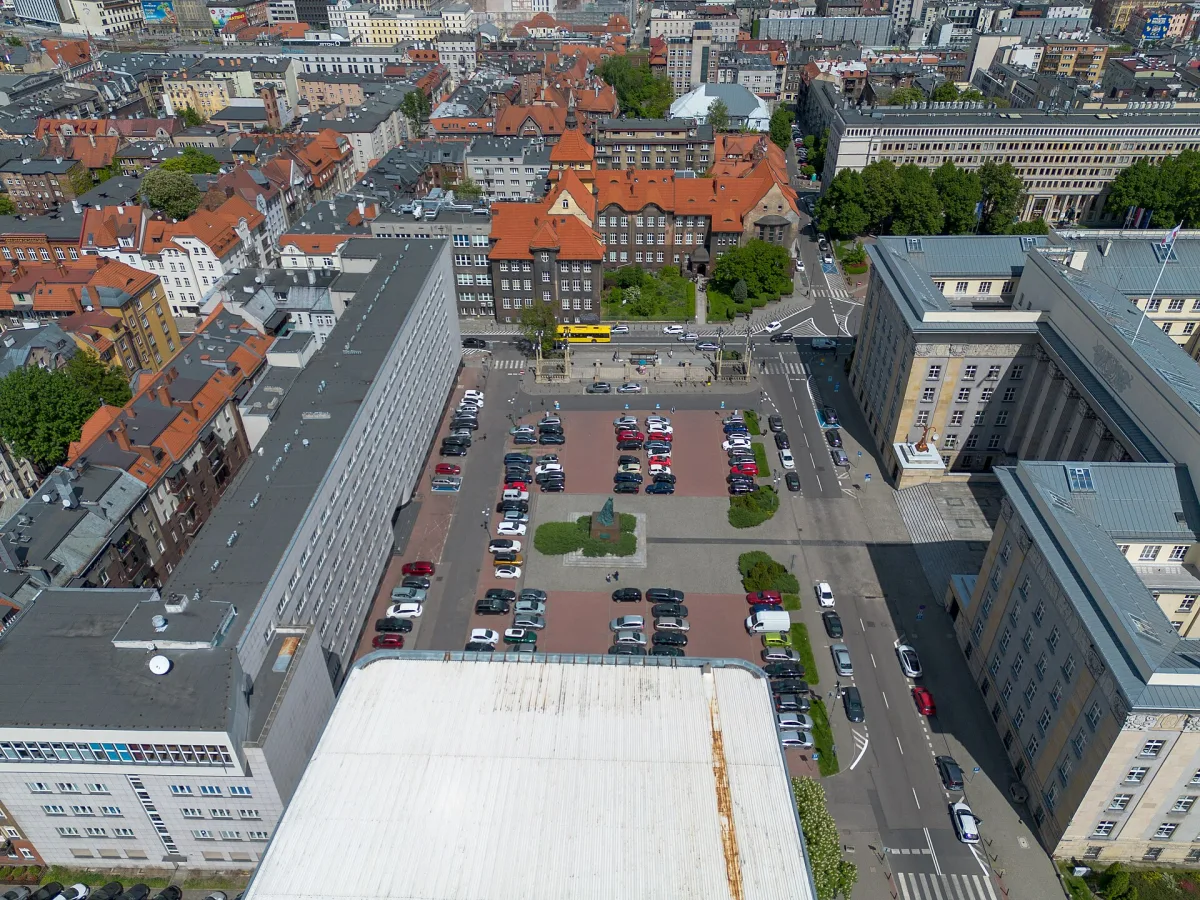
The Silesian Voivodeship of 1922-1939 was the only autonomous administrative unit of the Second Polish Republic. It had its own parliament, its own treasury and its own law in many areas of life. The seat of this autonomy was Katowice, and its visible sign was the building on today's Silesian Parliament Square (plac Sejmu Śląskiego).
Legal basis and a short history
The autonomy was established by the Organic Statute of the Silesian Voivodeship, a constitutional act of the Legislative Sejm of 15 July 1920. Some sources give a different date, 15 August 1920, but works on the Silesian Sejm, on the voivodeship and on the Silesian Treasury consistently give 15 July. The Statute waited a long time to be applied in practice, because Upper Silesia was divided only in 1922. The voivodeship began to function in earnest in June 1922, after the Polish authorities entered, and the first session of the Silesian Sejm took place on 10 October 1922.
The literature points out that the autonomy also had a propaganda dimension: in the intention of the Polish government it was to support Poland in its dispute with Germany over the allegiance of the region. It was justified by the national, cultural and economic distinctiveness of Upper Silesia.
What the Silesian Sejm looked like
The Silesian Sejm was the legislative body, and executive power was exercised by the Voivodeship Council, which included the voivode, the vice-voivode and five members elected by the Sejm. Initially it had 48 deputies, elected in three districts by a proportional system. After the change of electoral law in 1935 it had 24, elected by majority vote in two-member districts. After the annexation of Zaolzie in the autumn of 1938 four additional deputies joined it, so it then numbered 28.
The Sejm's competences included, among others, education, the police, the system of administration and local government, religious affairs, agriculture, water legislation, electricity and local railways. Foreign policy and the military remained outside its reach, and the president had the right to dissolve the Silesian Sejm before the end of its term. The voivodeship could create its own regulations that departed from the rest of the country. An example is the celibacy of women teachers in force in 1926-1938.
The first elections, in September 1922, were won by the National Bloc with 18 seats. German groupings won 14 seats in total. The first marshal was Konstanty Wolny, associated with the Christian Democrats, and he held that office until 1935. His successor was the president of Chorzów, Karol Grzesik. In 1930-1935 a sharp dispute went on between the Sanation camp and democratic groupings, and the 1935 elections, held under the new electoral law, were boycotted by the opposition.
The Silesian Treasury
Alongside the Sejm there existed the Silesian Treasury, which collected taxes from the territory of the voivodeship and could put its own securities into circulation. Part of the money went to the state budget according to a formula set out in the statute, taking account of population and tax capacity. Roughly 60 per cent of revenue stayed in the voivodeship and 40 per cent went to Warsaw.
The Silesian Treasury financed, among other things, some railway lines, for example towards Wisła and in Cieszyn Silesia, river regulation and the building of schools. In 1925-1928 32 elementary schools were built, and in the following four years 58 new ones and nearly 50 were extended. The vault itself was located in the basement of the Sejm building, and its walls are about 1.5 metres thick, while the armoured doors are 40 centimetres thick.
Voivode Grażyński and the dispute over autonomy
The voivodeship was headed by a voivode appointed by the president on the prime minister's proposal. Michał Grażyński, nominated on 28 August 1926 after the May Coup, held office until September 1939 (other lists give 6 September 1926 as the date he took office). He was associated with the Sanation camp and sought to integrate the voivodeship more closely with the rest of the state. Among his opponents was Wojciech Korfanty. In 1930-1935 the voivodeship authorities and the Sanation club in the Sejm sought to limit the legal distinctiveness of Silesia, and critics accused Grażyński of marginalising the Organic Statute. This is one assessment of that policy, and the assessment of the voivode's activity is disputed in the literature. The monument to Korfanty stands today in the middle of Silesian Parliament Square, and it is described by the card of the Wojciech Korfanty monument in Katowice.
The building on Silesian Parliament Square
The first, temporary seat of the Sejm and the Voivodeship Office was the building of the former school of building trades on Wojewódzka Street. The decision to build a new building was taken in December 1922, and the competition of 1923 attracted 67 entries. The design chosen was that of the Kraków architects Kazimierz Wyczyński, Stefan Żeleński and Piotr Jurkiewicz, and Ludwik Wojtyczko also worked in the execution team. Construction started in the spring of 1924 (another source gives the years 1925-1929), and the building was blessed on 5 May 1929. The finishing work was fully completed in 1932.
The building has 634 rooms and was regarded as the largest administrative building in Poland in terms of volume. It has a neoclassical form with pilasters and interiors with Art Deco elements. Inside is an amphitheatre-style chamber of the Sejm, and in the vestibule with a dome the coats of arms of Upper Silesian towns, among them Katowice, Cieszyn, Rybnik and Pszczyna. The chamber is regarded as the first parliamentary chamber in the Polish lands and served as a model for the extension of the Sejm building in Warsaw.
The building also contains a paternoster lift, installed in 1929. It has 14 cabins in continuous motion, and a full circuit of one of them takes 192 seconds. It was switched off in 1967, and after a thorough reconstruction it was started again in 1980.
From 1929 the building also housed the Silesian Museum, established by a resolution of the Silesian Sejm on the initiative of Voivode Grażyński. A temporary exhibition was opened here on 29 May 1930, and a separate museum building was to be built later. The museum's present seat, on the site of a former mine, is described by the card of the Silesian Museum in Katowice.
The war and the end of autonomy
In September 1939 the voivodeship authorities evacuated together with the government. The occupied lands were incorporated into the Third Reich by a decree of 8 October 1939. The building became the seat of the Katowice regency, and after the creation of the Province of Upper Silesia the seat of its authorities, and the Germans called it the Gauhaus. The Marble Hall was rebuilt in the style of Nazi architecture. The Silesian Sejm was never formally dissolved, reportedly as the only legislative body in Poland. The autonomy was abolished by an act of the State National Council of 6 May 1945. Today the building houses the Silesian Voivodeship Office, the Marshal's Office and the Silesian Voivodeship Assembly, and the building itself has been a Historic Monument of Poland since 2012.
Be the first! Add a comment.
You need to log in to add a comment.
Log in