
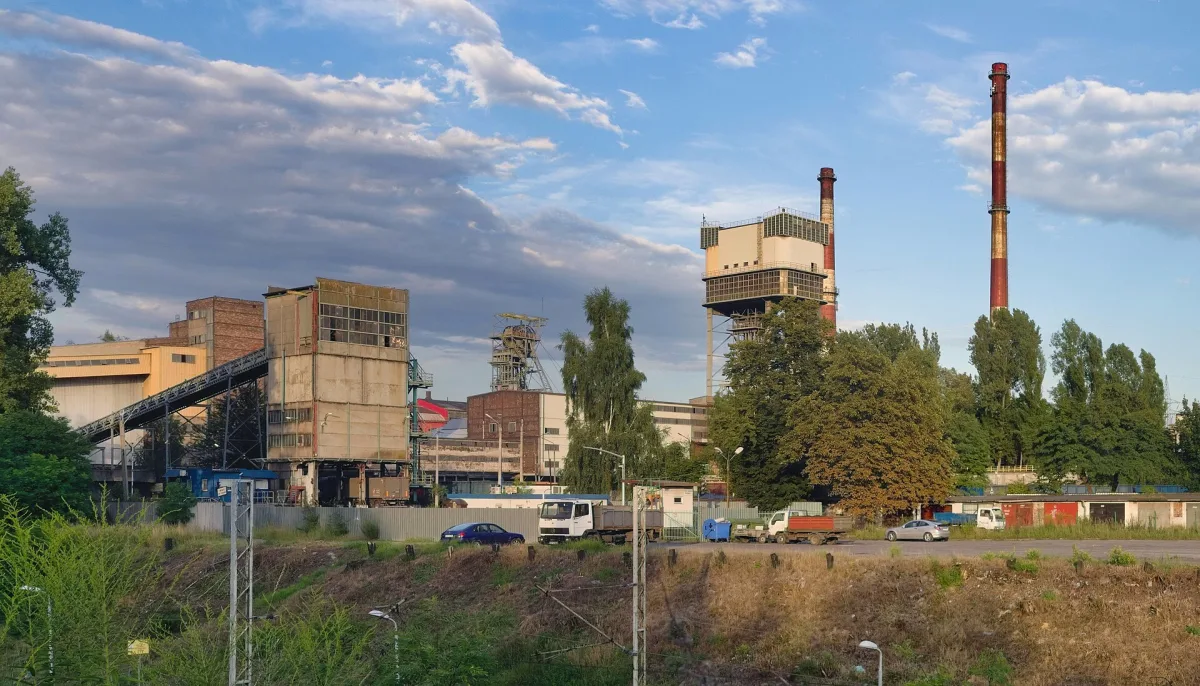
The Piast mine in Bieruń, at first called Bieruń Nowy, was built in 1972-1975. It entered history in December 1981, when the crew responded to the introduction of martial law with a strike underground. It was one of the longest underground strikes in postwar mining, and historians of the Katowice branch of the IPN (Institute of National Remembrance) count it among the two longest-lasting miners' protests under martial law, alongside the strike at the neighbouring Ziemowit.
14 December: the decision not to ride up
On Monday 14 December 1981 the miners learned of the internment of the Solidarity board at the mining works enterprise cooperating with the mine. News also arrived that the militia had detained the deputy chairman of the plant's Solidarity. The crew gathered at the altar of St Barbara demanded his release. One of the activists, Stanisław Trybuś, stood on a bench and called on the miners waiting at the shaft bottom to resist. It was decided that nobody would ride up.
The first shift went down underground and only pretended to work. On the second shift a strike committee was formed, and more miners joined. People working at the 500-metre level could not go lower by cage, so they climbed down for almost 40 minutes on ladders, 150 metres down. The strikers demanded the lifting of martial law, the release of activists and respect for the Jastrzębie agreements. The protest also concerned the militarisation of the mine and the suspension of the activities of the organisation.
Two thousand people and their daily life
At the start there were about 2,000 miners underground. The figures for those who held out to the end differ between sources. Some give more than a thousand people, the IPN account about a thousand, and one of the PAP texts speaks in its introduction of several hundred miners, although later in the same article it mentions a thousand. There is therefore no single certain figure.
The strikers kept discipline. A mine requires constant supervision: the ventilation and drainage equipment had to keep working, and at the working faces further layers had to be cut so that the excavation would not close in. A daily rhythm was maintained, from reveille, through washing and work in designated places, to shared prayers and singing. In the evenings between 9 and 10 pm cabaret performances were broadcast through loudspeakers. On the surface families and residents collected money and food, and meals were cooked in the mine canteen.
The authorities tried to break the protest with psychological pressure. Rumours were spread of the mine being flooded or gas being used, and the strikers' families were intimidated so that they would persuade their relatives to come back for the holidays.
Christmas Eve in the dark
On 23 December the mine management blocked deliveries of food prepared by the families and prevented the exchange of miners' lamps, which needed recharging. The miners saved batteries and spent most of the time in almost complete darkness. On Christmas Eve the auxiliary bishop of Katowice, Janusz Zimniak, went down to the strikers. He celebrated Mass and gave general absolution and a blessing. After he left, the miners ate their Christmas Eve supper and listened to a radio broadcast of the Midnight Mass. IPN historians describe this underground Christmas Eve as one of the most poignant moments of the strike, with bread, water and apples by the dimming lamps.
At the same time the Ziemowit crew ended its strike. The Piast miners decided to stay underground over the holidays, hoping that at the end of December the strike would spread across the whole country. Participants later recalled that after 24 December it was so hard that they even ate mouldy bread.
28 December and the trial
The strike ended in the afternoon of 28 December, when supplies of water and food were running out. After talks with the mine management the miners received an assurance that the leaders of the protest would face no consequences. As they rode up they sang the anthem, and then prayed before the altar of St Barbara. The assurance was not kept: after returning home many people were detained by the militia and the security service. Within a few hours 18 people were detained, 11 were interned and 7 were arrested.
More than 900 participants were dismissed disciplinarily. Most were later taken back on worse terms, and about a hundred were refused. Seven of those arrested stood trial in May 1982 before the court of the Silesian Military District. The prosecutor demanded from 10 to 15 years in prison for them, and one of the texts even gave 15 years for all. The witnesses withdrew the testimony they had given during the investigation, and on 12 May 1982 the court acquitted the accused, which under martial law was exceptional. Propaganda called them terrorists with pickaxes. After leaving the courtroom some of them were detained again and interned.
Remembering the strike
The strike is the subject of a song by Jan Krzysztof Kelus with words by Jan Zazula, Ostatnia szychta na KWK Piast (The Last Shift at the Piast Mine). The mine ceased to exist as an independent plant in July 2016, when it was merged with the Ziemowit mine into one plant, Piast-Ziemowit. Two days after the start of the strike at Piast, on 16 December, the Wujek mine in Katowice was pacified. That tragedy has its own article in the Places of Remembrance section, and the site is described in the entry Kopalnia Węgla Kamiennego Wujek.
Be the first! Add a comment.
You need to log in to add a comment.
Log in