
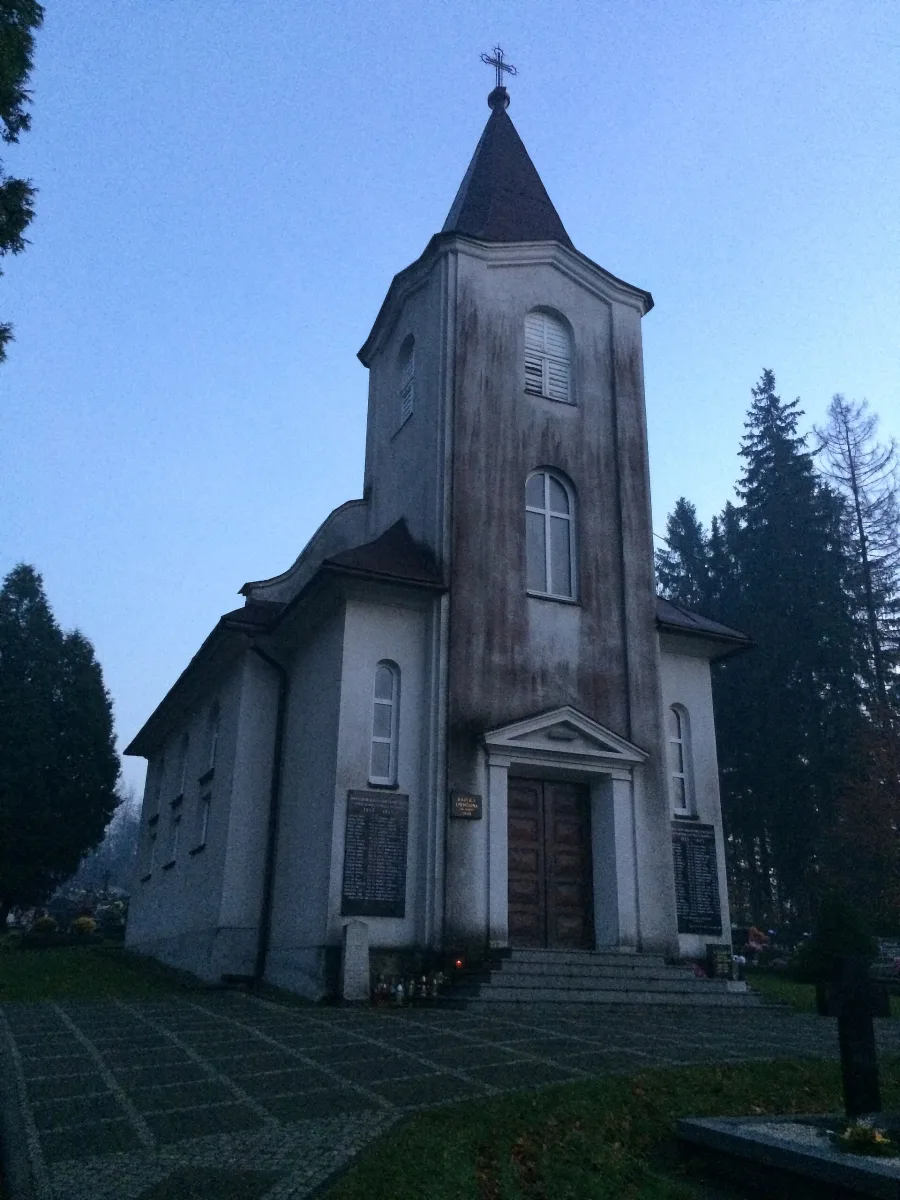
A village of woodcutters and shepherds below Barania Góra
The history of Wisła begins at the turn of the 16th and 17th centuries. The first settlers were woodcutters working for the dukes of Cieszyn, supplying firewood and shingles for the castle in Cieszyn. Almost at the same time came the Vlachs, or Wallachians, who brought pastoral culture. Szałaśnictwo, the summer grazing of sheep in the mountains, became the basis of life for the local population for a long time.
The first document mentioning the village dates from 1615 and concerns a delivery of shingles to a manor farm near Cieszyn. In 1643 the village was entered in the urbarium of the Duchy of Cieszyn, which lists 30 settlers. Wisła was a Protestant settlement from the start: the oldest land register, from 1644, already mentions the closing of a wooden Evangelical church. To this day Evangelicals are the largest religious group here, and several of their parishes operate in the town, as shown by, for example, the Evangelical cemetery at Groniczek, consecrated in 1819, and the Beskid Museum in a former Evangelical inn, devoted to the life of the highlanders of the Silesian Beskids.
In the 19th century pastoralism weakened. The ironworks of Cieszyn Silesia needed beech wood, the coal mines needed coniferous timber, and forestry pushed the highlanders out of the clearings. In 1913 seven shepherds' huts with about 600 sheep were still operating in Wisła. At the same time interest in the mountains themselves grew: the first documented trip to Barania Góra is considered to be the one made on 14 August 1810 by the future Duke of Pszczyna, Ludwig von Anhalt-Köthen-Pless, and in 1843 Wincenty Pol reached the sources of the Vistula.
Hoff, Ochorowicz and the first villas
The discoverer of Wisła as a place of rest is considered to be Bogumił Hoff, a local-studies enthusiast and amateur ethnographer from Radom, a collaborator of Oskar Kolberg. He first came to Wisła in 1882, looking for a place to improve his health, and then returned every year and praised the village in the press and among friends. In 1885 he built the first wooden holiday villa, named “Bożydar”, which locals called “Warszawa”. The name of the plot is also written as “Boży Dar”, so the spelling of names differs somewhat in different studies. In 1892 Hoff settled in Wisła permanently, and he died here in 1894. He is buried at the Groniczek cemetery. In 1888 he published the monograph “Lud cieszyński” (The Cieszyn People), the first part of which was devoted to the beginnings of Wisła and its inhabitants.
Hoff's work was taken over by the Warsaw philosopher and psychologist Julian Ochorowicz, who settled in Wisła in 1899 and lived here, with breaks, until 1913. Together with the architect Bogdan Hoff, Bogumił's son, he built several wooden guesthouses, including “Maja”, “Sokół” and “Placówka”. His brick villa, Ochorowiczówka, can still be seen on Ochorowicza Street. The guesthouses attracted writers: in 1900 Bolesław Prus stayed at “Placówka”, and in autumn 1901 Władysław Reymont wrote parts of “Chłopi” (The Peasants) here, in Ochorowicz's villa, according to various sources in “Placówka” or in “Jaskółka”. Maria Konopnicka visited Wisła in 1896 for one day and was put off by the primitive conditions, as she wrote in a letter to her daughter.
The official beginning of the summer resort is the year 1911. At Ochorowicz's urging and thanks to the efforts of Bogdan Hoff, a modern bathing establishment was opened in the centre of the village. In summer about 300 guests stayed in Wisła, so the Provincial Government in Opava recognised the village as a summer resort. A gravity water supply and a sewage system soon followed.
The Habsburgs and hunting lodges
The Beskid forests were also a hunting ground of the Cieszyn Habsburgs. In the Przysłop clearing below Barania Góra stands the wooden, Tyrolean Habsburg Hunting Lodge from 1897-1898, today associated with PTTK (Polish Tourist and Sightseeing Society). It is not the same building that was later turned into the president's residence. The second lodge was ordered by Archduke Frederick of Cieszyn in 1906 on the slope of Zadni Groń, and it was completed in 1907. The single-storey larch house in the Carpathian-Tyrolean style had about 30 rooms. This complex includes the wooden chapel of St Hedwig of Silesia from 1909, which has survived all later alterations.
In November 1918, after the collapse of the monarchy, the local population plundered the hunting lodge, in revenge for abuses by the archduke's forestry staff. According to one study, in 1915 the archduke's guests here were the German Emperor Wilhelm II and Hindenburg, while another study links Wilhelm II's visit precisely with that other building. The sources thus differ as to the place of this visit.
The Zameczek: Silesia's gift to the president
After 1918 the abandoned lodge was taken over by the state. In 1927 the Silesian Sejm decided to renovate it and designate it as the residence of the President of the Republic of Poland, as a symbol of the unity of Silesia with Poland. The renovation was completed on 23 December 1927, and in the night of 23 to 24 December the building burned down completely in unexplained circumstances.
The Silesian Sejm decided to build a new, more representative building. It allocated 2 million zlotys for this from the voivodeship treasury, and in addition money was collected among residents and industrialists. The design was entrusted to the Kraków architect Adolf Szyszko-Bohusz, who in 1929-1931 designed a complex of modernist buildings. On the site of the former lodge the Lower Castle was built for the retinue, and a little higher up the Upper Castle, the actual residence. Its curved shape follows the course of a contour line, and the body deliberately refers to a medieval stronghold. The interiors were designed by Andrzej Pronaszko and Włodzimierz Padlewski. The original flat roofs proved impractical in the mountain climate, so in 1938 steep copper-clad roofs were added.
On 21 January 1931 the Silesian Sejm ceremonially handed the building over to President Ignacy Mościcki, and Wisła granted him honorary citizenship. Until 1939 it served the head of state as a place of rest. The occupation period it spent at the disposal of the German SS, and after the war the restored building returned to the disposal of the president. After the office of president was abolished, it was a rest centre of the Office of the Council of Ministers, and in 1981 it became a holiday home of a mine. In 2002 it was taken back by the Chancellery of the President of Poland, and after renovation in 2003-2005 it was reopened as a residence. Today the Castle of the President of Poland serves representative and recreational functions, and some of the interiors, including Mościcki's study, are open to visitors on terms set by the Chancellery.
The road to the Zameczek leads along the Czarna Wisełka valley, above Lake Czerniańskie, and from here it is close to the Szarcula pass with its wooden viewing tower.
Railway, skiing and the interwar period
The development of the town in the interwar period was very rapid. A municipal office with a post office, a Spa House with a cinema hall, a swimming pool and about 100 new villas were built. In 1929 the railway line reached the centre of Wisła, and in 1932 it was extended to Głębce. The line from Goleszów to Wisła Głębce was opened in its last section on 11 September 1933, and a characteristic element of the route is the reinforced-concrete bridge over the Dziechcinka valley from 1931-1933. Wisła then overtook nearby Ustroń and was among the most popular summer resorts in Poland, and as a skiing centre it was second only to Zakopane.
In 1937 the town hosted the Mountain Festival, at which President Mościcki unveiled the Monument to the Sources of the Vistula by Konstanty Laszczka. The sculpture was destroyed by the Germans during the Second World War, and today's monument is a replica.
After the war: Wisła for holidaymakers
After 1945 most of the pre-war guesthouses were nationalised and handed over to the Workers' Holiday Fund. Wisła became the most popular holiday centre for residents of Upper Silesia. In 1962 it received town rights, and in the 1960s and 1970s company holiday homes and campsites were built. The present-day town grew out of that tradition; in it the Church of the Finding of the Holy Cross, with a tower moved in 1983 from Połomia near Wodzisław Śląski, is one example of wooden sacred architecture, and in the town centre concerts and town festivals take place under the roof of the amphitheatre at Bogumił Hoff Square.
Be the first! Add a comment.
You need to log in to add a comment.
Log in