
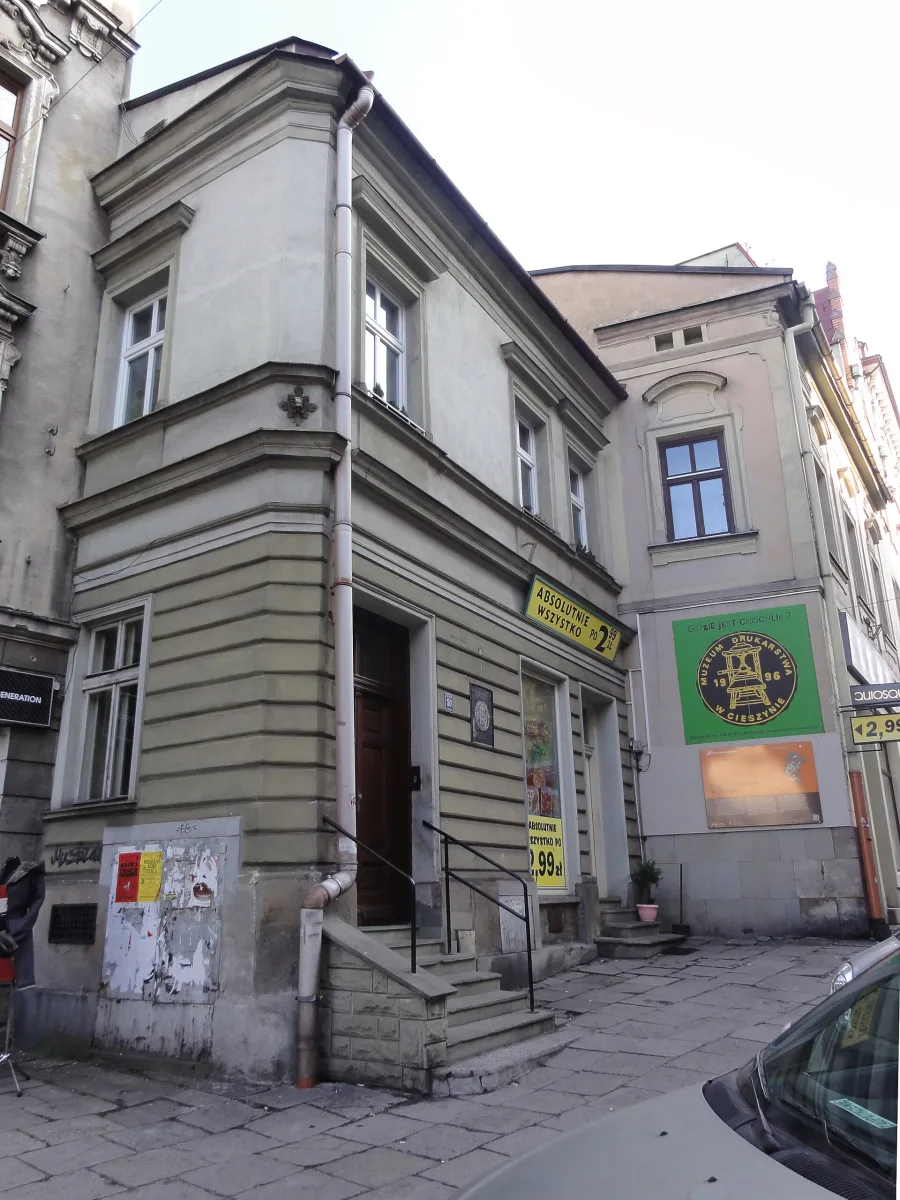
Cieszyn is associated with the Market Square, the rotunda and Castle Hill, but two places in the town are listed on the Industrial Monuments Route of the Silesian Voivodeship: the brewery beneath the castle and a small former printing house. The first was added to the route in 2017, the second in 2010. Both have kept equipment from the time when craft was turning into industry.
A brewery set into the slope of Castle Hill
The origins of the brewery go back to 1653. The steward of the ducal estates, Kaspar Tłuk of Toszonowice, started brewing at the castle at that time, breaking the one-mile privilege that belonged to the town. After protests from the townspeople he stopped brewing, and later resumed it, supplying beer only outside the area of one mile reserved for Cieszyn.
The present plant is younger. In 1838 Archduke Karl Ludwig of Habsburg commissioned the Viennese architect Joseph Kornhäusel to carry out a thorough rebuilding of the Cieszyn residence. All that remained of the Piast castle was the tower and the Romanesque Rotunda of St Nicholas. At about the same time, around 1840, work began just below the castle, on the slope of the hill, on a modern brewery intended to produce pilsner-style beer on an industrial scale. Construction was completed in 1846. The brewery is regarded as one of the longest continuously operating in Poland.
A monument that is 70 per cent underground
The heart of the plant is a four-wing, three-storey building with a courtyard in the middle. The corners and the gate are decorated with pseudo-rustication, which gives the whole a defensive look. It was extended up to the First World War, so today it is a complex of buildings in various styles, from Biedermeier to Neo-Gothic.
The layout of the rooms follows the successive stages of production. The maltings, built of brick and stone, with cellars for steeping and malting barley, lies underground. The barley and malt stores and the air-drying kiln were on the upper floors and in the attics. The fermentation room, with cylindrical and conical open vats for bottom fermentation, is on the first level of the cellars. Cieszyn is one of three Polish breweries that ferment in open vats.
The lagering cellars are underground corridors on different levels of the hill. Attached to the building is a tall cellar, an ice tunnel dug under Castle Hill almost as far as the middle of the upper castle courtyard. In winter, ice from nearby bodies of water was stored in it, and it cooled production until summer. It is estimated that about 70 per cent of the brewery is underground. Many pieces of equipment from the second half of the 19th century and the early 20th century still work in the plant.
The history of the brewery is well illustrated by its successive changes of owner. In 1920, after the fall of Austria-Hungary, the plant was nationalised. During the Second World War it did not stop production, and some of the rooms served as prison cells.
A printing house that became a museum
The Printing Museum in Cieszyn was founded in 1996 to commemorate the printing traditions of Cieszyn Silesia. In the same year the Prodruk company gave the town historic printing equipment. In 1998 the museum took over the equipment of a closed typography workshop from the Cieszyn branch of the University of Silesia, and later further machines: a pot for remelting linotype metal, a machine for casting hand-set text with a full set of matrices, a ruling machine and drawers of type.
The collections also include a typographic machine with a set of type, chemigraphic and woodcut blocks, platen presses and bookbinding equipment. The printing, typesetting and bookbinding machines are fully operational. In 2004 a graphic workshop was opened, where workshops are held. Participants design a graphic, transfer it to a plate and print it on an old press, and in the bookbinding workshop they sew their own notebook.
The institution has also changed the way it is run. The Association of the Printing Museum in Cieszyn was registered in 2004, and in 2014 the museum received the Juliusz Ligoń Silesian Award. From 1 April 2019 it was closed for extension and modernisation, and in 2022, after renovation, its management was incorporated into the structure of Zamek Cieszyn, which runs the site together with the association.
What the brewery and the printing house have in common
Both places show technology that is usually not visible from the street: in one, the successive stages of production are spread across the levels of a hillside, in the other, typesetting and printing machines have been collected. In both, working equipment from earlier times has survived.
Be the first! Add a comment.
You need to log in to add a comment.
Log in