
Narrow tracks with a gauge of 785 millimetres once wove across the whole Dąbrowa Basin and the area around Gliwice. The Upper Silesian Narrow-Gauge Railways (Górnośląskie Koleje Wąskotorowe, GKW), known in dialect as rosbanka, were created in the mid-19th century to carry coal, ores and semi-finished products between mines, ironworks and factories. Two living sections of this network remain today, but the history is long and well documented.
Why narrow tracks were built
The railway was a response to inefficient road transport, which relied on horse-drawn haulage. The network connected the autonomous internal railways of mines, ironworks and factories. The 785 mm gauge, that is 30 Prussian inches, was adopted in 1846. Not everything ran on this gauge, however: in Upper Silesia there were also railways of 600, 630, 800, 900 and 1050 mm, serving spoil heaps, brickworks and shafts, not infrequently several systems within one plant.
How the network grew: differing dates of the beginning
The first talks about an inter-plant network were held in 1843. The Upper Silesian Railway Society obtained a state concession on 24 March 1851, initially for a horse-drawn railway. The original network was built in 1854-1857, and the year 1854 is taken as the date of opening. So there are three dates connected with the beginnings: 1846 for the gauge, 1851 for the concession and 1854 for the opening, depending on what we regard as the start.
In 1854-1857 two basic sections were built: from Tarnowskie Góry to Wirek (25 km) and from Bytom Karb via Bogucice to the Kunegunda ironworks (15 km). Together with the sections from 1851-1852 this made about 75 km. The first steam locomotives were introduced in 1855, but horse traffic continued alongside them. From 1860 the network was leased by Rudolf Pringsheim, who temporarily withdrew the locomotives and stayed with horses. Steam traction returned in 1872. In 1870 freight exceeded a million tonnes. The network was nationalised on 1 March 1884, after which the Prussian railway administration expanded it.
The heyday and the 1922 border
In 1901 the state main lines were more than 138 km long, and in addition there were almost 30 km of branch lines and 163 private sidings with internal plant tracks 205 km long. The railway had 51 locomotives and 3,693 freight wagons. In 1904 nearly 3.8 million tonnes were carried. After the partition of Upper Silesia in 1922 the border cut the network in several places, and the administration, workshops and main junctions remained in German Bytom. On the Polish side additional sections therefore had to be built to link the northern, eastern and southern parts of the network.
Some private railways did not belong to this network. An example is the Gliwice Trynek - Rudy - Racibórz line, built in 1899-1900 and opened as a passenger and freight line. Regular passenger trains ran on it until 1991, and after the Second World War the line was incorporated into the GKW. Almost nowhere else in the network were people carried, because the main task was the transport of cargo.
The peak after 1945 and the decline
In the mid-20th century the network was 233 km long and stretched from Żyglin and Bibiela in the north to Racibórz in the south-west and Mysłowice in the south-east. In 1950-1970 5-6 million tonnes of cargo were carried annually. After 1989 PKP gradually wound down the narrow-gauge railways, and at the end of 1999 the operating length of the network was only 40 km. In 2002, under the PKP restructuring act, the assets were taken over free of charge by the municipalities of Bytom, Tarnowskie Góry and Miasteczko Śląskie, as well as Kuźnia Raciborska and Racibórz.
What survived
The oldest historic line is still in operation, from Bytom Wąskotorowy through Tarnowskie Góry to Miasteczko Śląskie, 21 km, run as a tourist railway. Tourist rides were already revived in the 1970s, but they were soon abandoned because they clashed with heavy freight traffic and interest exceeded carrying capacity. They were restarted in 1993, initially also to Siemianowice Śląskie. Along the route lies the Chechło-Nakło reservoir, which in the 1970s was the destination of the first tourist trains.
The network is regarded as one of the oldest continuously operating narrow-gauge railways in Poland.
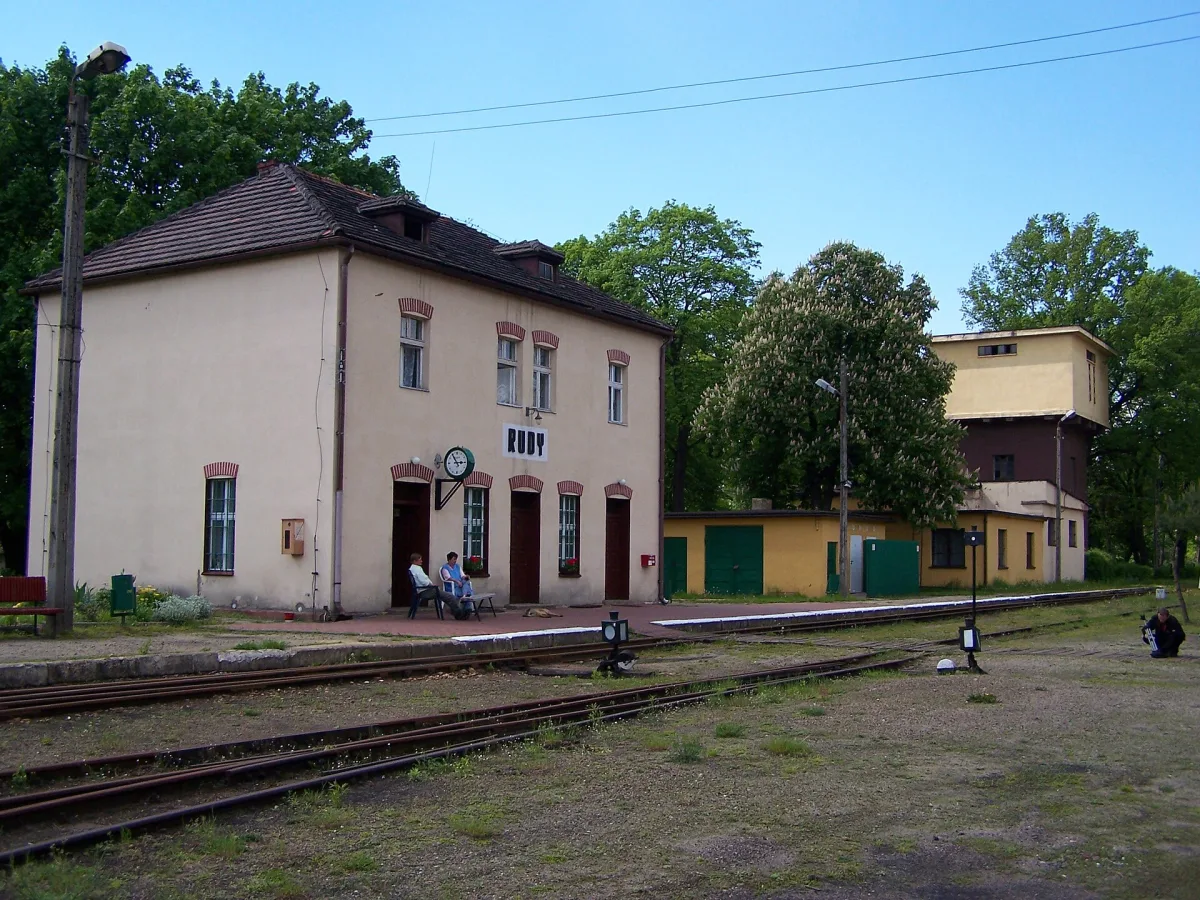
The second living section is the former Gliwice Trynek - Rudy - Racibórz line. The station was opened on 25 March 1899, and the station in Rudy is a historic monument and museum. The Rudy - Gliwice line was closed in 1992. The station building was entered in the heritage register in 1993, opened to visitors on 24 January 1994, and in 2006 it joined the Industrial Monuments Route. At the station there is an engine shed with a museum, and since August 2011 a refurbished Las49 steam locomotive has been running. The rides include routes to Paproć and to Stanica, and wagons and trolleys round out the offer. The page can be found under the name Zabytkowa Stacja Kolejki Wąskotorowej w Rudach.
Where to see rolling stock beyond the GKW tracks
Narrow-gauge locomotives and steam engines from the heyday of industry are also shown by the Steam Engine Open-Air Museum in Tarnowskie Góry, and various rail vehicles have been gathered in the railway open-air museum in Pyskowice. That is a different subject: standard-gauge rolling stock, not 785 mm.
Be the first! Add a comment.
You need to log in to add a comment.
Log in