

Where the subcamps came from and which lie in the voivodeship
The German Nazi concentration and extermination camp Auschwitz-Birkenau was located in what is now Lesser Poland and is not the subject of this text. The camp, however, had a network of subcamps, many of which were set up in Upper Silesia, at mines, steelworks and armaments factories. Prisoners were sent there because German companies were looking for cheap labour. The list of subcamps has 44 entries, of which 26 lie within the present borders of the Silesian Voivodeship. The rest are subcamps in Lesser Poland (among others Jawiszowice, Chełmek, Monowice, Libiąż, Trzebinia and the agricultural subcamps around Oświęcim), in the Opole region and outside Poland.
Borders have to be checked, because some lists are misleading in places. The Blechhammer subcamp is sometimes described as located near Blachownia Śląska, yet Sławięcice, where it stood, now belongs to Kędzierzyn-Koźle in the Opole Voivodeship, so Blechhammer remains outside this list. Likewise Prudnik lies in the Opole Voivodeship. Wesoła, where the Fürstengrube subcamp operated, is today part of Mysłowice.
Mines and power stations
The most numerous subcamps were set up at mines. In Jaworzno, Neu-Dachs operated from June 1943; in January 1945 it held about 3,660 prisoners, who worked in the mines and on the construction of a power station. The later fate of this place after the war is described in a separate text on the camp in Jaworzno, and the burial place of the prisoners is described in the entry Monument to the Prisoners of the Camp in Jaworzno. In Mysłowice-Wesoła operated Fürstengrube, established in July 1943 at a mine belonging to IG Farben. In January 1945 it held 1,283 prisoners, mostly Jews from Poland. About a thousand prisoners were evacuated on foot, and on 27 January 1945 the SS men killed those who remained in the camp. A cross from 1989 and a plaque from 2016 stand on the site of the camp.
In Lędziny, at the Günther mine, the Günthergrube subcamp operated, with between 300 and almost 600 prisoners, mainly Jews from France, the Netherlands and Poland. It was the only Auschwitz subcamp to change its location during its existence: in June 1944 it was moved to a new, larger camp. In Rydułtowy, at the Charlotte mine, Charlottengrube operated, and according to the list it held about a thousand prisoners, mainly Jews from Hungary, Czechoslovakia and Slovakia. In Łagisza in Będzin, from September 1943 to September 1944, about a thousand prisoners worked on the expansion of a power station. In Halemba in Ruda Śląska, in the former Stara Kuźnica, the Althammer subcamp held about 500 prisoners from September 1944, who were building a thermal power station.
Steelworks and armaments factories
In Świętochłowice-Zgoda, the Eintrachthütte subcamp operated from May 1943. At most 1,374 prisoners were held there, working in armaments factories. After the war, the Zgoda camp was set up on the site of the camp, which the entry Zgoda Camp describes. In Siemianowice Śląskie, prisoners produced anti-aircraft guns at the Laura steelworks, and at the time of the evacuation there were 937 of them. In Chorzów-Batory, the Bismarckhütte subcamp held, according to the Auschwitz Museum, about 200 people, mainly Jews from France, Belgium and Czechoslovakia. In Bytom-Łagiewniki, on the grounds of a steelworks, Hubertushütte operated: on 17 January 1945 it held 202 prisoners. In Zabrze, at the Hindenburg subcamp, there were at the peak about 470 women and about 70 men, who produced ammunition and grenades. In Sosnowiec, the Sosnowitz II subcamp, opened in May 1944 at a rolling mill, held up to 900 prisoners, mainly Jews, who produced barrels for anti-aircraft guns.
Gliwice: four subcamps and Sośnica
Gliwice had as many as four subcamps, numbered I-IV. Gleiwitz I, established in March 1944 at the railway rolling-stock repair workshops, held on average up to 1,300 prisoners. Gleiwitz II was set up at a carbon black factory, and from May 1944 a transport of about two thousand Jews from Hungary was brought to it. Gleiwitz III, from July 1944, operated on the grounds of a former steelworks and held about 600 people. Gleiwitz IV was set up at barracks under construction and had 600 prisoners on average. In Sośnica, now part of Gliwice, a short-lived subcamp, Sosnitz, existed as early as July 1940, in which thirty prisoners dismantled the fence of a former prisoner-of-war camp. Wire from this fence was used to build the first fence of the camp in Oświęcim. Plaques and monuments commemorating the Gliwice subcamps were unveiled in 1979.
Other subcamps
Besides industry, smaller subcamps also operated. In Goleszów, in Cieszyn Silesia, from July 1942 prisoners worked in a cement works and a quarry. The register book recorded 2,348 names, although the number may be higher. In Czechowice-Dziedzice, after the American bombing of the refinery in August 1944, two subcamps were set up: Tschechowitz I for removing unexploded bombs and Tschechowitz II for clearing rubble and rebuilding. In the forests near Pszczyna, three small forest camps operated: Altdorf in Stara Wieś, Radostowitz in Radostowice and Kobier in Kobiór, the largest of them, with 60 to 150 prisoners. In Kobiór, an obelisk commemorating the prisoners was put up in 2005. In Międzybrodzie Bialskie, from 1940, several dozen prisoners built a recreation centre for SS men. In Katowice, about ten prisoners worked for a year on the construction of a shelter and a barracks for the Gestapo, and in Sosnowiec, in a tenement house on Targowa Street, Sosnowitz I operated briefly.
January 1945 and traces today
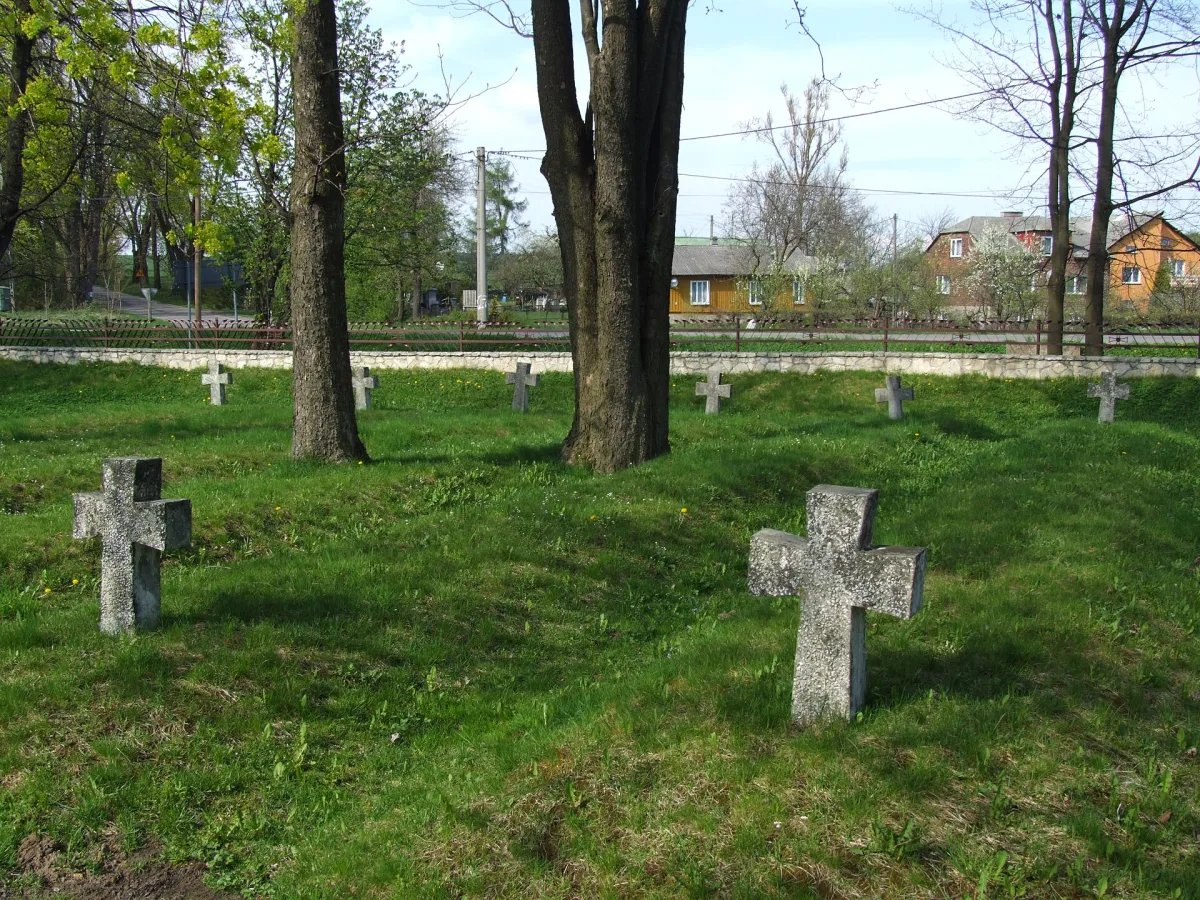
In January 1945, with the front approaching, all the subcamps were evacuated on foot or by rail to camps deeper inside the Reich. The course of the marches is described in a separate text on death marches. Generally only isolated traces of the subcamps remain: some of the barracks in Gliwice, watchtowers and fragments of fences on the site of the former Gleiwitz III and IV, a mass grave with a monument by Xawery Dunikowski at the cemetery in Chorzów-Batory from 1960, while in Siemianowice the camp buildings were demolished around 2016 together with the steelworks. In some places, such as Radostowice, there is no commemoration at all. Industrial plants on whose grounds some of the plaques stand, for example in Sosnowiec, have their own access rules. A list of the subcamps is also maintained by the Auschwitz-Birkenau State Museum.
Be the first! Add a comment.
You need to log in to add a comment.
Log in