
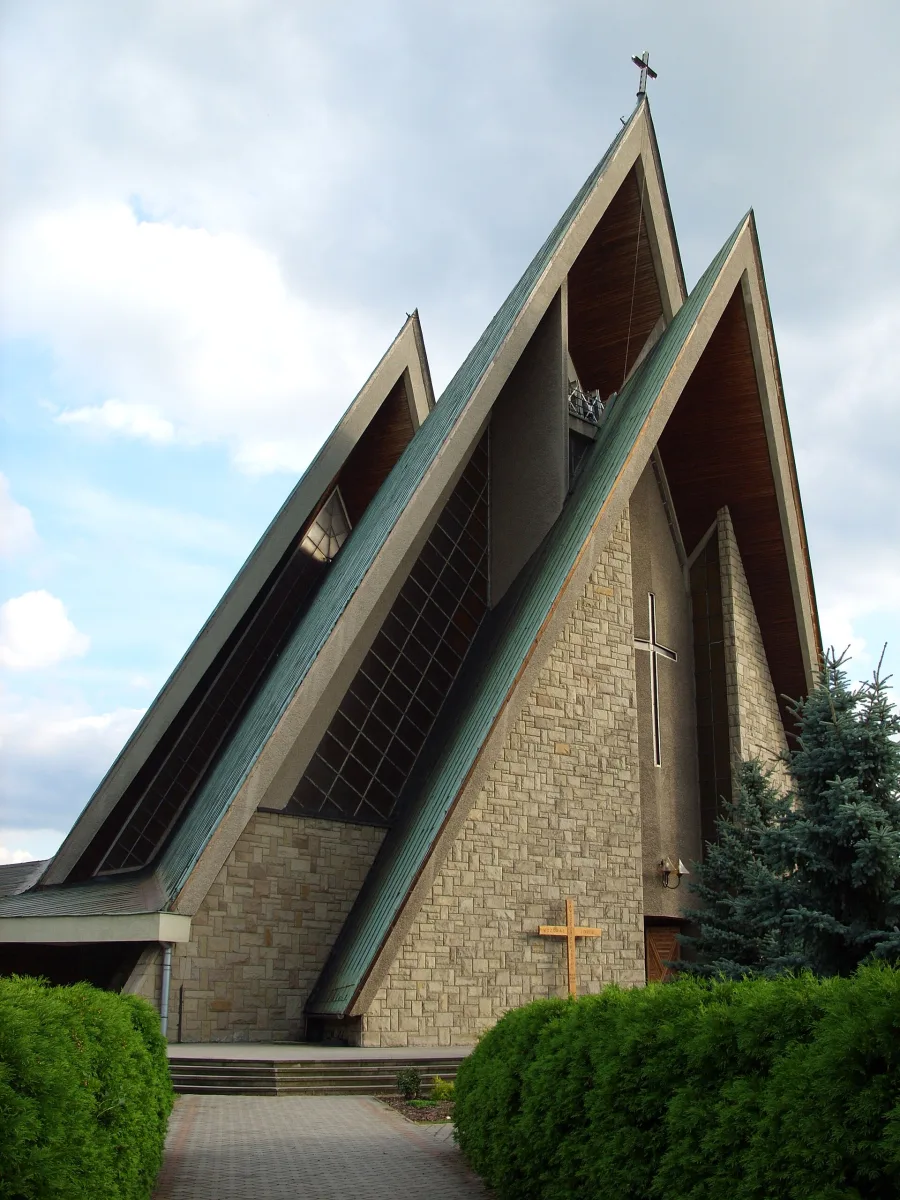
Węgierska Górka lies in the Soła valley, on the road leading from the Zwardoń pass into the Żywiec region. It was here that units of the German 7th Infantry Division crossed from Slovak territory on 1 September 1939. The valley was closed by reinforced-concrete fighting bunkers, and the battles for them lasted from 2 to 3 September. The battle is called the “Westerplatte of the south”; the term is attributed to the defenders because of their resistance against superior forces, and it is not a historical name of the engagement.
The defensive line in the Soła valley
The southern border east of Zwardoń was held by units of the 1st Mountain Brigade under Col. Janusz Gaładyk. The valley of the Soła and the road from Čadca through Zwardoń to Żywiec were defended by the 1st Battalion of the “Berezwecz” Border Protection Corps (KOP), supported by the “Żywiec” National Defence battalion and small artillery forces. Behind this defence stood the bunkers in Węgierska Górka, manned by the 151st “Węgierska Górka” Fortress Company, formed on 28 August 1939 and commanded by Capt. Tadeusz Semik.
16 fighting bunkers were planned to close the valley, but only five had been built by the outbreak of war. They were reinforced-concrete bunkers armed with heavy machine guns. None received an armoured cupola, although these were planned for all of them, because there was no time to install them.
The five bunkers and their names
Each bunker had its own name and its own commander.
- Waligóra - an artillery bunker, a so-called traditore, with two 75 mm field guns. It was commanded by 2nd Lt Leopold Galocz. The crew consisted of one officer, three non-commissioned officers and seventeen privates.
- Włóczęga - a bunker for an anti-tank gun and machine weapons, on the eastern slopes of Mount Glinne, about 100 metres from Waligóra. It was commanded by reserve 2nd Lt Marian Matkowski; in another account his surname is given as Małkowski.
- Wędrowiec - a heavy infantry bunker, which in the initial phase of the fighting served as the command bunker of the sector commander, Capt. Semik. It stands in the Żabnica valley.
- Wąwóz - a bunker on a rise above the Węgierska Górka - Żabnica road, armed with a 37 mm gun and heavy machine guns. It was commanded by reserve 2nd Lt Czesław Chludziński.
- Wyrwidąb - a bunker on the Bukowina hill. When the war broke out it was not yet finished or armed, so it did not take part in the fighting.
The course of the fighting on 2 and 3 September
From 1 September, KOP and National Defence covering units delayed the German advance in the area of Zwardoń, Ujsoły, Milówka and Kamesznica. On 2 September German artillery shelled the Polish fortifications and the village, and civilian buildings burned down as a result. After the artillery preparation the infantry moved forward. The first attack was repelled with heavy machine-gun fire. The Germans then changed tactics and began to take the bunkers one by one, using assault groups supported by sappers. The attacks continued until late at night.
Col. Gaładyk ordered a withdrawal from the positions held, under cover of night. The crew of Waligóra left the bunker late in the evening of 2 September; sources give lack of ammunition as the reason, or a withdrawal to Oczków together with KOP soldiers. The withdrawal order did not reach Włóczęga and Wędrowiec. Włóczęga fought through the night of 2 to 3 September, in part of the fighting with groundwater flooding the interior, and surrendered on 3 September at 8.30. The fall of this bunker opened dead ground in front of Wędrowiec for the Germans, and Wędrowiec surrendered the same day at 17.00, after running out of ammunition. The crew of Wąwóz, which was not captured, left it in the night of 3 to 4 September.
A study of the 151st Fortress Company describes how, after leaving Wędrowiec, the defenders were beaten by German soldiers and one of them died; the intervention of the regiment commander was said to have prevented further bloodshed. These details come from a single study.
Losses and discrepancies
According to some sources the Germans lost about 200 soldiers in the fighting, according to others the losses are estimated at 200 to 300 men. These are estimates, not a documented figure. In the fighting in the Zadziele area on 4 September, after the fall of the bunkers, 47 dead are listed on the German side.
Polish forces withdrew towards Żywiec and Andrychów. The Germans entered Żywiec on 4 September, and the whole Żywiec region was incorporated directly into the Third Reich.
The bunkers after the war and today
After the fighting ended, the Germans dismantled the equipment, including the armoured and gas-tight doors. In autumn 1939 both the Waligóra and Włóczęga bunkers were fired at from a short distance with a gun during the filming of a German propaganda film, and in Wąwóz sappers detonated mines and ammunition left over from the fighting. In the 1960s Waligóra was used by the army as a command post during manoeuvres, and Wyrwidąb was used after the war for tests of explosives and is the most damaged bunker. A house was built over Włóczęga in the 1970s, and Wąwóz is described as unused and decaying.
In 1993 a museum with relics of the defence was opened in the Wędrowiec bunker, and an amphitheatre was built in front of it, where ceremonies are held. The rules for visiting are provided by the museum. The Wędrowiec and Waligóra bunkers were entered in the heritage register in 2021. For the fighting in 1939, Węgierska Górka was awarded the Cross of Grunwald, 3rd class, in 1971.
Be the first! Add a comment.
You need to log in to add a comment.
Log in