
The building on Poniatowskiego Street in Gliwice was built as a Jewish pre-burial house (funeral hall) at the community's new cemetery. Today it houses the House of Remembrance of Upper Silesian Jews, a branch of the Gliwice Museum, and the neighbouring necropolis is still in use. This text describes the building, its history after 1945 and other traces of the Jewish community in Gliwice.
The pre-burial house of 1903
The house was designed by the Viennese architect Max Fleischer, and the contractor was the Gliwice building firm of Julius Scheer. The cemetery and the pre-burial house were opened on 15 November 1903. The Gliwice Museum states that the necropolis was founded in 1902-1903. According to other sources, the pre-burial house was brought into use in November 1905, so the dates in the sources differ. The building is sometimes called the Little Synagogue.
According to the museum's description, the house consisted of three parts: a stately prayer hall with an exit directly onto the cemetery, a mortuary in which the deceased was prepared for burial in accordance with Jewish law, and the caretaker's flat. Other sources add an office, a room for the rabbi and a boiler room in the basement.
It is a neo-Gothic building of red brick. The main hall measures about 10.5 by 17.6 metres and is 10 metres high. The floor is decorated with an ornament of black and white ceramic tiles, the vault is a cross-rib vault with a starry sky painted on it. The gable walls contain two large stained-glass windows.
From warehouse to museum
During the Second World War the building housed a military warehouse, but it was not destroyed. After 1945 the cemetery and the pre-burial house were used by the post-war Jewish community in Gliwice. Over time the house fell out of use and began to fall into ruin.
In 2003 the building was entered in the heritage register, and in 2007 the Jewish community transferred it to the city of Gliwice. In 2012 the city mayor decided to restore the building and turn it into a museum branch. The museum states that the revitalisation was financed entirely from the city budget. Other sources date the renovation and conservation work to 2012-2016, while the museum writes of a revitalisation begun in 2013, the final stage of which was the opening of the permanent exhibition.
The exhibition and the profile of the branch
The museum defines the branch's mission as researching and commemorating the history of the Jews in Upper Silesia and creating a space for dialogue between cultures, religions and nations. The permanent exhibition “Jews in Upper Silesia” shows the history of the community from the Middle Ages to the present day. According to the museum, it is the only such permanent exhibition in the region. It tells of the lives and achievements of several dozen members of this community: industrialists, people of science and culture, and Upper Silesian rabbis. The museum describes the branch's area of interest as stretching from Prudnik to Katowice and from Kluczbork to Pszczyna.
In 2016 the building won the competition for the Best Public Space of the Silesian Voivodeship in the category of revitalised public utility building. Visiting rules are set by the museum, and they should be checked on its website.
Two cemeteries and a synagogue that is no more
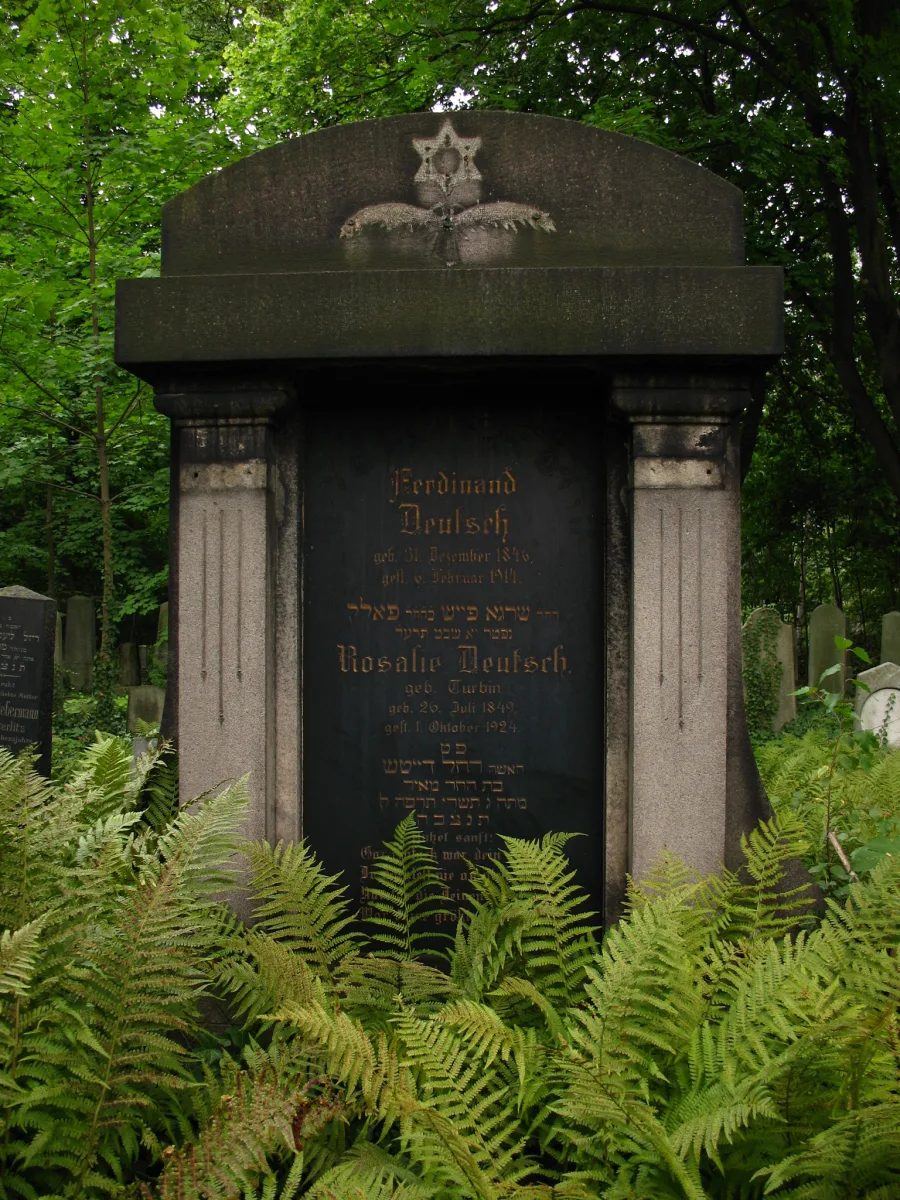
The pre-burial house stands next to the new Jewish cemetery. It covers 1.7 ha and is still used for burials. According to some sources about six hundred gravestones have survived there, while Przemysław Burchard writes of four hundred. In 1932 a monument to Jewish soldiers killed in the First World War was erected in the cemetery, and it too has survived.
The old Jewish cemetery on Na Piasku Street is the oldest surviving monument of Jewish culture in the city. It was founded in 1815 on land that the community had bought in 1795. After the opening of the railway line from Wrocław to Mysłowice and the building of the station, it found itself right beside the tracks. The last burial took place in 1937, and the necropolis was closed in 1953. After 1945 gravestones made of valuable stone were stolen and used as building material, in 1956 the cemetery was taken away from the community, and in the 1970s its liquidation was planned to make way for a flyover, a plan that was abandoned. About five hundred gravestones have survived, mainly matzevot of grey sandstone. Those buried there include members of the Troplowitz, Frankel, Freud and Froehlich families and the siblings of Edith Stein. Since 2010 the cemetery has been opened periodically on the initiative of the association “Pamięć - Zikaron”.
The community's main synagogue, the New Synagogue, stood at Dolnych Wałów 15. It was built to a design by Salomon Lubowski, and the builder was the firm of Louis Troplowitz. According to some sources construction took place in 1859-1861, while the Gliwice chronicler Benno Nietsche writes of 1860-1861 and of the solemn opening of the synagogue on 29 August 1861. On the night of 9 to 10 November 1938 the synagogue was set on fire by Nazi gangs, and in the morning a unit of the Technische Nothilfe blew up the walls, which were in danger of collapsing. It was not rebuilt after the war. The remains of the basement and the tower were demolished in early 2007. Today the site is an empty square, and the memory of the building is kept by two plaques.
Similar places in the region
Other Upper Silesian synagogues shared the fate of the Gliwice one. The Great Synagogue in Katowice was burnt down in 1939, the Great Synagogue in Zabrze in 1938, and of the synagogue in Bytom there remain a plaque on Plac Grunwaldzki and the memory of the Moorish-style building of 1869. In Tarnowskie Góry the site of the synagogue of 1864 is marked by a column with a Star of David. Among the surviving necropolises are the cemetery in Racibórz, founded in 1814, and the smallest Jewish cemetery in the Silesian Voivodeship, in Sośnicowice. Detailed descriptions of these places can be found on their entries.
Be the first! Add a comment.
You need to log in to add a comment.
Log in