
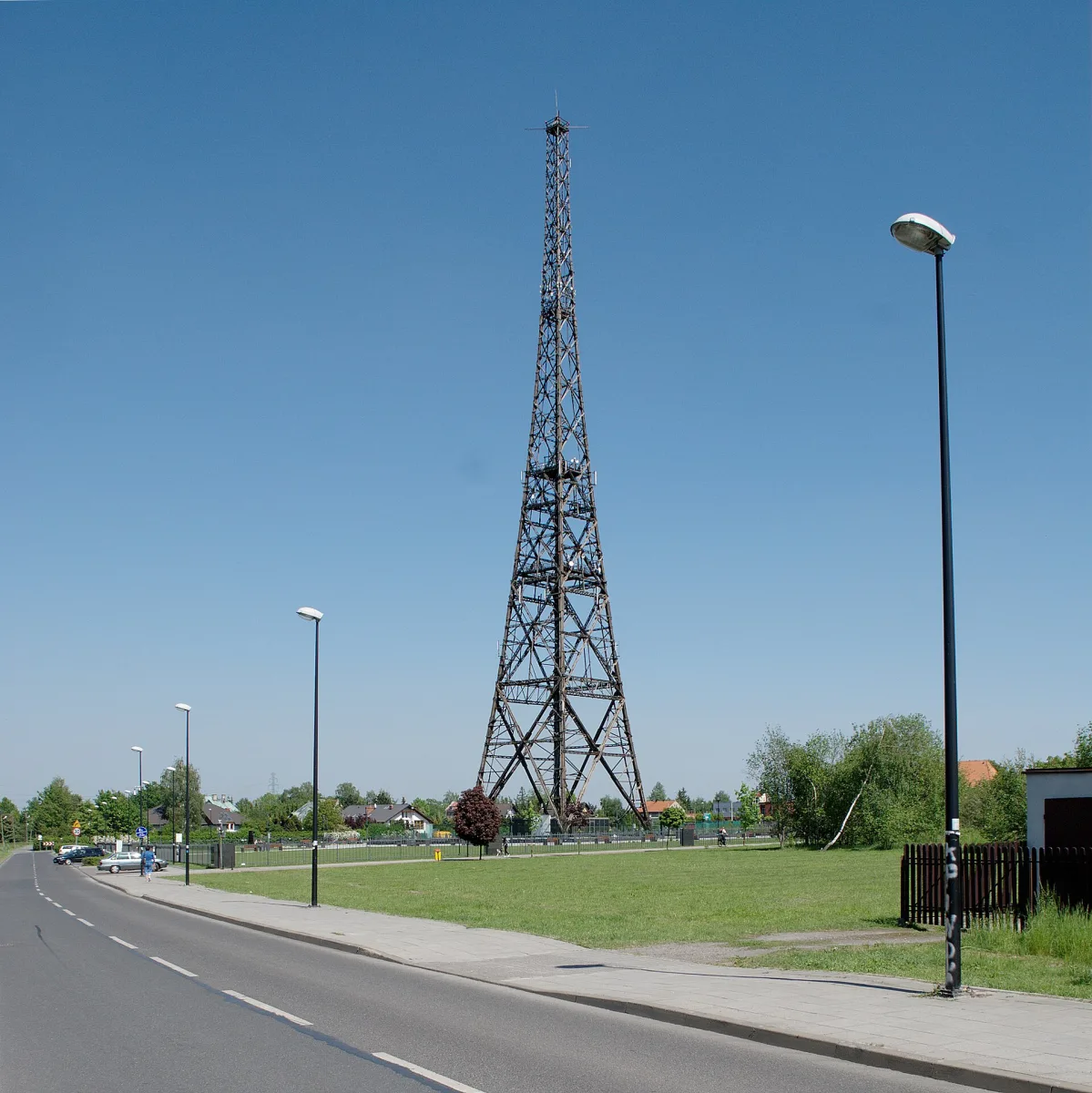
The transmitter complex on Tarnogórska Street in Gliwice, then Gleiwitz, was put into operation on 22 December 1935. It is the second radio station in Gliwice: the first, from 1925, was located on what is now Radiowa Street, roughly four kilometres away. On the evening of 31 August 1939, in the transmitter building on Tarnogórska, a scene was played out that was meant to look like a Polish attack but was a German false-flag operation. Today the Gliwice Radio Tower is a branch of the Museum in Gliwice.
Context: three incidents on the border
The initiative came from the circle of the highest authorities of the Reich, and supervision of the preparations was entrusted to Reinhard Heydrich of the SS Security Service (SD). On the border of Upper Silesia three staged events were planned: in Gliwice, in Stodoły (German Hochlinden, today a district of Rybnik) and in Byczyna near Kluczbork. They were to provide propaganda with proof of alleged Polish aggression and justify the attack on Poland, and at the same time weaken the will of Poland's allies to give it help.
The group sent to Gliwice was commanded by Alfred Naujocks of the SD. His men had been in the city since mid-August, in civilian clothes and under false identities, waiting for the signal to begin the operation. The signal came on 31 August in the afternoon, when the decision was taken on the date of the attack on Poland.
The evening of 31 August 1939
At about 8 p.m. the group entered the grounds of the radio station. Part of the guard had been removed earlier on an instruction from outside, and the station's employees were overpowered and locked in the cellar. The attackers were said to have gone to the transmitter building, not to the studio, which was in another part of the city. From 1935 the station did not broadcast its own programme but only relayed the programme from Wrocław, so it had no normal studio. A microphone intended for announcing breaks in broadcasting because of a storm was used.
The content of the announcement in Polish is not precisely established. According to Naujocks's testimony it lasted three to four minutes, and only a few words reached listeners saying that the radio station was in Polish hands. The signal had a local range, so it did not reach Berlin, where those who had commissioned it were waiting. Technically, the operation did not meet its assumptions. Even so, at about 10.30 p.m. German radio reported news of alleged Polish attacks, and on 1 September Adolf Hitler referred in the Reichstag to Polish border incidents.
Franciszek Honiok
The victim is identified as Franciszek Honiok of Łubie, a German citizen of Polish nationality and a participant in the Silesian Uprisings, whom the Gestapo had detained the day before. Sources give different dates of his birth, 1896 and 1899. Before his death he was drugged with an injection, and his body was left in the radio station building as alleged proof of a Polish attack.
The circumstances of his death are not resolved. The cause is not known, and both a gunshot and an overdose of a narcotic are possible. Sources also differ as to whether only his body was left in the radio station or also the bodies of other people. Studies repeat the information about prisoners dressed in Polish uniforms, but according to other findings the attackers wore civilian clothes, and Polish uniforms were used in the other two operations. This question remains disputed.
For decades the Honiok family did not know his fate. The victim's identity was established only in the 1960s, after German journalists began to write about the matter, being interested at the time in an East German film about the Gleiwitz incident. Pupils of one of the Gliwice primary schools described his story in a book published by the Museum in Gliwice.
Clarifying the matter after the war
The matter was raised at the Nuremberg trial in 1945-1946, where the Abwehr officer Erwin Lahousen testified, and the Tribunal placed responsibility on the SD. In 1963 the German prosecutor's office opened an investigation, initially in Hamburg, moved to Düsseldorf after the death of one of the suspects in 1966. It was then established that the three incidents were staged operations prepared by the German side. To this day no written trace of the plan for the Gliwice operation itself has been found.
The radio station after 1945 and today
The station operated until 22 January 1945, when the Red Army was entering the city. From 23 October 1945 Katowice programmes were broadcast from here. In 1950-1956 the site served for jamming foreign stations, mainly Radio Free Europe. Later, transmitters were produced here. In 2002 the city bought the complex, and in 2005 the Museum in Gliwice took it over. In 2009 the three-hectare property was opened as a park, and in 2017 the complex was placed on the list of Historic Monuments, as the museum's website states.
The antenna tower is 111 metres high and is built of larch beams joined with pegs and brass screws. According to studies, it is considered the tallest surviving structure made entirely of wood in Europe. In the main building much of the equipment from 1934 has survived, including a transmitter by Lorenz, which was handed over in 1963 to the Museum of Technology in Warsaw and returned to its former place in 2013. The rules for visiting the park and exhibitions are given by the museum.
The events of 31 August 1939 are part of the wider history of the beginning of the war in Upper Silesia, which is also covered in separate texts on the fighting at Wyry and the defence of Katowice, and on Węgierska Górka.
Be the first! Add a comment.
You need to log in to add a comment.
Log in