
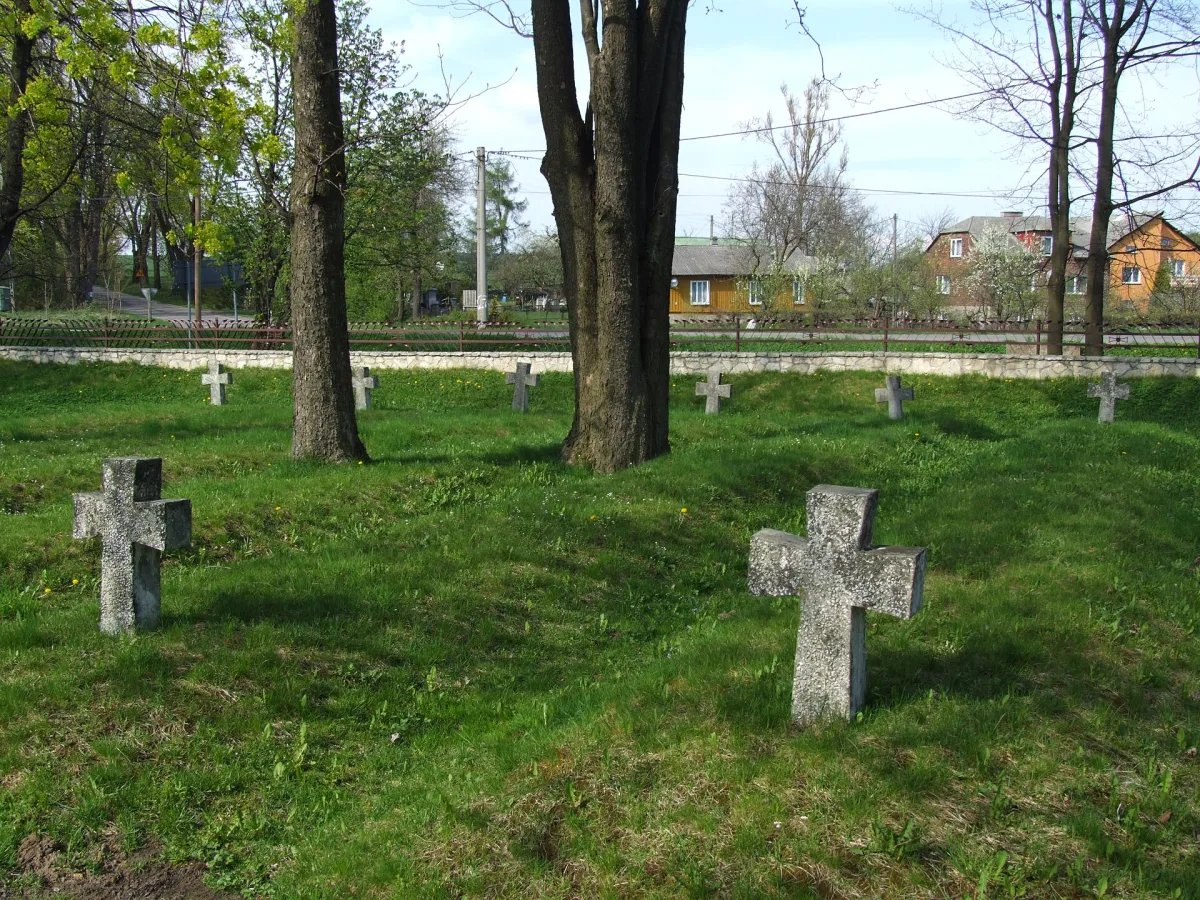
War cemeteries in the Silesian Voivodeship differ in the time they were created, the nationality of those buried and the way they are maintained. Some come from the fighting of 1914 on the Kraków-Częstochowa Upland, others from September 1939, from the German occupation and from the beginning of 1945. Alongside them are necropolises of Soviet soldiers and a large German cemetery from the 1990s. The overview below is not a complete list, only the types of places that have their own cards in the portal.
The First World War: cemeteries on the Jura
In November and December 1914, fighting took place between the Austro-Hungarian and Russian armies around Pilica, Kroczyce and Morsko. The fallen were at first buried in many places, and towards the end of the war the Austrian authorities set up collective cemeteries. In the interwar period remains from further small cemeteries were moved to larger ones, which explains why soldiers of different armies lie in one place.
The war cemetery in Biskupice near Pilica was established in 1918. In line with Austrian principles, the fallen of both opposing armies could lie in one place. In the mid-1930s 779 Austrians and 219 Russians were recorded there, 998 people in total, and later two more mass graves were added. One gravestone of an identified person has survived, that of an Austrian second lieutenant.
The war cemetery in Kroczyce on the Bleszczowa hill was begun by the Austrian authorities in 1917-1918 and completed by the Polish authorities to their own plan. 938 soldiers of three armies lie there, killed in November and December 1914. Among them were Austrians, Czechs, Germans, Poles, Slovaks, Russians and Ukrainians. The graves of Russian soldiers are marked with double-armed crosses, and those of Austro-Hungarian and German soldiers with single-armed ones.
The war cemetery in Kotowice was probably established at the beginning of 1915. In 1936 remains from over a dozen other cemeteries were moved to it, so about 1200 soldiers of the Austro-Hungarian, German and Russian armies lie there. The cemetery has six kinds of cast-iron crosses, three Latin and three Orthodox. Almost all of those buried remain nameless. In Łazy, in the Podlesie housing estate, the war cemetery from 1914-1918 today takes the form of a ring of stones from a mound in the forest with an obelisk and a German plaque; locally it was sometimes wrongly called a Jewish cemetery.
September 1939 and the German occupation
The graves of the defenders of towns date from September 1939. In the cemetery on Panewnicka Street in Katowice-Ligota stands the Monument to the Defenders of Katowice. 105 people lie beside it: Silesian insurgents, girl and boy scouts, killed by the Germans in September 1939 in prisons, forests and on the streets of the city. The bodies were buried secretly at the time, and after the war they were exhumed and placed in a common grave. The first monument was unveiled in 1961, and the rebuilt one was consecrated in 2000. The whole cemetery is an active municipal necropolis, and the defenders' grave is also described on the administrator's website.
Graves of defenders from September 1939 are also in the municipal cemetery in Rybnik, among the graves of Silesian insurgents.
From the German occupation comes the martyrdom cemetery-mausoleum in Olsztyn near Częstochowa, in the forest by the road to Kusięta, in a place called "Szubienica" ("the Gallows"). In 1940-1945 the Germans secretly shot residents of Częstochowa and the surrounding area here, prisoners, captured partisans and soldiers of the 3rd Brigade of the People's Army. The first were shot in June 1940, prisoners from the so-called AB Action. The total number of victims is given as about 1968; this is a figure from a single source. The cemetery has 18 symbolic graves, a bas-relief and two monuments.
The death march from Auschwitz in 1945
In the winter of 1945 the Germans drove prisoners from Auschwitz and its subcamps deeper into the Reich, and those who could not go any further died by the roadside. They were then buried in scattered graves along the route, and after the war some were moved. At the Central Cemetery in Gliwice in 1948 eight mass graves were created for those who died during the death march from Auschwitz-Birkenau; 14 mass graves of Polish Army soldiers who died in captivity of their wounds were also laid out there. The cemetery, with an area of 22 ha, was created in 1920-1927 as a layout combined with a park.
Cemeteries of Soviet soldiers
Red Army soldiers killed between January and May 1945 during the capture of Upper Silesia and the Żywiec region lie in cemeteries established after the war, often moved from town centres. Today they have different statuses and different rules of access.
- Soviet Soldiers' Cemetery in Bielsko-Biała: the first cemetery was established in 1948 on St Nicholas Square. 28 officers and 10,634 non-commissioned officers and privates were buried there. In 1968 the cemetery was moved out of the centre, to what is now Lwowska Street. It is not open to visitors.
- Red Army Soldiers' Cemetery in Racibórz: established in 1946 in a park on the Oder. In 14 graves lie 348 soldiers, although about a thousand Soviet soldiers were killed in the Racibórz area.
- Soviet Soldiers' Cemetery in Wodzisław Śląski: the Żydowina hill, the site of a former Jewish cemetery destroyed by the Germans. 5896 soldiers were buried there, and there is also a grave of 19 soldiers of the 1st Czechoslovak Armoured Brigade.
- Soviet Soldiers' Cemetery in Katowice: in 2014 a sculpture of two soldiers from the monument on Wolności Square was moved here.
The German war cemetery in Siemianowice Śląskie
The German soldiers' cemetery in Siemianowice Śląskie, in the Bańgów district, was built in 1996-1998 by the Volksbund Deutsche Kriegsgräberfürsorge on a wooded site of 3.4 ha. It is regarded as the largest German war cemetery in Poland. Remains exhumed from hundreds of places in southern and central Poland were gathered there. According to Volksbund data, more than 36,000 people killed or who died during the Second World War lie there, and eventually about 40,000. Stone plaques and stelae give the names, surnames and dates of identified people and the names of the places from which the remains were moved. The cemetery was opened to the public on 10 October 1998.
Be the first! Add a comment.
You need to log in to add a comment.
Log in