
A region associated with mines and steelworks also has a surprisingly rich list of places where plants are the main attraction. There are gardens with official botanical status, arboreta in former forests and parks, one of the best-known rose gardens in the country, palm houses with glass pavilions, and even gardens on former quarry and mine sites. Below is an overview of the places that have their own entries on the portal.
Botanical gardens: from brickworks to old workings
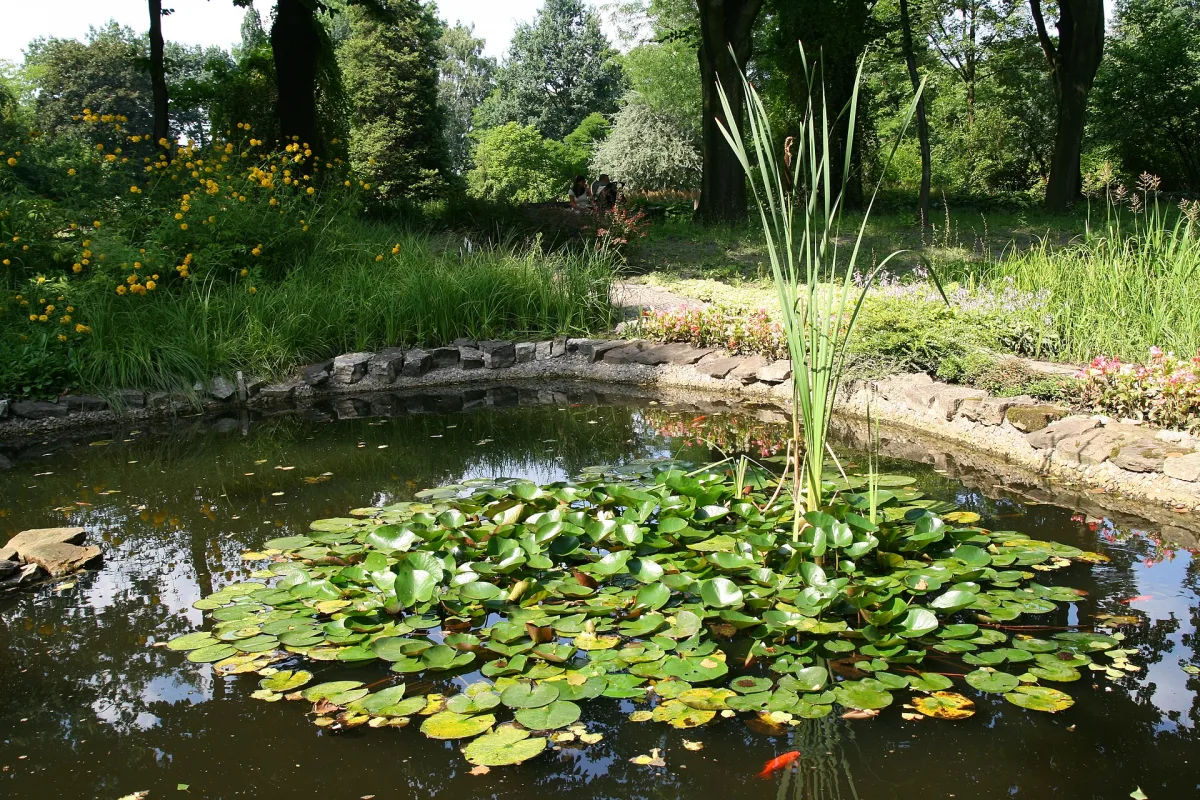
The Municipal Botanical Garden in Zabrze covers 6.36 ha on Piłsudskiego Street. The plan of the garden was presented on 14 October 1936 by Fritz Berckling, director of the municipal greenery department, and it opened to the public at the end of June 1938. It was originally called the Botanischer Zentralschulgarten, that is the Central Botanical School Garden, and was meant to show the full range of wild plants growing in what was then Germany. The site had earlier belonged to the municipal brickworks, and the pond, the largest of three, was created in 1960 in a clay pit left by the brickworks. The status of a botanical garden, that is a scientific and research institution, was granted to it by the Ministry of the Environment in January 2006.
The garden has a botanical section laid out in the French style and a park section in the English style. About 5,000 specimens of trees and shrubs grow in the park section, including a dendrological collection of about 260 taxa. In 2004 a rose garden was laid out with 2,500 roses in 64 varieties. Since 2019 the garden has held the National Collection of Heuchera: 346 varieties of botanical and garden species. According to the garden's website it is the only national collection in the Silesian Voivodeship. In the northern part, since 2014, there has been an eastern garden, called the Garden of Five Candles, with plants from the Far East, especially Japan.
The Silesian Botanical Garden in Radzionków has a completely different character. It is a habitat garden of 16 hectares on the grounds of Księża Góra, where calamine ore and dolomite were extracted. The mine left warpie, small round spoil heaps, and pingi, hollows often filled with water. The varied relief of the terrain, created by past mining, is regarded as an asset of the place. The collections are divided into conservation collections (old varieties of fruit trees and a chronological bed of cereals), habitat collections (meadows, sand and xerothermic grasslands, heathland) and ornamental ones, including roses, rhododendrons, honey plants and herbs. The garden is run by the Silesian Botanical Garden - Association of Societies, which according to the same description also manages the garden in Mikołów.
More modest and school-run is the botanical garden in Brynek, founded in 1946 at the forestry grammar school, and from 1952 the forestry technical school, in the palace and park complex of the Henckel von Donnersmarck family. The founder was the forest botany teacher Henryk Eder. All the work was done by pupils, and it is still so today: care is provided by pupils under the direction of a teacher. The collections have the character of an arboretum, with about 400 taxa of trees and shrubs, mainly from Asia and North America. The most valuable are the groups of rhododendrons and azaleas around the ponds, and specimens of magnolia, witch hazel and cork tree. The garden is owned by the county, and the school uses it on a loan basis, so the rules of admission must be checked before a visit.
Arboreta: a forest, a quarry and the trap of a name
The Moravian Gate Arboretum in Racibórz covers about 160 ha of the Obora forest on the right bank of the Oder, of which the fenced garden with collections is about 35 ha. According to the arboretum's website the forest has never been cleared, and its owners were successively the Piasts, the Cistercians of Rudy Raciborskie, the Duke of Racibórz and, from 1928, the town. The arboretum was founded in 2000, and its paths include ecological, dendrological and health trails. The largest collection is the Enchanted Garden of 1.1 ha, opened on 22 June 2012: the plants are arranged so that from above they form a flower with five petals, and the interior is crossed by an evergreen maze of conifers. The grounds also include a mini zoo and a viewing platform.
The name of Arboretum Park Gródek in Jaworzno needs careful reading. Despite the name it is not an arboretum in the strict, scientific sense: the park has no labelled dendrological collections and does not appear in the registers of arboreta or botanical gardens, and its status is that of a municipal park. It is nonetheless an excellent example of how nature takes over a post-industrial site. The park occupies dolomite quarry workings which, according to the town's website, were operated from about 1880 to 1990. The most famous features are the turquoise-water lakes, Wydra and Orka, and a winding wooden path leads across Wydra. Reclamation proceeded largely on its own, and a mosaic of habitats arose: warmth-loving grasslands, meadows, rock habitats, wetlands and pine forests.
Themed gardens: roses, herbs and a garden for the senses
The Rose Garden in the Silesian Park in Chorzów opened on 24 June 1968, at the same time as the first International Rose Exhibition. The initiative came in 1964 from the Polish Society of Rose Lovers, and the design was produced at the Warsaw University of Life Sciences (SGGW) under the direction of Prof. Władysław Niemirski. The layout is not modelled on German or English gardens: it consists of large honeycomb-shaped modules, and each bed is divided into cells of 7.5 m2, of which there are 374. According to the Silesian Park's website the roses bloom most intensely from mid-June to mid-July, and then repeat-flower with less force until autumn. The figures given by sources differ: the park speaks of about 35,000 bushes in about 300 varieties, and other sources of about 30,000 bushes.
Herbs are at the centre of the Beskid Herb House “Przytulia” in Brenna. It is a museum with a multimedia exhibition on how herbs functioned in the culture and daily life of the Silesian highlanders. From spring to autumn a herbarium operates around the building, a herb garden with the most important herbs of the region, where visitors can learn to recognise plants.
In Jaworzno, in the basin of a former Triassic limestone quarry, there is GEOsfera. The centre covers about 8 hectares and, besides a geological trail and a dinosaur park, has a sensory garden with heathland. More than 40,000 plants have been planted here, and in places the terrain is semi-natural, with meadows where orchids grow. The signs describing the plant collections have descriptions in Braille.
Palm houses: exotic plants under glass
The Municipal Palm House in Gliwice stands in Fryderyk Chopin Park. The first greenhouses on this site were built around 1880, and the present building in 1924. The oldest specimens, Canary Island date palms, date from 1924. The interior is divided into five pavilions: useful plants of the subtropical climate, rainforest, a historical pavilion, succulents with almost 2,000 cacti and water-storing plants, and an aquarium pavilion with the Amazon in a tank of 60,000 litres.
In Sosnowiec the Egzotarium Centre for Ecological Education operates in a municipal park founded in 1935. The first building with a palm house and aquarium was erected in 1954-1956, and the old collection of aquarium fish numbered 60 tanks. The old building was demolished in 2020, and the new one opened on 2 December 2023. The second level is occupied by a palm house with plants of the Mediterranean, desert and tropical zones. Since 2023 the egzotarium, together with the park, has formed a complex called a botanical garden.
How to plan a plant-themed walk
Roses in Chorzów are best seen in June and July, the wetlands and meadows in Radzionków in the warmer half of the year, and the palm houses in Gliwice and Sosnowiec work well when it is cold outside. School and park gardens, such as the one in Brynek, have their own admission rules, which must be checked before a visit. Around Jaworzno it is worth combining Gródek with GEOsfera, because both sites are managed by the same centre.

Be the first! Add a comment.
You need to log in to add a comment.
Log in