
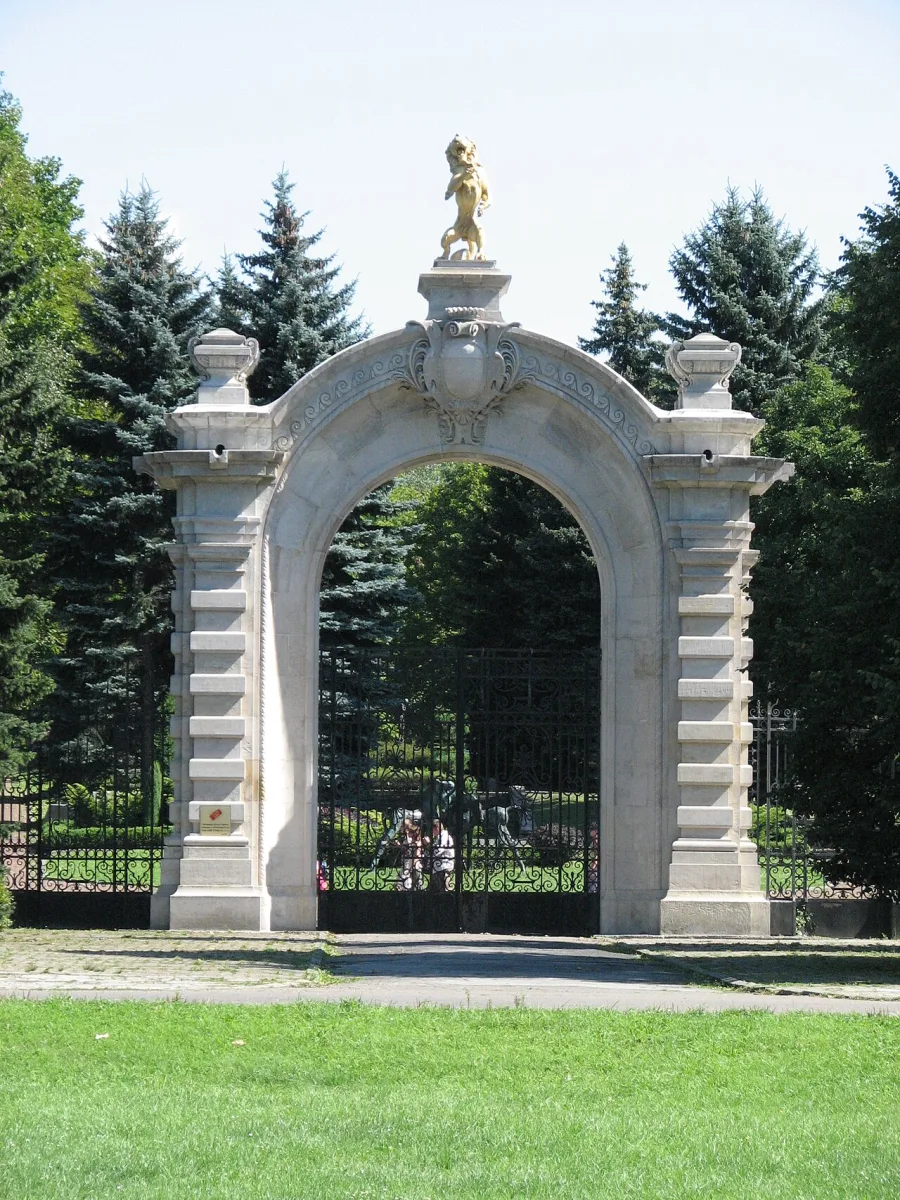
Silesian Park in Chorzów covers about 535 hectares and is among the largest urban parks in Europe. Its beginning was a specific resolution, not a chance event: the decision to build it was taken in 1950 by the Provincial National Council in Katowice, and one of the main initiators was Gen. Jerzy Ziętek. Until 2012 the park was called the Gen. Jerzy Ziętek Provincial Park of Culture and Recreation.
A park on spoil heaps
The area planned for the project covered about 640 hectares in Chorzów and Katowice. As much as 75 per cent of it was post-industrial land: spoil heaps, dumps of mining waste, old bootleg coal pits, subsidence hollows and marshes, with the rest being agricultural wasteland. The local soils were acidic and of little use, so 3.5 million cubic metres of earth and half a million cubic metres of humus soil and peat were brought in.
Construction began in July 1951. A large part of the work was done as voluntary community labour, donations were collected, and the proceeds from the sale of philatelic cards went towards building the park. The team of architects was headed by Prof. Władysław Niemirski. The park was divided into two zones: the middle was designed as woodland crossed by paths, and about 13 hectares as a cultural and recreational part. About 3.5 million saplings of trees and shrubs were planted, in 70 species and varieties. In October 1953 a company to manage the park was established.
The 1950s and 1960s: one facility after another
The most intensive period of expansion fell in the two decades after the decision of 1950. In 1954 work began on the cages for the Silesian Zoological Garden, which today covers 47.5 ha. The Dinosaur Valley, with concrete reconstructions of sixteen dinosaurs, was completed in 1975. The entrance to the zoo is marked by the symbol of the whole park, the giraffe sculpture, a reinforced-concrete structure more than 16 m tall, cast in 1959 at the Gliwice Technical Equipment Works.
The Silesian Stadium, the construction of which was decided on 20 December 1950, was opened on 22 July 1956. The inhabitants of the voivodeship worked a total of 589,938 man-hours on it. The Silesian Planetarium was founded on 4 December 1955, and construction began in 1953 to mark the Copernicus Year, on the highest elevation in the park, Góra Parkowa. It is regarded as the largest and oldest planetarium in Poland, and its dome has a diameter of 23 metres.
In 1957 the park railway began operating, with trains running along a route of just over 4 km. Two years later, in September 1959, the first visitors entered the Silesian Funfair (Śląskie Wesołe Miasteczko), today known as Legendia. It is regarded as the oldest amusement park in Poland, and it has borne the name Legendia since 2017.
In 1967 the Elka cable car was opened, its name being an abbreviation of Elektryczne Linowe Koleje (Electric Cable Railways). The original route, 5,539 m long, formed a triangle around the park and was regarded as the longest lowland cable car in Europe. The old route was dismantled in 2012, and in 2013 one section was reopened, between the Stadion Śląski and Wesołe Miasteczko stations.
In 1968 three facilities appeared at once: the Kapelusz exhibition hall, the Rosarium and a tower greenhouse, at that time the tallest in the world, which stood in the park until 1983. The idea of the rosarium was put forward in 1964 by the Polish Society of Rose Lovers. The garden was opened on 24 June 1968, together with the first International Rose Exhibition. It is regarded as the largest rose garden in Poland, with more than 35,000 roses in almost 300 varieties.
An open-air museum of Upper Silesia and the Basin
In 1975 the park gained the Upper Silesian Ethnographic Park. The idea of an open-air museum goes back to 1928, when Dr Tadeusz Dobrowolski, director of the Silesian Museum in Katowice, declared he would create an institution for endangered wooden churches and other monuments. The idea was returned to in 1952, and the first buildings were moved in 1964. The museum was established on 1 August 1974 and opened to visitors on 1 June 1975.
In six geographical sectors and one thematic one stand about 78 buildings from villages, small towns and estates of eastern Upper Silesia and the Dąbrowa Basin, dating from the 17th to the 20th century. In 1963, because of a planned road, the museum's location was shifted from the eastern part of the park to the north-western part, and in the programme the place of buildings from the western part of the region was taken by buildings from the Basin.

Be the first! Add a comment.
You need to log in to add a comment.
Log in