
Będzin is associated with its castle, but the town has more to show: a shelter hewn deep inside the hill, medieval walls, a steel water tower from the days of the mine, and a museum spread across several addresses. Below is the layout of these places, so that they can be combined into one walk or two shorter visits. The fortress itself is described in a separate article on Będzin Castle.
The underground beneath Castle Hill
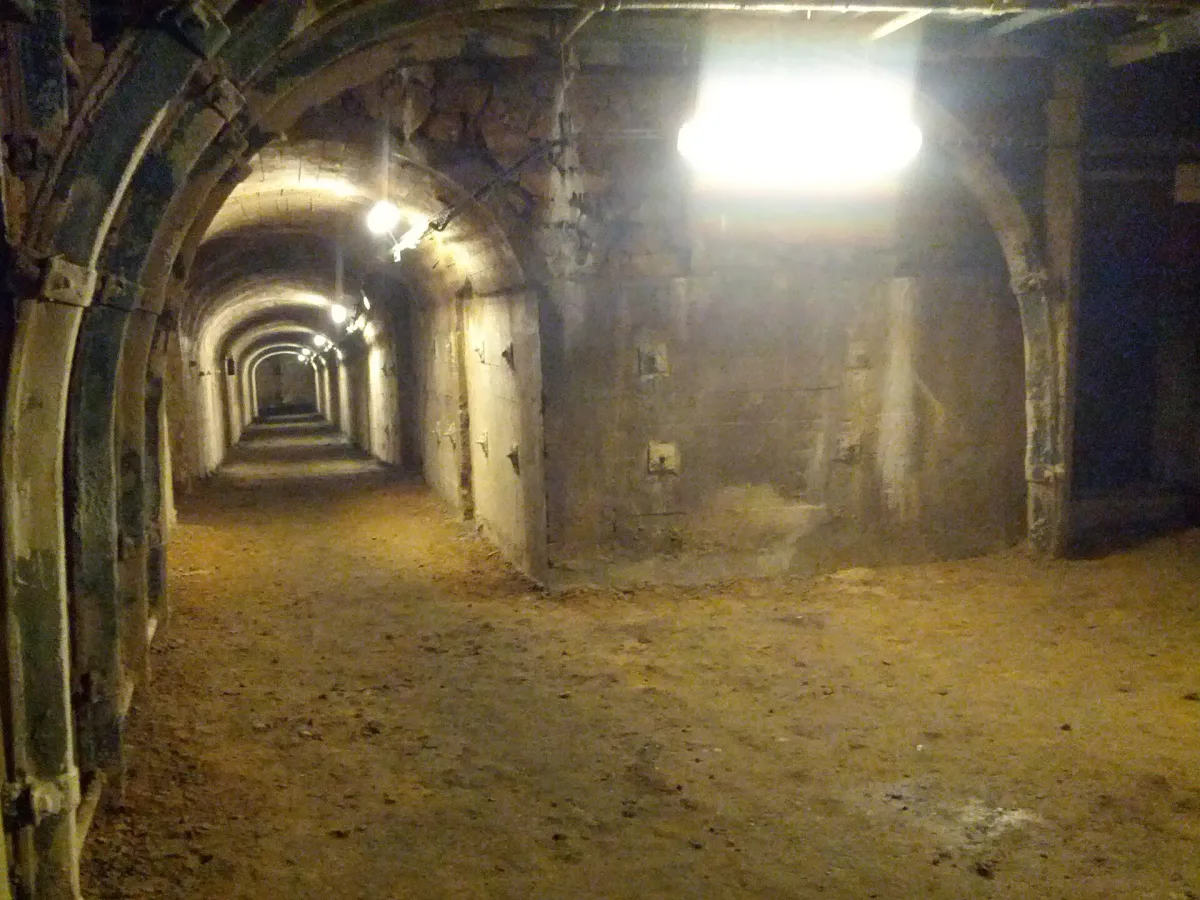
The Będzin Underground (Podziemia Będzińskie) is a route set up in an unfinished German air-raid shelter. The shelter was built in 1943-1944 to protect the German population of the town. It was hewn deep inside Castle Hill by concentration camp prisoners. The whole complex has about 700 metres of corridors and adits, and the tourist route is about 400 metres. The temperature inside stays between 9 and 12 degrees Celsius, so a warm layer will be useful.
The route is run by the Zagłębie Museum. It was opened on 13 December 2013, and in February 2018 a new arrangement appeared under the name “Tropiciele Historii Podziemi Będzińskich” (Trackers of the History of the Będzin Underground). There are small exhibitions on the beginnings of Będzin and on the German occupation. The entrance is on aleja Kołłątaja, not far from the Church of the Holy Trinity. It is visited in a group with a guide, by prior arrangement. The place calls for a restrained tone, because it came into being through the forced labour of prisoners.
Walls and the old town
The town walls were ordered by Casimir the Great in the 1360s, as mentioned by Janko of Czarnków and Jan Długosz. They encircled an oval town of about 7 hectares, and their line was about a thousand metres long. There were two gates, the Sławków Gate and the Bytom Gate, and neither has survived. In 1655 the walls were partly destroyed, and by 1823 only the south-eastern and eastern parts remained.
A short stretch has survived with two partly reconstructed towers. In 2011 a further section was rebuilt in the area of Modrzejowska and Zawale streets, over 170 metres long, following the medieval course. The towers had a rectangular plan and stood about every 60 metres. The oval of the former town is still legible in the layout of the streets today.
In the middle of this oval lies Casimir the Great Square, the former market square. Rescue excavations in 1977 showed four levels of use there, the oldest dating from the 10th-11th century. The houses on the northern side were pulled down during the German occupation, and the last buildings there were demolished in the 1970s to make way for an expressway, so the square does not look like a postcard market square. The castle is about 200 metres from here.
The Zagłębie Museum in several places
The Zagłębie Museum was opened on 22 July 1956, on the 600th anniversary of Będzin receiving town rights. This is what the sources state, although the charter under German law is dated to 5 August 1358, and the first town under Polish law to 1346, so the dates in the sources differ. Until 1983 the museum was housed only in the castle, and then the Mieroszewski family palace and park complex in Gzichów was added, with interiors from the 18th and 19th centuries. The museum also includes the Underground, the walls, Castle Hill and the former Mizrachi house of prayer at Potockiego 3, described on the page Mizrachi Synagogue in Będzin.
In the castle there is an exhibition of historic arms from the 16th to the early 20th century and a display on the history of the castle and the town. The history of the Jews of Będzin and the ghetto is a separate, difficult subject, which is covered in the article on the ghettos of the Dąbrowa Basin and in the memorial site page Będzin Ghetto.
The water tower in Grodziec
The Water Tower in Grodziec is regarded as the only entirely riveted steel water tower in Poland. It was built in 1902 by the Warsaw firm Drzewiecki i Jeziorański for the Grodziec Society of Coal Mines and Industrial Works. Water was supplied by two pumps from a depth of about 300 metres. It was drawn first by the mine, then also by the workers' housing estate, the Solvay works, the brewery, the residents of Grodziec and the railway station.
The tower is 27 metres high, and the tank held 100 cubic metres of water. In the early 1960s it was taken out of use and began to deteriorate. Renovation work lasted from March to August 2020: the roof truss was reconstructed, and lighting and a camera at the top were added. Originally the tower was rust-coloured; after renovation it is grey. Visitors cannot go inside; the tower is viewed from the outside, from the path leading up steps to the rise by Barlickiego street.
In Grodziec there is also the Baroque Church of St Catherine on Wolności street, built of brick in 1726-1729 and extended in 1931-1932, with a freestanding brick bell tower.
Two churches in other districts
The Church of St Barbara in the Koszelew district was created from the converted assembly hall of the offices of the “Ksawery” mine, which in 1875 changed its name to “Koszelew”. It was opened in 1922. A painting of the Black Madonna is venerated in it, crowned on 1 June 2009.
The church in Łagisza, dedicated to the Immaculate Conception of the Blessed Virgin Mary, is a post-war church: construction began on 27 May 1946 to a design by Tadeusz Rudzki, and it was consecrated on 25 September 1949. Inside are the Stations of the Cross by Jadwiga Socha of 1949. Both churches are in use, so visits to the interiors are best planned outside services.


Be the first! Add a comment.
You need to log in to add a comment.
Log in