
Czantoria Wielka is 995 m above sea level and is the highest peak of the Stożek and Czantoria Range in the Silesian Beskids. The border between Poland and the Czech Republic runs over its summit, together with the main watershed that divides the basins of the Vistula and the Oder. From the Ustroń side, the difference in height between the town and the summit is about 630 m. Several stories have grown up around the mountain, and some of them are confirmed by documents, while others remain legends.
Where the name came from
The name Czantoria first appears in a charter of the Duke of Cieszyn, Adam Wenceslaus, of 3 October 1615, which sets the boundary between his estates and the property of Adam Goczałkowski. The original form is said to have been Czartoryja and to have meant a place dug up by devils (czarty). Other explanations derive the name from the local name of a plant called czantoryjka (this is the medicinal plant Centaurium erythraea), from words meaning the winning and cultivation of land, and also from a legend about Tatars who in the 13th century were supposed to have pitched a tent here for their khan. These are hypotheses and stories, and none of them is established.
The legend of the sleeping knights
The most famous legend about Czantoria tells of knights who sleep in a huge gilded chamber inside the mountain together with three hundred horses. They are to wake in the hardest moment and help Silesia as its army. The story is recalled by Dariusz Zalega in the collection of tales Bez pana i plebana, published in 2021. It is a legend, not a historical event.
The Knights' Path
The legend gave its name to a walking trail. The Knights' Path (Ścieżka Rycerska) is 20 km long and leads over the slopes of Czantoria. It is a Polish-Czech path, whose Polish section runs from the Stokłosica clearing through Czantoria Wielka and Poniwiec to Ustroń Polana and is marked with a green image of a knight. On the Czech side there is a separate educational trail of the same name, Rytířská stezka. It is 10.5 km long, begins and ends in Nýdek, and at seven stops with boards tells about settlement in the Beskids, the local fauna and flora, and the knights sleeping in the mountain. The Polish and Czech sections therefore have different lengths.
What really happened on Czantoria
The history of the mountain is as interesting as the legends. In the time of the Counter-Reformation, in the 17th and 18th centuries, Protestants held secret services on the western slope, by the red trail to Nydek. The outcrop with a carved cross is called the Protestants' Stone (Kamień Ewangelików), and beside it stands a plaque in honour of Jerzy Trzanowski. A similar place, located on Równica, is the Stone on Równica.
The clearings of Czantoria served shepherds for centuries, and a shepherd's hut on Czantoria Wielka was already mentioned in 1750. In 1913 a twelve-year-old shepherd froze to death here while looking for a lost sheep in a blizzard; a wooden cross then stood in his memory. In the interwar period goods were smuggled over the summit, in one direction mainly industrial ones, for example shoes, in the other food, and sometimes even cattle. In 1990 a group of activists and hikers tore down the border cordon at the summit in protest against the Iron Curtain. The border crossing was closed on 21 December 2007, after the Schengen agreement came into force.
On the mountain today
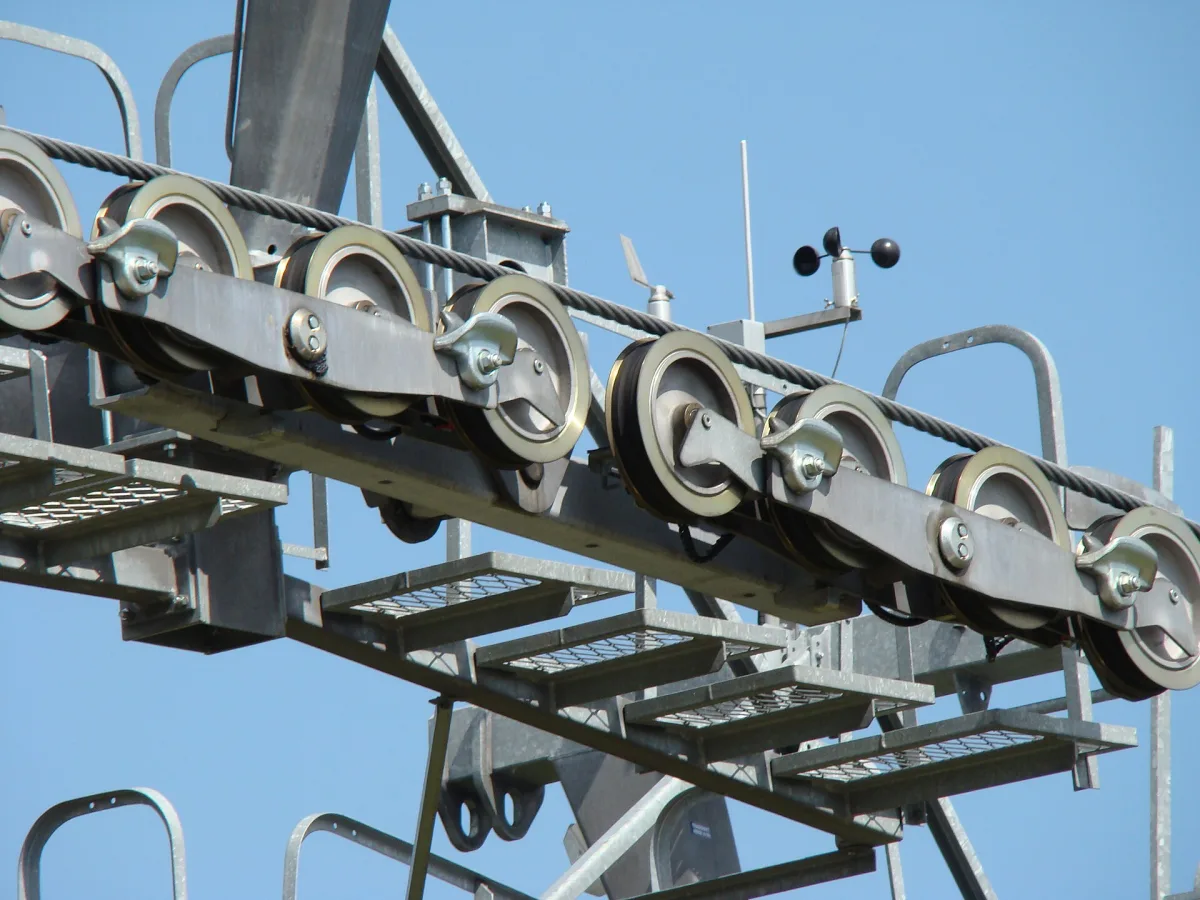
Czantoria is among the most visited peaks of the Polish Beskids, mainly thanks to the chairlift from Ustroń Polana, the first version of which started running in 1967, and the Czantoria resort. At the summit, on the Czech side of the border, stands a steel viewing tower with a platform at a height of 29 m. To the west of the summit stands a Czech mountain hut built in 1904 by the German association Beskidenverein. The northern slopes are protected by the Czantoria nature reserve, established in 1996, with an area of 97.71 ha.
Be the first! Add a comment.
You need to log in to add a comment.
Log in