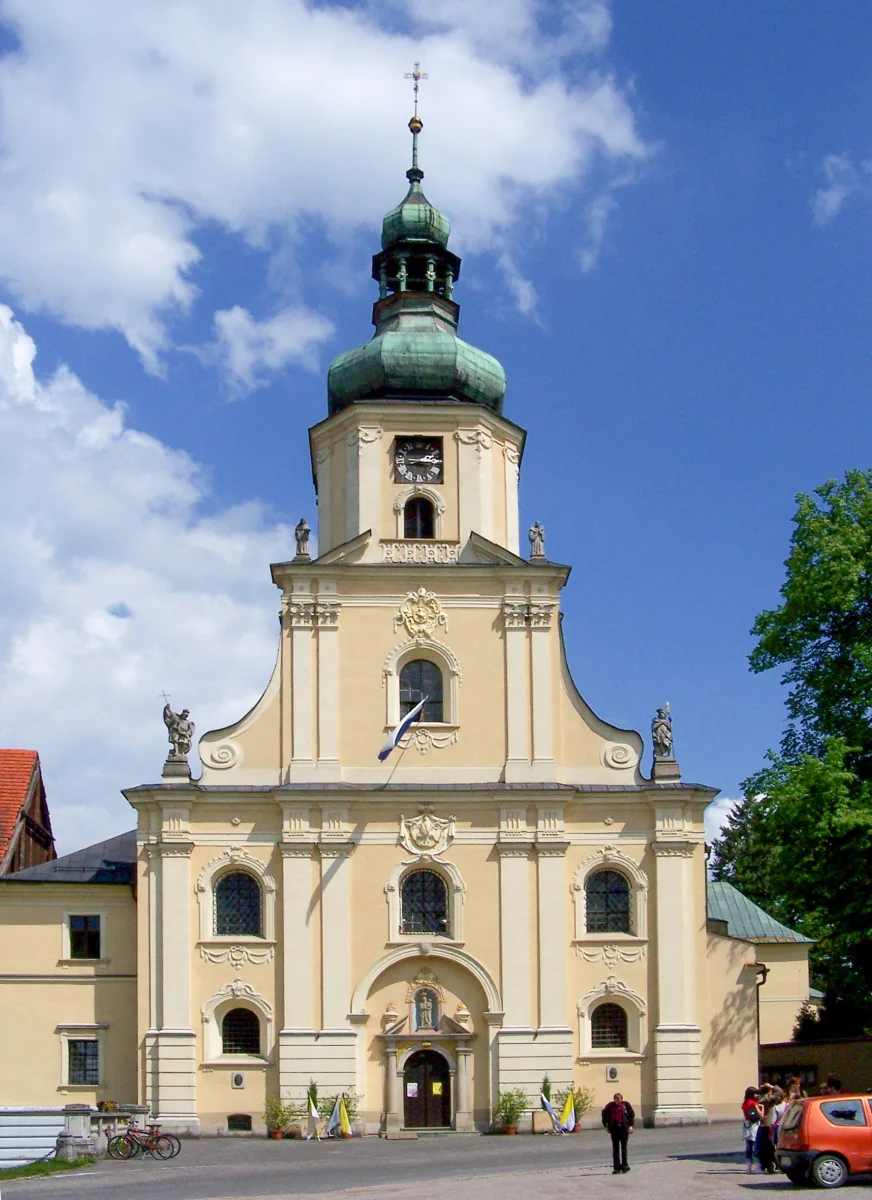
The Gothic basilica of the former Cistercian abbey in Rudy, with Baroque chapels and the diocesan shrine of Our Lady the Humble.
The basilica in Rudy is the former church of a Cistercian abbey, built of brick around 1300 and today serving as a parish church and the diocesan shrine of Our Lady the Humble. Since 2009 it has held the title of minor basilica. It lies in Rudy, in Kuźnia Raciborska municipality, in Racibórz County, and is part of the former Cistercian monastery and palace complex.
The Cistercians came to Rudy from Jędrzejów in 1258. They put up the first church, probably wooden, immediately after arriving. The present church began to be built after the whole convent had been brought over, around 1300. Its consecration is said to have taken place around 1303. The monks lived here until the suppression in 1810.
The church was rebuilt in the 17th and 18th centuries. In 1685 a porch with a portal was added, and in 1723-1726 the chapel of the Blessed Virgin Mary with a burial crypt of the Cistercians. After a fire in 1725 a Baroque façade was built over the porch, which concealed the medieval elevation.
It is a three-aisled basilica on a Latin cross plan with a transept and a rectangular chancel, built of brick with sandstone in the structural parts. The naves are covered with rib vaults. The layout of bays of equal length in the nave and aisles is linked with Romanesque architecture, while the other elements are Gothic.
The Baroque façade has two storeys and a partly hidden tower. On it stand figures of the Archangel Michael, St Florian, St Benedict and St Bernard. The sculptures on the façade and the stucco figures of Moses, Aaron, John the Baptist and John the Evangelist by the side altars were made by Jan Melchior Österreich in 1725.
The Baroque chapel of Our Lady on the south side has four niches with statues of archangels, the work of Jan Schubert of Lipnik. By the chancel there are also the chapels of St John of Nepomuk, with 18th-century stuccoes, and of the Holy Cross, with a polychrome from 1775. In the porch, beneath which lies the crypt of the dukes of Racibórz of the Hohenlohe-Schillingsfürst family, stands a cast-iron sarcophagus of Duke Victor and his wife.
The centre of devotion is an image of Our Lady from the mid-15th century, painted in tempera on a lime-wood panel measuring 114 by 73.5 cm. It is probably a copy of an older image. The Cistercians brought the image from Jędrzejów, and it was donated by the dukes of Racibórz, Casimir and Vladislaus. The parish website indicates that it was modelled on the Roman image Salus Populi Romani.
Rudy was a place of pilgrimage from all over Silesia, Lesser Poland and Bohemia, which peaked in the first half of the 18th century. The image was crowned in 2000, and in 1995 the church was made a diocesan shrine. The basilica holds relics of St Valentine and relics of the wood of the Holy Cross.
In 1945 the Red Army set fire to the abbey and the church burned down, although the chapel with the image survived. Rebuilding began in 1947 and was carried out in stages until 2000. The plaster was then removed, revealing the brick Wendish bond of the interior, and the vaults and windows were rebuilt. The first Mass after the war was celebrated in 1950 in the chapel of the Blessed Virgin Mary.
In the area you will find the monastery and palace park.
Rudy also has a historic narrow-gauge railway station.
Rudy also lies in the area of the Cistercian Landscape Compositions of Rudy Wielkie Landscape Park.


Be the first! Add a comment.
You need to log in to add a comment.
Log in