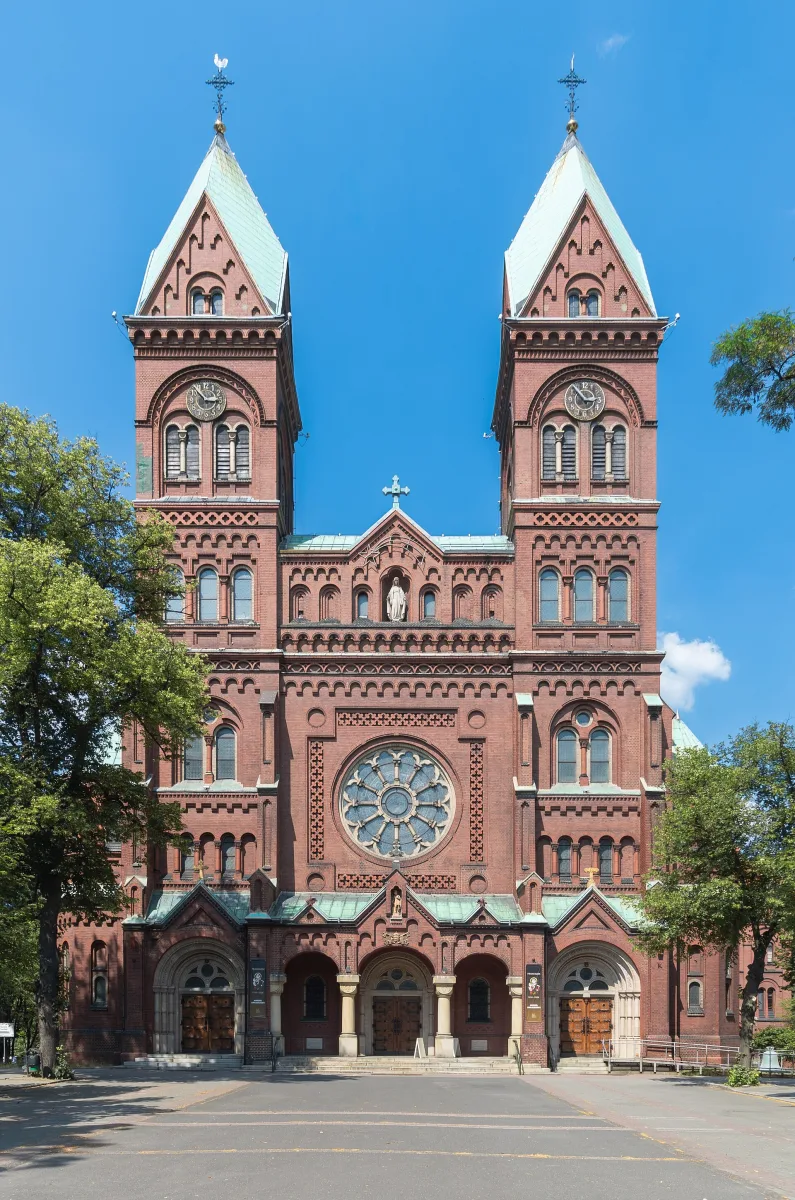
A Neo-Romanesque Franciscan monastery church from 1905-1908 in Katowice-Panewniki, a minor basilica since 1974, with a Calvary and an annual nativity scene.
The Panewniki Basilica is a Neo-Romanesque Franciscan monastery church, built of clinker brick in 1905-1908 in the Ligota-Panewniki district of Katowice. It is entered in the heritage register, serves as a parish church, and since 1974 has held the title of minor basilica. The church is 76 metres long, with a facade 28 metres high and two towers of 48 metres each.
The decision to settle the friars permanently was made for pastoral reasons. From the 19th century the Franciscans from Góra Świętej Anny reached the eastern edges of Upper Silesia, and the number of inhabitants of Panewniki and Ligota was growing quickly. The nearest parish church stood in Mikołów, seven kilometres as the crow flies. An area by the Kłodnica of about 8 hectares was bought for the building of a monastery, and the friars settled here in 1902.
The Prussian authorities delayed granting permission to build a church and monastery, because they feared that the Franciscans would work for the Polish cause in Silesia. The friars therefore began with a grotto of Our Lady of Lourdes, which the regulations allowed. Work started in March 1905, and the grotto was consecrated in August of the same year in the presence of nearly 30 thousand pilgrims. The structure was made of 188 thousand bricks and faced with trachyte tuff brought from the Eifel mountains on the Rhine.
When the resistance eased, construction of the church and monastery began to a design by Brother Mansuetus Fromm. The foundation stone was laid on 1 July 1906, and the works were directed by Franciszek Neumann of Bytom. About two hundred workers were employed, among them many volunteers from the area. The church was consecrated on 19 July 1908 by Cardinal Georg Kopp. According to accounts, the ceremony gathered 80 thousand of the faithful, and more than 50 special trains ran to the station in Ligota.
The outer walls of bare clinker brick are decorated with arcade friezes and cornices made of ceramic shaped bricks. In the lower part of the facade stands a three-part portico on sandstone columns, and in the central niche of the arcade a figure of St Florian. Above the portico is a stained-glass rose window 7 metres in diameter, and the gable is crowned with a figure of the Mother of God. The dome is covered with Moselle slate, and on its top stands a figure of St Francis weighing one and a half tonnes. The roofs of the basilica are covered with copper sheet.
The interior consists of three naves, a transept and a two-part chancel under a rib vault. The central nave is 17.5 metres high. In the gallery of blind arcades hang paintings by Norbert Paprotny from 1963 with scenes from the life of St Francis of Assisi. The stained glass was made by the Forst workshop in Münster in Westphalia, and the altars were worked on by, among others, the sculptor Georg Schreiner of Regensburg and Bruno Tschötschel of Wrocław. In the left side aisle stands the altar of St Barbara with a sculpture of her rescuing miners, made in Bavaria in 1920.
Beneath the upper chancel is a crypt with the chapel of St Joseph, 18 metres long. In the towers hang five bells, the largest weighing over two tonnes.
The basilica is known for its nativity scene (szopka), which is built in it every year before Christmas, according to various accounts since 1908 or 1913. It is described as the largest altar nativity scene in Europe, and in the festive season the church becomes a pilgrimage centre. Adjoining the monastery is a Calvary, a place of devotion to the Passion of Christ, whose history begins with the Lourdes grotto of 1905.
The nearest, about a kilometre from the basilica, is Zadole Park.
It is about five kilometres from here to the town centre. There stands the second great church of Katowice, the Cathedral of Christ the King.

Be the first! Add a comment.
You need to log in to add a comment.
Log in