
A modernist residence of the Presidents of Poland from 1929-1930 on the slope of Zadni Groń in Wisła, visited in guided groups by prior booking.
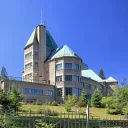
The Castle of the President of the Republic of Poland in Wisła, called Zameczek (the Little Castle), is a modernist palace from 1929-1930 on the slope of Zadni Groń in the Silesian Beskids. It was built for President Ignacy Mościcki, and today it is a residence of the Presidents of Poland, partly open to visitors.
In 1906 Archduke Frederick Habsburg of Cieszyn had a larch hunting lodge built on the slope of Zadni Groń, completed in 1907. After 1918 the building was taken over by the state. The Silesian Voivodeship Sejm decided to renovate it as a presidential residence, but in the night of 23-24 December 1927 the freshly renovated building burned down completely for unexplained reasons. Only a wooden chapel from 1909 survived.
The new residence was funded as a gift of the Silesian Voivodeship to the head of state. The main initiator was Voivode Michał Grażyński, and the design was made free of charge by Professor Adolf Szyszko-Bohusz in cooperation with Andrzej Pronaszko and Włodzimierz Padlewski. President Mościcki came to the castle for the first time on 21 January 1931.
The residence proper, the Upper Castle, stands on the contour line linking Zadni Groń with Barania Góra, and its arched shape follows the course of that contour. The form refers to a medieval castle and is regarded today as a classic example of constructivism and functionalism of the late 1920s. The original flat roofs proved impractical in the mountain climate, so in 1938 steep, copper-covered roofs were added. On the site of the Habsburg lodge the Lower Castle was built for the president's retinue. The slope descends towards Czerniański Lake. The complex is entered in the heritage register (number A/705/94, decision of 7 June 1994).
During the occupation the castle was at the disposal of the SS. After the war it was quickly restored and placed at the president's disposal, and after the abolition of that office it served as a holiday centre of the Office of the Council of Ministers. In those years it was classified and vanished from maps. In 1981 it became a holiday home of a mine, and in 2002 it returned to the Chancellery of the President of Poland. Renovation lasted in 2003-2005.
The route includes the Pronaszko Salon, the former veranda with a view of the Barania Góra range. It holds a preserved set of furniture made of bent chromed tubes, which the residence's website calls unique in Poland, and the chandeliers were designed by Stanisław Bartłomiejczyk. Further on are an Art Deco dining room with a table for 16 people, a lounge with a smoking room and a small hunting room with a display of weapons. On the second floor the study of the president of the Second Republic and the bathing salon have been recreated. The visit also includes the Chapel of St Hedwig.

Be the first! Add a comment.
You need to log in to add a comment.
Log in