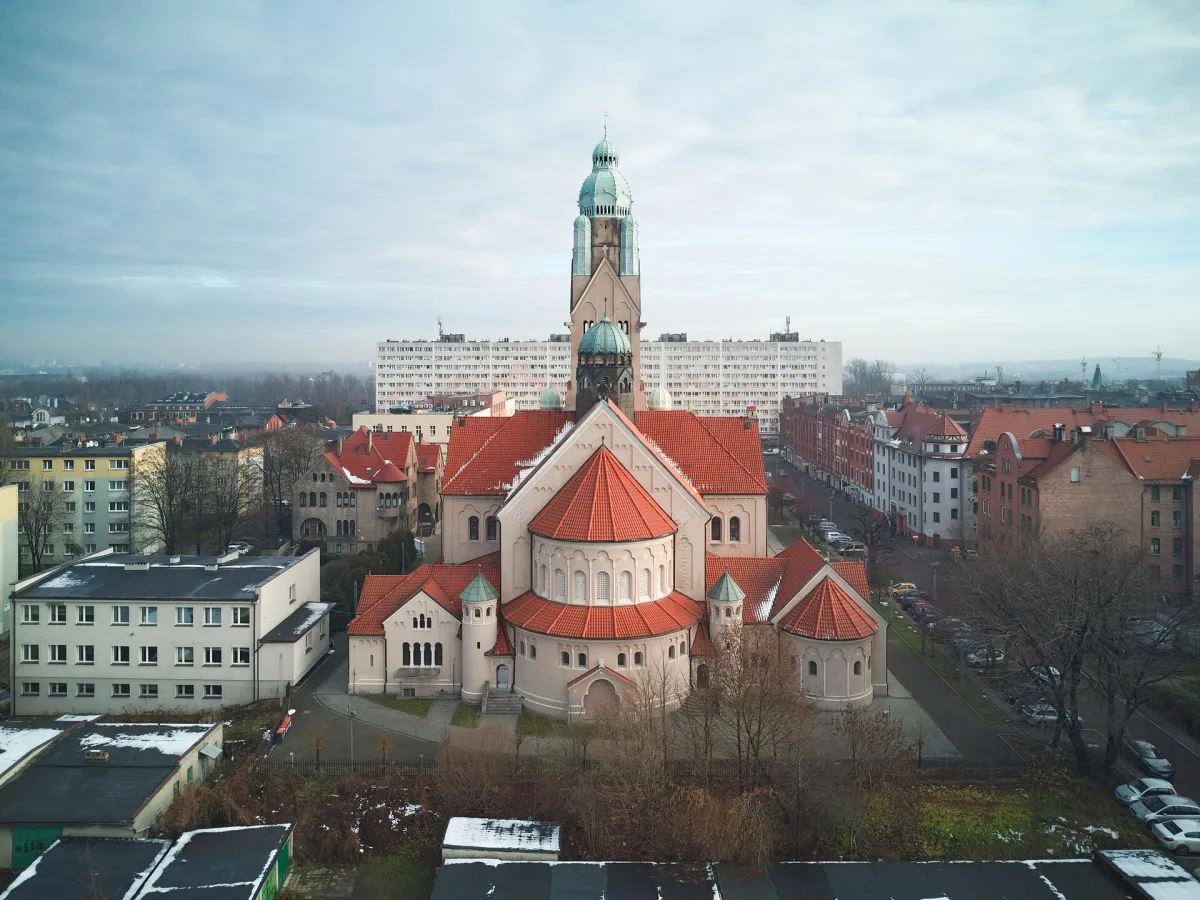
Neo-Romanesque basilica from 1911-1912 designed by Johannes Franziskus Klomp, with rich sculptural decoration.
The Church of St Paul the Apostle closes off the west side of plac Jana Pawła II in Nowy Bytom, a district of Ruda Śląska. It is a Neo-Romanesque basilica, the work of the architect Johannes Franziskus Klomp of Dortmund, regarded as a valuable example of sacred architecture of this style in Upper Silesia. The building is listed in the heritage register.
The Nowy Bytom parish has roots in the 15th century, but the present church dates from the early 20th century. The former Church of St Joseph on the Otylia estate was too small for the rapidly growing industrial town, centred on the Pokój ironworks and mine. Klomp's design was made in 1909, the foundation stone was blessed in 1911, and the consecration took place as early as 15 September 1912. The architect also designed the neighbouring rectory building. The church was originally to bear the same dedication as Klomp's main work in Rheine, but the director of the Pokój ironworks decided on St Paul as patron.
The church is a three-aisled basilica with a transept and a semicircular apse. On the east rises a tower mass with a porch of three arcades, and the façade is flanked by two round towers with domes. The main tower is square in plan at the bottom and octagonal higher up, with eight turrets and a domed spire with a lantern. The Neo-Romanesque style was enriched with elements of Early Christian, Byzantine and Ottonian art, and the architect drew on churches of the Rhineland, Westphalia and Saxony.
The exterior sculptural decoration is rich. In front of the entrance stand figures of St Florian, patron saint of steelworkers, and St Barbara, patron saint of miners. The columns of the porch carry carved lions, and in the gable of the façade appear Christ in a mandorla with the symbols of the four Evangelists and a Crucifixion group. Inside, part of the original decoration, especially in the chancel, was changed in the renovation of 1982.


Be the first! Add a comment.
You need to log in to add a comment.
Log in