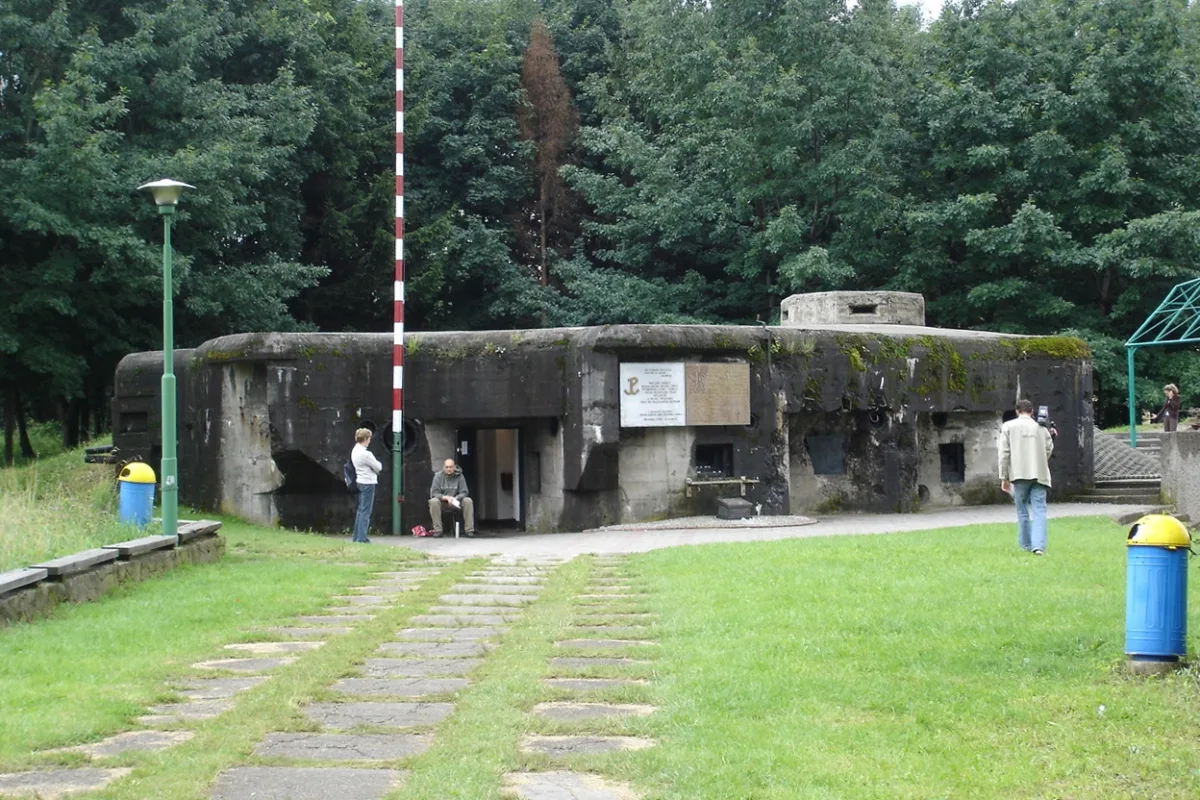
A concrete combat bunker from 1939 in Węgierska Górka, today a heritage site and a museum of the border defence.
The “Wędrowiec” bunker is one of four heavy combat bunkers in Węgierska Górka that defended Poland's southern border in September 1939. Today it is a monument in the heritage register and a place of remembrance of the defence of this line.
The bunker was built of concrete in 1939 in the valley of the Żabnica river. It had a single storey and served at once as a command post and as shelter for infantry. Its equipment included a 37 mm Bofors wz. 38 anti-tank gun, three wz. 30 heavy machine guns and a wz. 28 light machine gun, as well as flare launchers, a grenade chute and an optical communication station.
The garrison was commanded by Captain Tadeusz Semik, deputy commander of the 151st “Węgierska Górka” Fortress Company. The bunker defended itself against attacks by the 7th Bavarian Infantry Division, together with the neighbouring “Włóczęga” bunker. It surrendered on 3 September 1939 at around 5 p.m., after the gun was damaged and the ammunition ran out. Sources give differing estimates of German losses, from 200 to 300 men, and after leaving the bunker the defenders were treated brutally. We describe the wider background of these battles in the article on September 1939 in Węgierska Górka.
In 1993 a museum of mementoes connected with the defence was created in the bunker. The site was entered in the heritage register under number A/864/2021 in August 2021. The museum is open in the summer months.
Nearby is the Church of the Transfiguration, about 2 km from the bunker.

Be the first! Add a comment.
You need to log in to add a comment.
Log in