
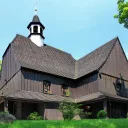
A wooden parish church from around 1670 in Jankowice Rybnickie, with shingled arcades and paintings of a local legend, a shrine of the Blessed Sacrament since 2002.
The Corpus Christi Church in Jankowice Rybnickie is a 17th-century wooden church that still serves as a parish church. It is entered in the heritage register, lies on the Rybnik loop of the Wooden Architecture Trail of the Silesian Voivodeship and since 2002 has been part of the Shrine of the Blessed Sacrament.
The church was built around 1670 on the site of a chapel destroyed during the Thirty Years' War. The builder and founder was Count Ferdinand Leopold von Oppersdorff. Other sources give the year 1674, and the heritage register dates the building only generally to the 18th century, so treat the exact year as an approximation.
The church has a log construction, two naves and a Greek cross plan, and measures 25 by 16 metres. It has no bell tower; on the gable roof, covered with shingles, stands only a small hexagonal turret with a small bell. A characteristic feature is the arcades, called “soboty”, also covered with shingles, which probably served pilgrims as shelter from the rain.
Inside stand three pseudo-Baroque altars: the main one with paintings of the Last Supper and the Ascension, and two side ones, dedicated to Our Lady of Mount Carmel and the Sacred Heart of Jesus. In 1869 the interior was painted by Teodor Gajda, and two of his paintings refer to the local legend of Father Walenty and the hiding of the Blessed Sacrament in a hollow tree.
An organ has been in the church since around 1700. Today it is pneumatic, with thirteen stops, two manuals and a pedalboard, and the case is decorated with busts of eight angels.
In 2002, by decree of the Metropolitan Archbishop of Katowice, the parish church and the forest shrine in Studzienka were established as the Shrine of the Blessed Sacrament. It is about 1.7 km from here to the Studzienka Shrine.

Be the first! Add a comment.
You need to log in to add a comment.
Log in