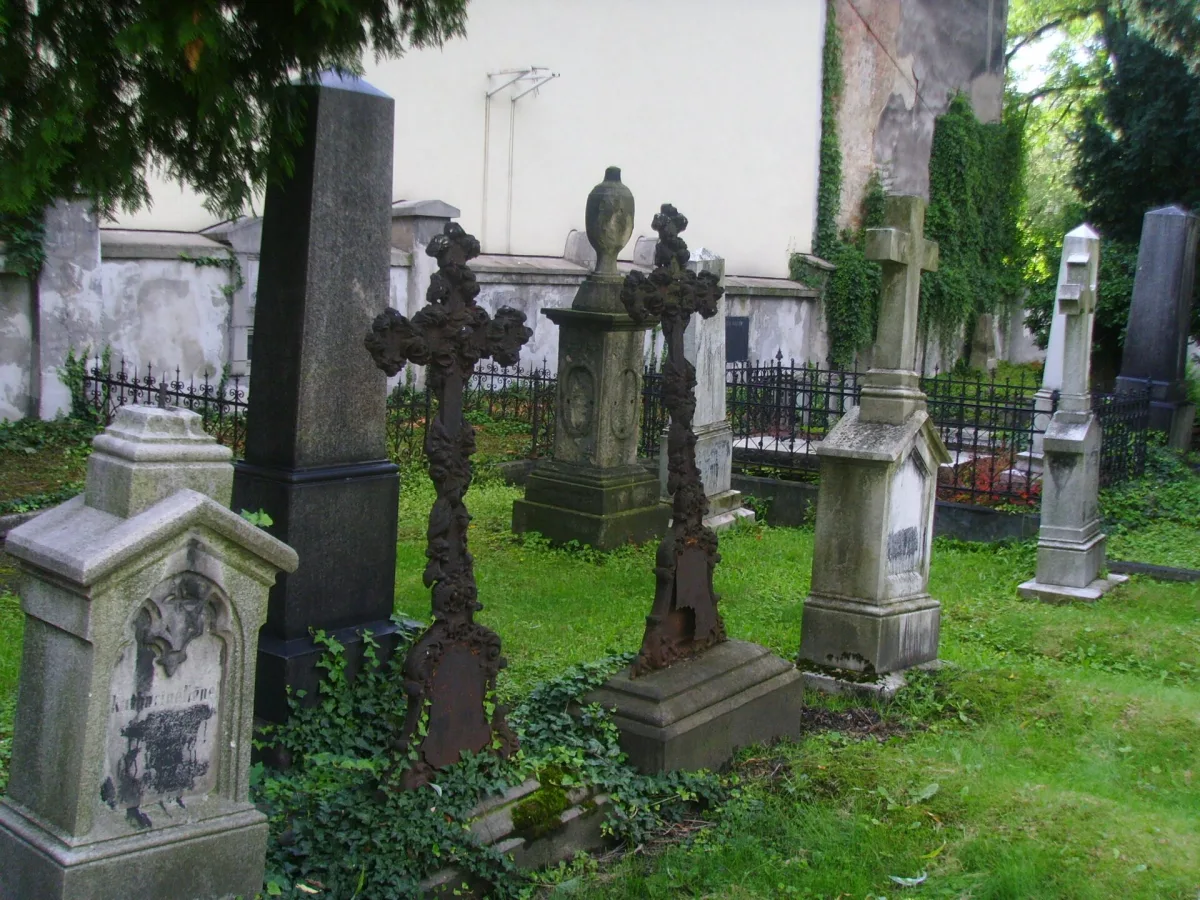
A working Evangelical cemetery from 1783 in the centre of Bielsko-Biała, with the graves of industrialists, mayors and the painter Peter Michal Bohúň.
The Evangelical cemetery on Piłsudskiego Street in Bielsko-Biała is one of the oldest necropolises in the town. It was consecrated on 26 June 1783 and is still used for burials today. It lies among the buildings of the centre, so from the street mostly a section of wall can be seen.
Earlier, Protestants and Catholics buried their dead in a common cemetery, which was located where, from 1782, the Evangelical church was built. The last burial at the old site took place on 15 June 1783. The first person buried in the new cemetery was a fifteen-day-old child, and its gravestone bears the inscription “First in the new cemetery”.
The parish enlarged the grounds twice: in 1838 it bought the neighbouring garden, and in 1867 it added a strip from the east. The necropolis then received its present shape, and a wall with two gates, a main one on the east and a side one on the west, was built around it. In 1945-1948 German inscriptions were removed from the gravestones: most inscriptions in that language were destroyed or painted over.
The cemetery has a shape close to a trapezium and is divided into five sectors, and an avenue lined with tall ash trees leads from the main gate. The oldest sector runs along the western wall. Buried here are industrialists of Bielsko and Biała, teachers, clergy and local government figures, among them the mayors of Biała Rudolf Seeliger and Rudolf Lukas, the painter Peter Michal Bohúň and Carl Schwabe, owner of a bell foundry. The whole is entered in the heritage register.
After a walk through the cemetery you can go on to the nearby Bolek and Lolek monument, about 200 metres away.

Be the first! Add a comment.
You need to log in to add a comment.
Log in