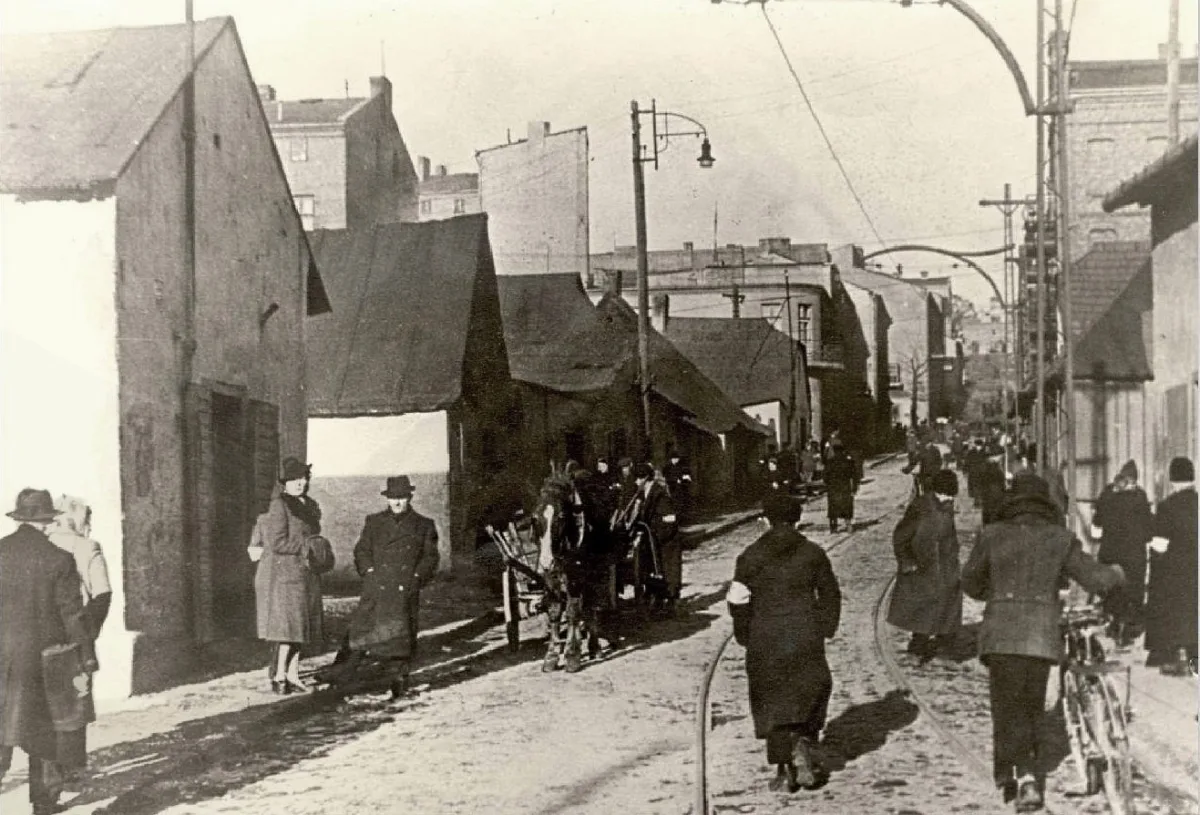
A Jewish ghetto created by the Germans in May 1942 in Będzin, with parts in Warpie and Kamionka, liquidated in August 1943.
The Będzin ghetto was a Jewish district in Będzin, which during the occupation bore the name Bendsburg. The Germans created it in May 1942 and resettled Jewish people here mainly from nearby areas of Eastern Upper Silesia. The final liquidation began on 1 August 1943.
The large ghetto was in the Warpie district. The Germans placed Jews from the Basin there, and also from Bohumín, Kielce, Oświęcim and Czechoslovakia. The small ghetto was in Kamionka. Supervision of the ghetto was exercised by Moshe Merin, chairman of the Central Office of Jewish Elders in Eastern Upper Silesia.
The ghetto was not surrounded by a wall, but in places barbed-wire barriers and warning signs prohibiting leaving it were put up. A checkpoint stood at ul. Modrzejowska 88, called Marktstrasse during the occupation.
The inhabitants were forced to work in factories and workshops. Work was done, among others, in Brauner's shed in Dąbrowa Górnicza, employing about 200-250 people, in Rossner's shed, in which about 8,000 people worked, in a workshop on ul. Małachowskiego with about 650 workers, and in factories making orthopaedic products and suitcases.
From 15 June 1942 a hospital operated in the ghetto, run by Dr Salomon Weinzieher, a physician and former member of the Sejm. At first it was at ul. Podzamcze 41, and in April 1943 it was moved to ul. Krakowska 60.
By mid-August 1942 about 2,400 people had been deported from the city to extermination camps. On 12 August 1942, under the pretext of stamping documents, Jews were gathered on the pitch of the Hakoah sports club, where a selection was carried out of people to be sent to labour camps and to extermination camps. In 1943 about 18,000 Jews still lived in Będzin.
A local unit of the Jewish Combat Organization operated in the ghetto. When the final liquidation of the ghettos in Będzin and in Środula in Sosnowiec began on 1 August 1943, the inhabitants took up self-defence, known as the Będzin-Sosnowiec ghetto uprising. Its organisers were Józef and Bolesław Kożuch, Zvi Brandes and Frumka Płotnicka. The inhabitants of the ghetto were deported to the Auschwitz-Birkenau camp. The last group, which was clearing the abandoned district, was deported in February 1944.
People connected with the ghetto include the diarists Rutka Laskier and Chajka Klinger, and Sam Pivnik, a survivor and author of memoirs.

Be the first! Add a comment.
You need to log in to add a comment.
Log in