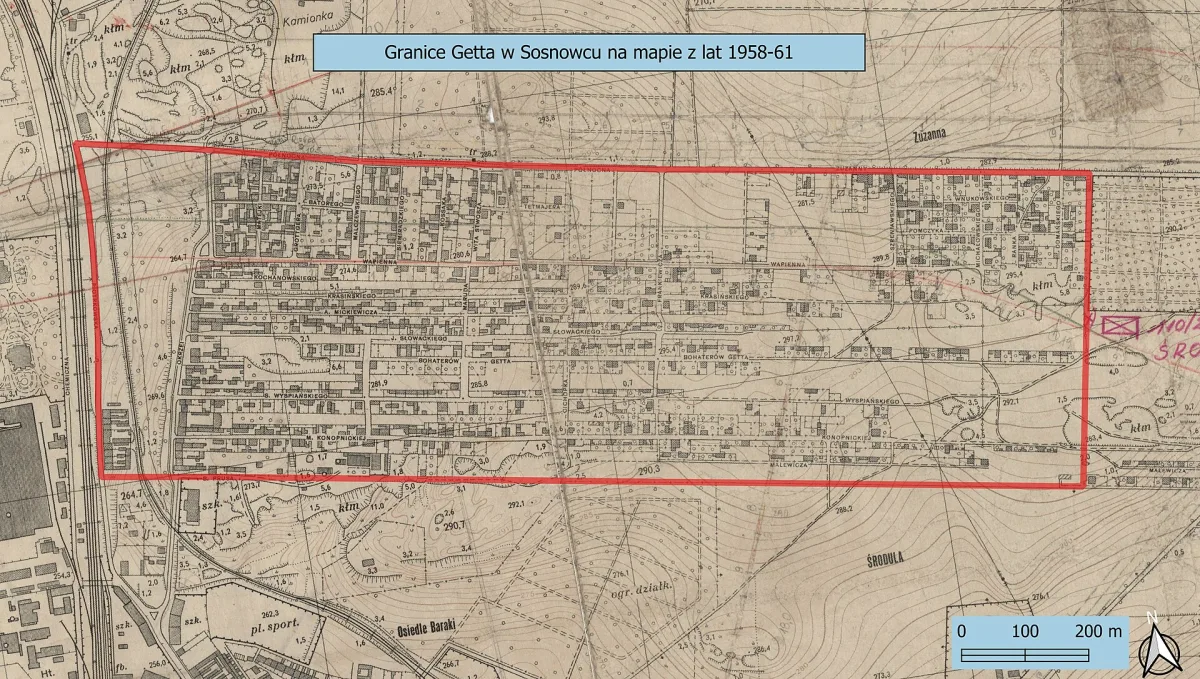
The Jewish ghetto in Środula in Sosnowiec, established in 1942-1943 and liquidated in August 1943; today commemorated by a monument and a plaque.
The Środula ghetto was the part of Sosnowiec to which the German occupation authorities resettled the Jewish inhabitants of the city and its surroundings. The main liquidation action took place in August 1943 and ended with deportations to the Auschwitz-Birkenau camp.
Before the war Jews made up a significant part of the population of Sosnowiec. Sources give about 30,000 people in 1939, that is about 20% of the city's inhabitants, while the Encyclopaedia of the Dąbrowa Basin gives about 28,000 people in 1938.
After the Germans occupied the city and incorporated it into the Reich, persecution began. The Great Synagogue in Sosnowiec was blown up on 9 September 1939. In the following months Jews from the surrounding areas were resettled here, which increased their number from 30,000 to 45,000. A Judenrat operated in the city, headed by Moshe Merin, who was also chairman of the Central Office of Jewish Elders in Eastern Upper Silesia.
In October 1942 the Gestapo decided to isolate Jews in ghettos in Środula, Stary Sosnowiec and Modrzejów. Środula was to be a concentration of young, healthy people able to work. Resettlements lasted from November 1942 to March 1943, and from May 1943 only the Środula ghetto existed in Sosnowiec, linked to the ghetto in Będzin.
The area of the ghetto was delimited by the streets: Zuzanny to the north, Bolesława Prusa to the south, Stefana Jędryczki to the east and Stefana Okrzei to the west. Leaving the ghetto was forbidden and, according to sources, punishable by death. The sources do not agree on fencing: according to some the area was not fenced, while the Encyclopaedia of the Basin says it was fenced with barbed wire. Housing conditions were catastrophic, with as many as 20 people in a single room. People who worked in factories outside the ghetto, called the Sheds, walked to work and back under escort.
The first transport of Sosnowiec Jews to Auschwitz-Birkenau left on 12 May 1942, with further ones in June and August. In May and June 1943 more than a thousand people were deported from Środula.
The main liquidation action lasted from 1 to 6 August 1943. The area was surrounded by a cordon of troops and police, and the inhabitants hid in bunkers and cellars. According to the Encyclopaedia of the Dąbrowa Basin, several hundred Jews were killed during the action, and more than 10,000 people were deported to Brzezinka. The last transports to the camp left in December 1943 and January 1944 and included groups left to clear the ghetto, and people caught in hiding.
A local unit of the Jewish Combat Organization operated in the ghetto. When the final liquidation of the ghettos in Będzin and Środula began on 1 August 1943, the inhabitants took up self-defence, known as the Będzin-Sosnowiec ghetto uprising. The Encyclopaedia of the Basin records that some inhabitants tried to resist with firearms.
The memory of the ghetto is recalled by a commemorative plaque on the square at ulica Ujejskiego and by a monument on plac Braci Kożuchów with an inscription dedicated to the Polish Jews murdered during the Second World War on the territory of the ghetto in Sosnowiec-Środula. Bolesław and Józef Kożuch were among the leaders of the uprising, and the square bears their name. The memory of the uprising is also recalled by the name of ulica Bohaterów Getta (Ghetto Heroes Street).

Be the first! Add a comment.
You need to log in to add a comment.
Log in