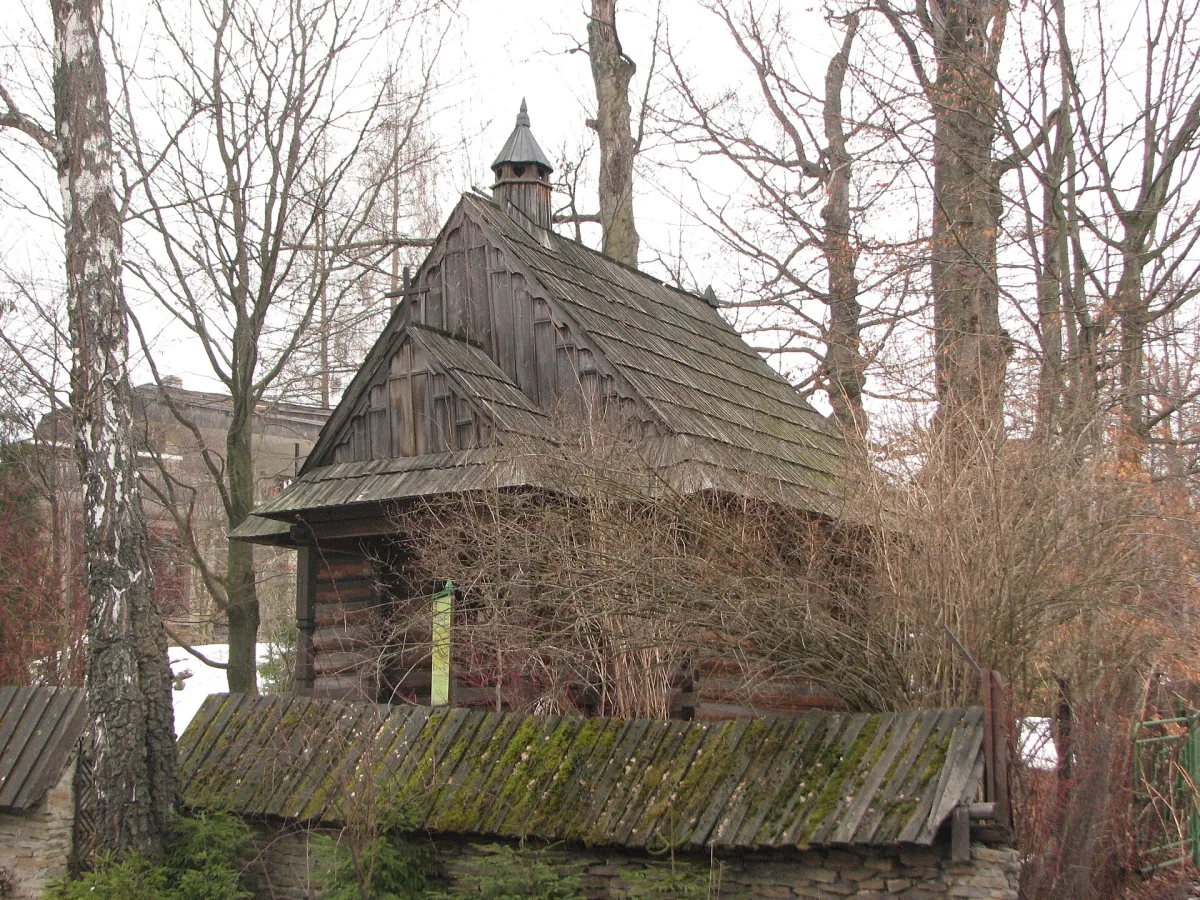
A wooden votive chapel of the Konarzewski family from 1923 in the hamlet of Bucznik in Istebna, with an altar carved by the founder.
The wooden votive chapel in Istebna, in the hamlet of Bucznik by provincial road no. 941, was built in 1923 as an offering of the Konarzewski family. It was designed and funded by Ludwik Konarzewski senior, grateful for his return from exile in the Urals during the First World War.
The chapel is an offering for a happy return from the Urals, where the family ended up during the First World War. Konarzewski settled in Istebna in 1922, and a year later the chapel was built. During the Second World War the remaining buildings were demolished on the order of the occupier, and only the chapel survived.
The building measures about 10 by 5 metres and was built in log construction. In front of the entrance is a porch, and the roof is covered with shingles. The form refers to the traditional architecture of the Silesian Beskids and to the Zakopane style. Inside stands a triptych altar carved by the founder himself. It depicts the Virgin and Child above the Piast Tower in Cieszyn and refers to the Young Poland style.
From the chapel it is close to the Zagroń Istebna Complex, and a little farther, in the centre of the village, is the Jerzy Kukuczka Memorial Room in Istebna.

Be the first! Add a comment.
You need to log in to add a comment.
Log in