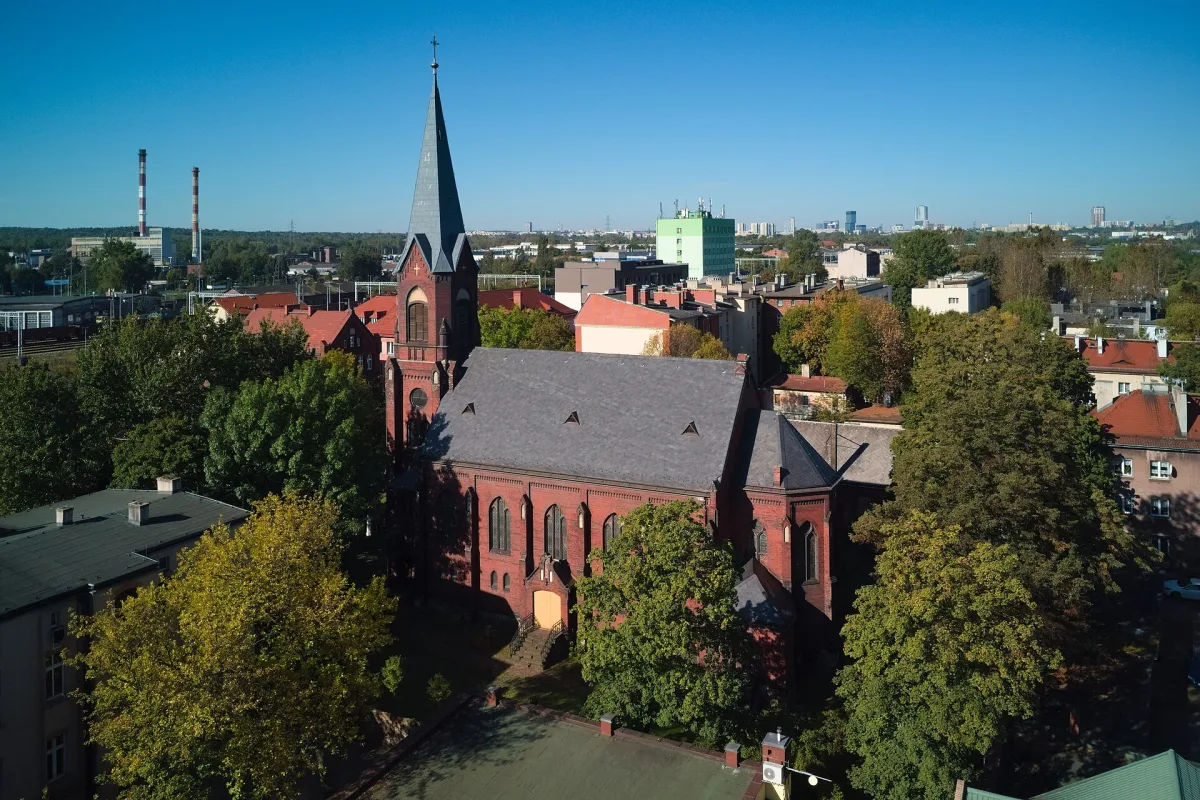
A Neo-Gothic Evangelical-Augsburg church of clinker brick from 1901 in Szopienice, entered in the heritage register.
The Church of the Saviour is the church of the Evangelical-Augsburg parish in Szopienice, a district of Katowice. It was built in 1899-1901 in the Neo-Gothic style from clinker brick. It was entered in the heritage register in 2002. It is one of two Evangelical-Augsburg churches in Katowice.
The development of the mining and steelmaking industry brought new residents to Roździeń and Szopienice, among them Protestants. The plot for the building was donated by Count Tiele-Winckler, owner of Katowice and numerous neighbouring estates, but after an expert opinion on the risk of mining damage it was exchanged in 1895 for a site less affected by extraction. At the beginning of 1898 the residents decided to build their own church. The church building committee was formed later that same year, headed by the steelworks official Ernst Prittwitz und Gaffron.
The first spade was driven in on 13 March 1899, and the foundation stone was blessed by General Superintendent Erdmann of Wrocław. The builder was the master mason Hermann Ritschel of Roździeń. The finished church was consecrated on 6 March 1901. In 1910, after an independent parish was established in Roździeń, the church ceased to be a branch of the parish in Mysłowice.
The church is built of clinker brick, unplastered, on a sandstone foundation. It has a rectangular plan with a five-sided chancel closed by an apse and a three-storey tower 42 metres high. A pointed-arch portal set between buttresses leads inside, and the walls are decorated with arcaded friezes and large windows with tracery, filled with stained glass. The roof is covered with slate.
The interior is a single-nave hall. The walls are painted white, the nave has no vault, so the roof structure is visible. The Neo-Gothic wooden altar from the end of the 19th century was donated by Empress Augusta Victoria, and behind it in the apse there is a stained-glass window with Christ the King. A carved pulpit with plant motifs, a font from 1907 depicting a kneeling angel and pews from the time of construction have survived. The organ of 18 stops was built by Heinrich Schlag of Świdnica and donated by Count Hubert von Thiele-Winckler.
In the vestibule hangs an epitaph with the names of parishioners killed in the First World War, with German inscriptions and a Polish explanation added in the 1990s. Three steel bells hang in the tower.
About 700 metres from the church is the Rolling Mill - Zinc Metallurgy Museum, which tells the industrial history of this part of Katowice.
Towards the centre, about 4 kilometres away, stands the Katowice History Museum.


Be the first! Add a comment.
You need to log in to add a comment.
Log in