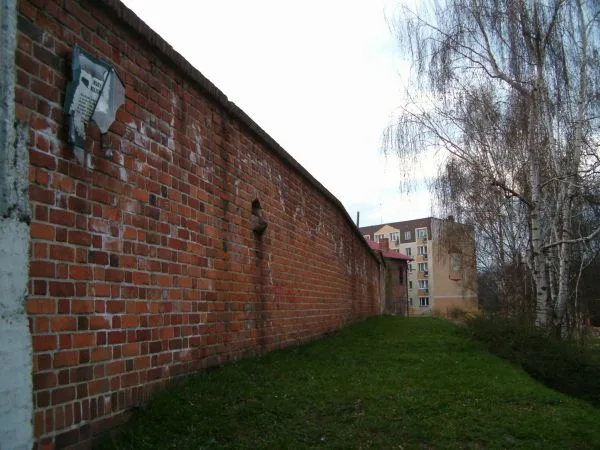
Surviving fragments of Racibórz's brick defensive walls from the 13th-17th centuries.
Only a few fragments of the Racibórz town walls have survived, but they make it possible to reconstruct the course of the fortifications that surrounded the Old Town. Brick sections can be seen, among others, on Basztowa, Drzymały, Batorego, Lecznicza and Drewniana streets.
According to tradition, the first fortifications took the form of a moat, wooden barriers and gates, and were built in the 13th century, when the town was taking shape. In 1255 the Moravians burned Racibórz, and during the rebuilding Duke Władysław of Opole extended the town to the south. The first documented mention of the walls dates from 1299, when Duke Przemysł of Racibórz commissioned the reeve to build and finance them. In the 14th century the walls were extended and surrounded by a moat, in 1666 they were modernised because of the threat of a Tatar invasion, and in the 17th century they were reinforced with nine towers.
The walls were about 1.3-1.6 m thick, 1.9-2.2 m high on the town side and 3.8-4.7 m on the outside, in places about 9 m. They were built of brick on lime mortar, with a filling of rubble or fieldstones. The moat was about 3.7 m deep, and ramparts were piled up behind it. The whole circuit measured about 1.8 km and enclosed an area of about 20 hectares. One of the nine towers has survived to this day, known as the prison tower.
At the turn of the 18th and 19th centuries the walls were gradually pulled down. In 1818 the Great Gate was removed, and in 1828 the Oder Gate, which was in danger of collapse, was demolished. Most of the moat was filled in after the Third Silesian War (1763), and its remnants were still filled with water in the 1830s. Not far away stands Racibórz Castle.

Be the first! Add a comment.
You need to log in to add a comment.
Log in