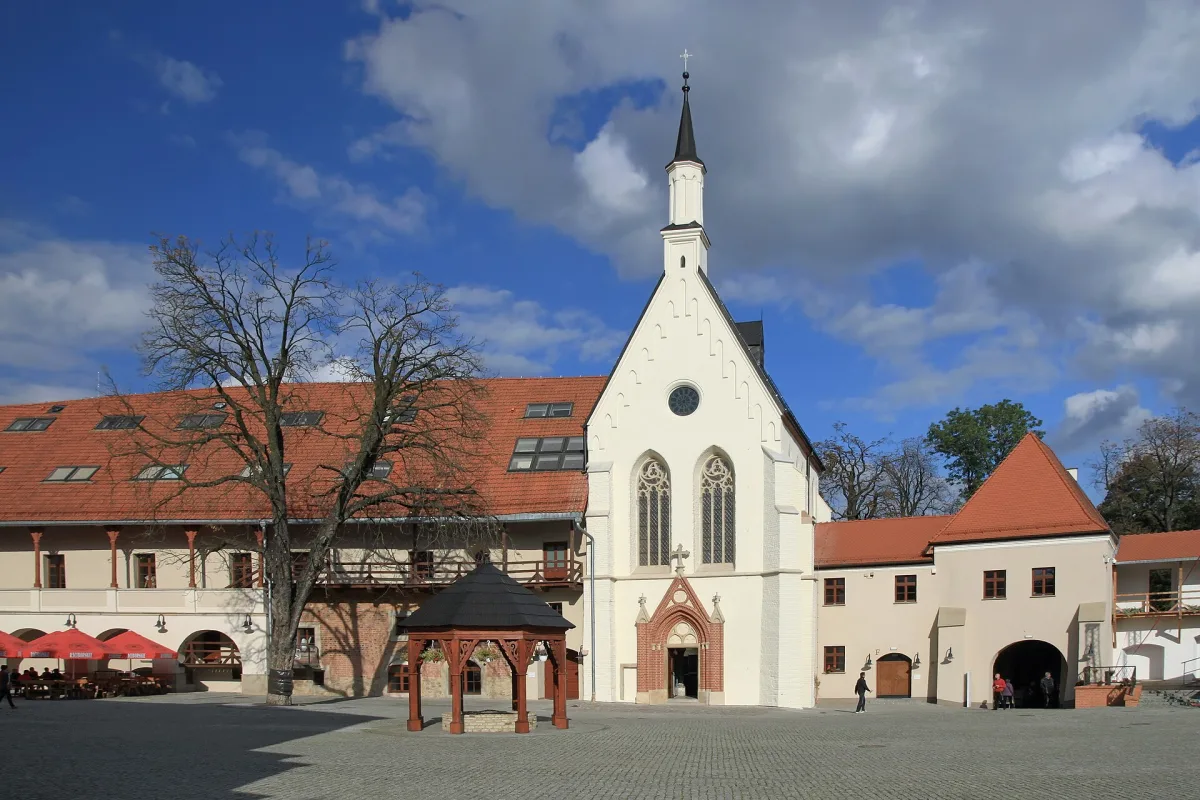
A brick castle on the Ostróg in Racibórz with a Gothic chapel of St Thomas, museum exhibitions, a tower with a dungeon and a castle brewery.
Racibórz Castle (Zamek Piastowski) stands on the Ostróg, a former island in a bend of the Oder, where for centuries a stronghold guarded the borderland. The brick buildings, with the Gothic castle chapel, a house known as the ducal palace and a gatehouse, form a complex entered in the heritage register. Today it houses a museum with exhibitions, a dungeon in the tower, the castle brewery and a tourist information point, and in the courtyard traces of several epochs can be seen at once.
The Racibórz stronghold is known from the chronicle of Gallus Anonymus, which mentions it under the year 1108 as a border castellan's fortress.
The site was not chosen by chance: a natural bend of the Oder was cut across by a branch of the river, creating an island, and access was provided by a causeway, along which Zamkowa Street runs today. From 1172 the castle was a ducal seat, and in the time of Mieszko Tanglefoot, at the end of the 12th century and the beginning of the 13th, a mint operated here. When an independent Duchy of Racibórz was created in 1281, Duke Przemysław began a reconstruction: the timber-and-earth ramparts were replaced with walls, and in place of the former wooden buildings a compact brick complex arose, with a residential house of palatial character. Archaeologists have confirmed as many as seven cultural layers, and the undisturbed ground lies about five metres below today's courtyard.
The chapel dedicated to St Thomas of Canterbury, that is Becket, was built in 1288-1293 and since the mid-19th century has been called the pearl of Silesian Gothic and the Silesian Sainte-Chapelle.
It was built of brick in Wendish bond, on a rectangular plan measuring 8.5 by 13 metres, on the foundations of an earlier church. It was the first free-standing sacred building on Silesian lands built on a rectangular plan. After the fire of 1858 the chapel regained its Gothic front facade and a painting of St Thomas Becket. The former furnishings, including a painting by Jan Bochenek and the figures of the apostles from the sedilia, are today kept by the Racibórz museum.
The castle burned many times and changed owners, which is still visible in its form.
The fire of 1637 was repaired by Italian masters, who gave the north-eastern wing an arcaded cloister and the gate tower a Baroque appearance. The first mention of a brewery by the castle dates from 1532. The fire of 19 January 1858 destroyed the wing parallel to the Oder; in its place a new brewery was built, which still forms the northern wing of the complex. From the 1830s until 1945 the castle belonged to the princes of Hohenlohe-Schillingsfürst, who resided in nearby Rudy, and officials lived in it. After 1945 the building passed to the State Treasury, from the 1950s it gradually fell into ruin, and since the 1990s it has been restored.
The castle's website lists permanent exhibitions, temporary exhibitions, a tower with a dungeon, the castle brewery with a pub, a botanical garden and a playground.
Among the permanent exhibitions it lists, among others, displays on medieval instruments of torture, the study of Duke von Ratibor, the story of the castle's history in the Middle Ages, and the chambers of the alchemist and the witch. On the mezzanine next to the north wall of the chapel one of the oldest graffiti in Poland has survived: the 17th-century inscriptions were probably left by soldiers stationed here during the Thirty Years' War. During the renovation a tunnel was also discovered under the gatehouse, probably a fragment of a former channel carrying away water or sewage. Visitors are offered audio guides and a mobile app, and it is possible to stay overnight on the castle grounds.
Around the castle there are several places that are easy to combine into one outing.
Closest, about 1.2 km away, lies the Roth Town Park in Racibórz.
About 300 m from the castle stands the Oder Gate (Brama Odrzańska) in Racibórz.
Lovers of greenery can go to the Moravian Gate Arboretum, about 3 km from the castle.
Further on, to the Łężczok nature reserve, about 5.7 km from the castle.

Be the first! Add a comment.
You need to log in to add a comment.
Log in