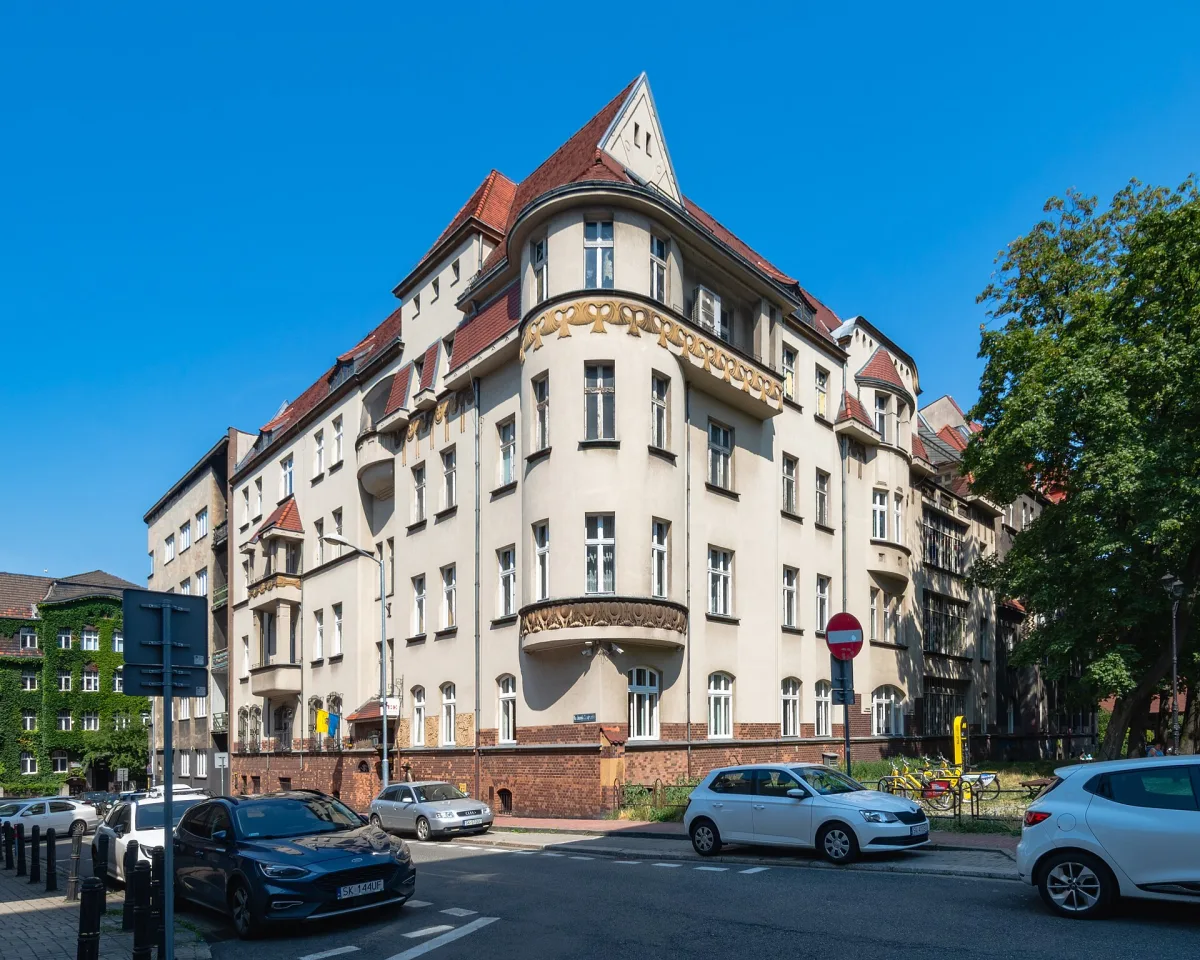
A municipal museum in a 1910 townhouse in Katowice, with an exhibition on the history of the city and branches in Nikiszowiec, in Śródmieście and in a wooden church in the park.
The Katowice History Museum (Muzeum Historii Katowic) is a municipal cultural institution that documents the past of the city and shows it in the main building at ulica księdza Józefa Szafranka 9 and in three branches. The main seat is a burgher townhouse from 1910. The collections include, among other things, 26 portraits of the Asymmetrical Lady by Stanisław Ignacy Witkiewicz, photographic collections of Józef Dańda and Anna Chojnacka, prints by Paweł Steller, and porcelain from the “Giesche” and “Franciszek” works.
Its beginnings are linked with the Museum Section of the Katowice Social and Cultural Society. At the beginning of the 1970s residents, among them scouts, began to gather mementoes. A museum room was opened on 17 July 1972 in one of the rooms of the building at ulica Dworcowa 13a. The Social Museum of the History of Katowice began operating on 21 July 1976 with the exhibition “Katowice's Road to People's Poland”.
In 1979 the museum was given rooms in the townhouse at ulica Szafranka 9, and under a will it received portraits painted by Witkacy. From 1981 it operated as a branch of the Upper Silesian Museum in Bytom, and from 1983 as an independent institution. In 2007 a life-size figure of Witkacy was unveiled in front of the entrance, and in 2015 and 2018 further parts of the new permanent exhibition on the history of Katowice were opened.
The exhibition “From the History of Katowice” tells the history of the city against the background of the region, from the earliest times to the present, together with the history of the districts that were originally separate settlements. It has three levels of narrative, is interactive and is available in Polish and English. It is accompanied by about 500 exhibits, postcards, archive photographs and films. The second part of the exhibition describes the city from the granting of town rights in 1865.
Two further exhibitions show the life of burghers in the 1910 townhouse. In the first, covering 310 square metres, two model burgher flats from the turn of the 19th and 20th centuries have been recreated: a drawing room, a boudoir, a dining room, the master's study, children's rooms and a bedroom. The second, on the upper floor, presents a four-room flat of a middle-income family with a typical Upper Silesian kitchen, a tiled stove, a sideboard, a hand-cranked washing machine and a sewing machine.
The City Ethnology Department is based in the Nikiszowiec workers' housing estate, in the revitalised building of the former laundry and mangle at ulica Rymarska 4. The building was opened after renovation in 2011. The exhibitions tell about work in the laundry, show paintings and sketches of the Janów Group, that is amateur painters from the “Wieczorek” mine, associated since 1946, and a recreated interior of a Nikiszowiec miner's flat.
The Theatre and Film Department is located at ulica Kopernika 11 in Śródmieście, in the former flat of Barbara and Stanisław Ptak. The exhibition shows costumes and costume designs connected with Barbara Ptak's work with directors such as Andrzej Wajda and Kazimierz Kutz, and awards, including four Golden Masks.
The museum also looks after the wooden church of St Michael the Archangel in Tadeusz Kościuszko Park. It was brought from Syrynia, probably dates from 1510 and still serves a religious function. The original polychromes, a Gothic holy water stoup and a Baroque pulpit have survived. In the courtyard a lapidarium symbolising a cemetery was unveiled in 2009.
The museum lies in Śródmieście. About 600 metres from here stands the Stanisław Wyspiański Silesian Theatre.
About 800 metres from the museum is the Cathedral of Christ the King.
A kilometre further on is the Silesian Museum in Katowice.

Be the first! Add a comment.
You need to log in to add a comment.
Log in