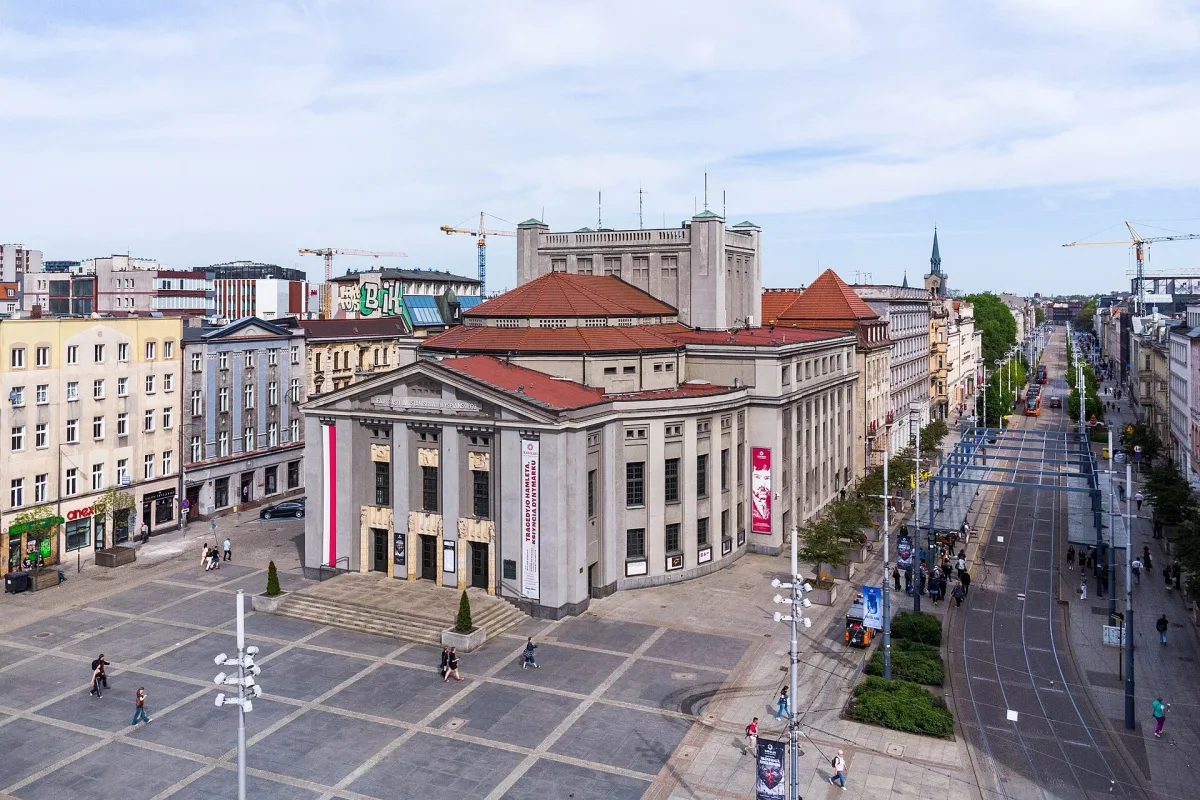
The largest drama stage in Upper Silesia, in a Neoclassical building of 1907 on the Katowice Market Square, entered in the heritage register.
The Stanisław Wyspiański Silesian Theatre is housed in a building at Rynek 10 in Katowice and is the largest drama stage in Upper Silesia. The building of 1907, entered in the heritage register, has three stages, and the theatre emphasises a repertoire in the Silesian ethnolect. About 400 m away stands the Monument to the Silesian Insurgents.
The building was designed by the government master builder Carl Moritz, and construction began in 1906 on the site of the first Katowice town hall.
The decision to build was taken in 1898, and the construction was financed by the state, the city and private donors. The Neoclassical building was completed in 1907 and then had 800 seats for the audience. The top of the façade was decorated with reliefs of scenes from "The Ring of the Nibelung", and the tympanum bore the German inscription "Deutschem Wort - deutscher Art". The theatre was inaugurated on 2 October 1907 with the premiere of Friedrich Schiller's "William Tell". In the interwar period the reliefs were removed, and in the early 1970s the sculptures standing in the niches were taken down. The building was entered in the heritage register on 30 December 1991. After renovation at the turn of the 20th and 21st centuries the sculptures returned to the niches.
Until 1922 the stage was the German Municipal Theatre, and then it became a Polish theatre.
After Katowice was incorporated into Poland, the city handed the building over on a free lease to the Society of Friends of the Polish Theatre. The drama stage of the Polish Theatre began operating on 7 October 1922 with the premiere of Lucjan Rydel's "Królewski jedynak" ("The King's Only Son"), and a day later the opera stage was opened, closed in 1932 for financial reasons. In 1936 the theatre was renamed the Stanisław Wyspiański Theatre. In 1939-1945 it operated as a German theatre, and since 6 October 1945 it has borne its present name. In 1954-1956 the artistic director was Gustaw Holoubek, who invited, among others, Tadeusz Kantor to collaborate.
The theatre performs on the Main Stage, the Chamber Stage and in the Malarnia.
One of the main directions of its work is a repertoire in the Silesian ethnolect. Stanisław Ligoń's "Wesele na Górnym Śląsku" ("Wedding in Upper Silesia") had its premiere here in 1928, and later productions include, among others, Kazimierz Kutz's "Piąta strona świata" ("The Fifth Side of the World") and an adaptation of Małgorzata Szejnert's "Czarny ogród" ("Black Garden"). The theatre also organises festivals, including "Open The Door", co-organises the "Interpretacje" festival, runs the Foyer gallery of contemporary art, and in summer turns the square in front of the building into a venue for the dance evenings "Roztańczony Wyspiański". It regularly presents performances with English surtitles, Polish Sign Language interpretation and audio description.
The theatre lies in the heart of Katowice, about 600 m from the seat of the NOSPR and about 0.9 km from the Silesian Museum.

Be the first! Add a comment.
You need to log in to add a comment.
Log in