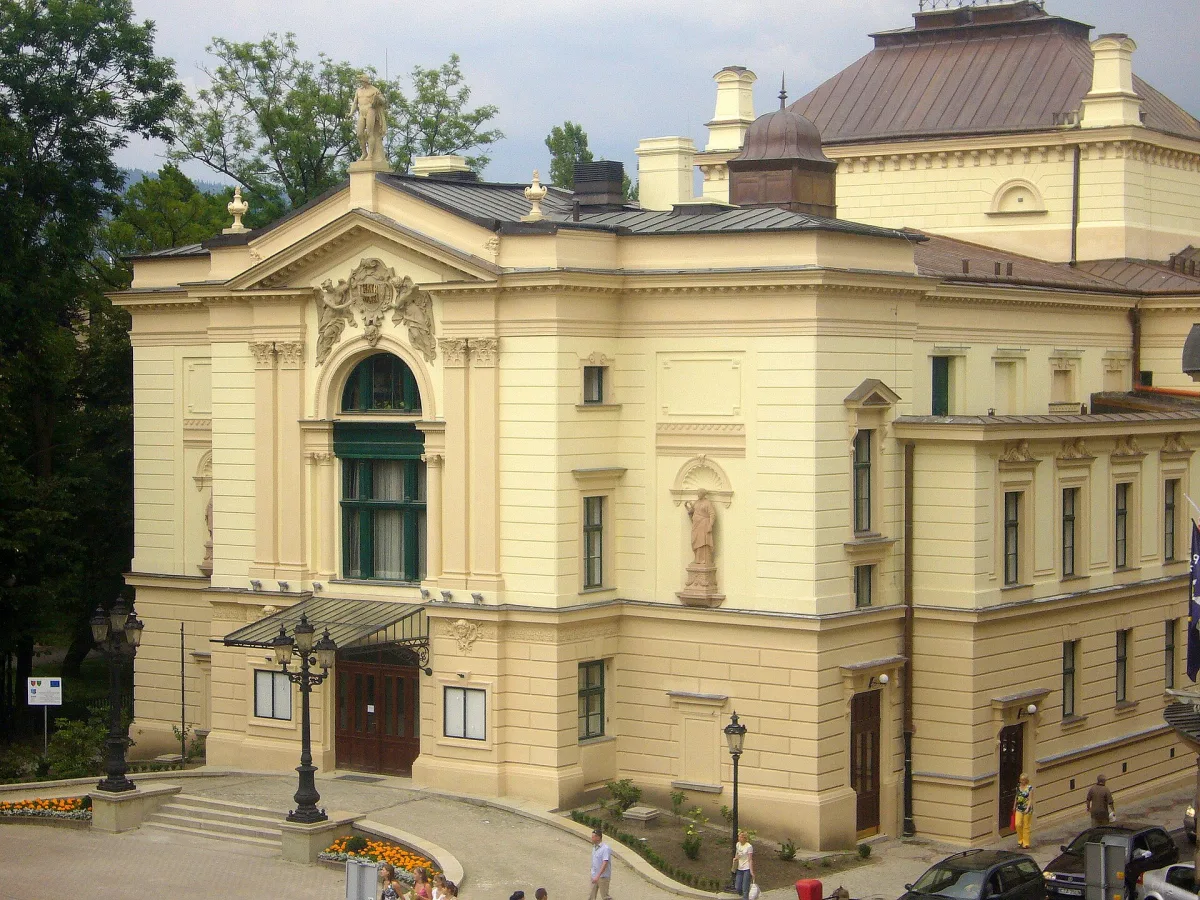
A historic theatre from 1888-1890 in the Dolne Przedmieście district of Bielsko-Biała, designed by the Viennese architect Emil von Förster, with a façade decorated with statues of Apollo and the Muses.
The Polish Theatre (Teatr Polski) stands on 1 Maja Street in the historic Dolne Przedmieście district of Bielsko-Biała, right next to the Sułkowski Dukes' Castle. It is a brick building from the late 19th century, entered in the heritage register, and for more than 130 years it has been home to the city's permanent stage.
The building was erected in 1888-1890 to a design by the Viennese architect Emil von Förster. The heritage register describes its style as eclectic, while other studies point to a predominance of neoclassicism and neo-Baroque. The façade is built on the motif of a Roman triumphal arch and is decorated with statues of Apollo and the Muses Melpomene and Thalia. According to Förster's intentions, the theatre was meant to resemble the Vienna Opera and the National Theatre in Budapest.
Inside, a curtain from 1890 has survived, showing “The Dance of the Nymphs” and made in the workshop of Franciszek Rottonara. In 1904-1905 the building was remodelled to a design by the Viennese firm Fellner & Helmer, known for designing many theatres in Central Europe. In front of the entrance stands a replica of a fountain from 1895, donated to the city by the builders of the Bielsko waterworks.
The first stage in the city operated from the end of the 18th century in the former castle brewery, on the initiative of Prince Franciszek Sułkowski. In 1887 a Theatre Building Committee was set up, and a year later a public fundraising campaign began. The building was opened on 30 September 1890 with Shakespeare's “A Midsummer Night's Dream”. Until 1921 only a professional German company performed here, and in the interwar period it was the only professional German stage in Poland.
In 1921 the Polish Theatre Society was founded, which in time gained access to the stage for several evenings a week, and in 1938 a permit to run a permanent theatre company. After the war, in June 1945, the stage was revived with “Krakowiaki and Highlanders” by Jan Nepomucen Kamiński. The theatre was nationalised in 1949, and for many years it also ran a stage in Cieszyn.
The façade was renovated in 2008: the sculptures were conserved, the roof covering was replaced and illumination was added. The building has a revolving stage and air conditioning, and a café has been set up in the basement. The repertoire includes classical and contemporary drama as well as musicals, among them “Zorba” and “Six Incarnations of Jan Piszczyk”, which won Golden Mask awards. Since 2013 the theatre has run the “Performances Without Barriers” series with audio description and sign language interpreting. Besides the Main Stage, the theatre also performs in the Music Salon at the Sułkowski Dukes' Castle.
A few minutes' walk from the theatre are St Nicholas Cathedral and the Władysław Reymont Literature Museum. A little further on stands the monument to Bolek and Lolek.

Be the first! Add a comment.
You need to log in to add a comment.
Log in