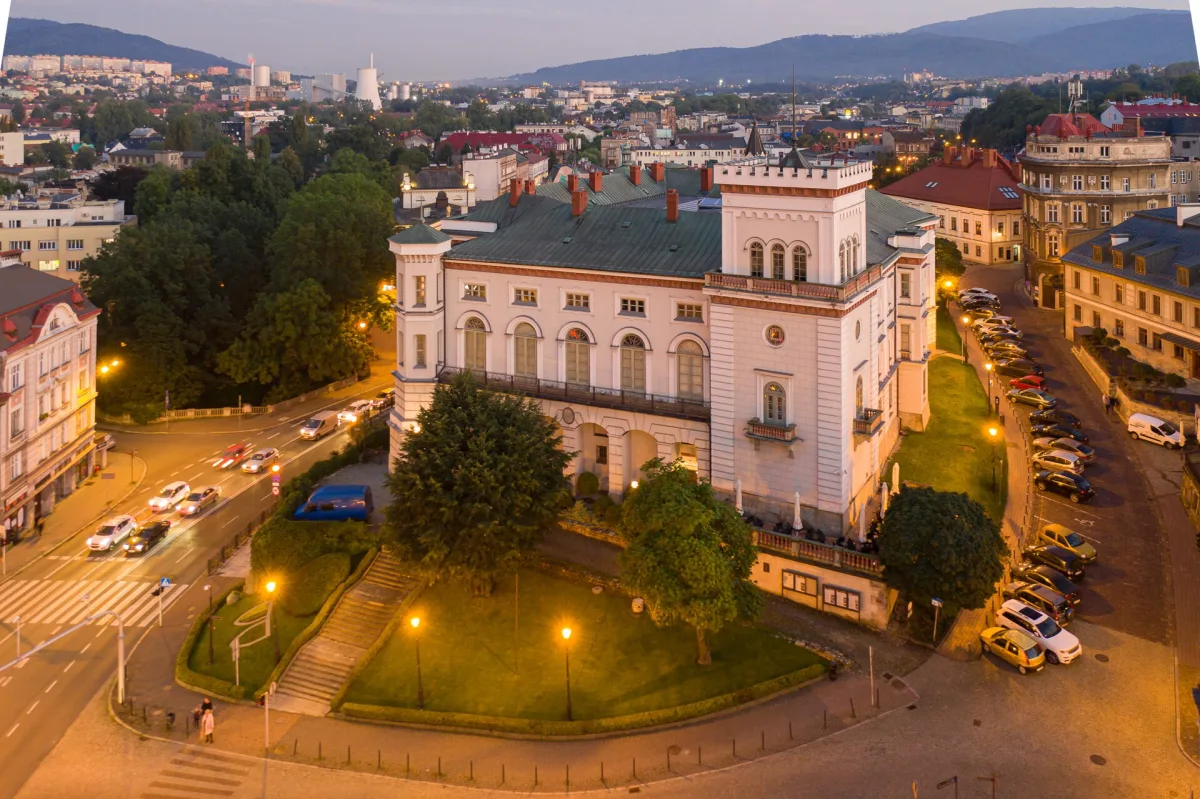
The oldest building in Bielsko-Biała, a 14th-century castle rebuilt in the 19th century, since 1945 the home of the Historical Museum with exhibitions on the city and art.
The Castle of the Sułkowski Princes is the oldest and largest historic building of historic Bielsko, situated in the eastern part of the Old Town. Since 1945 it has housed a museum, today the Historical Museum in Bielsko-Biała, which presents exhibitions here ranging from the archaeology of the city to the contemporary art of the region. The castle is entered in the heritage register.
The castle stands on the site of a wooden stronghold from the 13th century, which guarded a crossing of the Biała river. Archaeological research confirms that the stronghold controlled the crossing of routes: the salt route from Kraków to Cieszyn and Moravia, and the road from Upper Silesia through Żywiec to Hungary.
In the second half of the 14th century a masonry castle, built by Duke Przemysław I Noszak of Cieszyn, replaced the watchtower destroyed by fire. It was a town castle, incorporated from the start into the fortifications of Bielsko, and a Silesian border fortress. From 1316 the Biała river separated the duchies of Cieszyn and Oświęcim, in the 15th century it became the Czech-Polish border, and in the years 1526-1772 it separated the Habsburg monarchy from the Polish-Lithuanian Commonwealth.
From 1572 the castle was the centre of the independent Bielsko state country (państwo stanowe), ruled by successive noble families. In 1752 it passed into the hands of the Sułkowskis and was raised to the rank of a duchy. The castle was damaged by town fires in 1753, 1808 and 1836, and its present eclectic form was given by the rebuilding of the 1850s and 1860s, commissioned by Prince Ludwik. It was then that, among other things, the façade facing Bolesława Chrobrego Square was created.
The Sułkowskis resided in Bielsko until 1945. In 1973, during the rebuilding of the road layout of the centre, the group of buildings in the castle's outer ward was demolished, which exposed the castle from the east and the north. The façades were renovated in the years 2006-2008, the courtyard was covered with a glass roof in the years 2012-2014, and the Chapel of St Anne, the burial place of the Sułkowski family, was renovated in the years 2019-2021.
The permanent exhibition combines several threads: the history and archaeology of the region, early art, castle interiors and contemporary art. The archaeological section shows the earliest history of Bielsko-Biała, from Neolithic axes and Lusatian culture vessels to finds from the stronghold site in Stare Bielsko and the beginnings of the medieval town. The historical section presents guild documents from the 16th-18th centuries, royal privileges and maps of the Duchy of Cieszyn.
The exhibition of Polish and European art of the 14th-17th centuries includes medieval sculpture, panel painting and stained glass from 1564. The gallery of 19th- and 20th-century painting collects paintings by artists associated with Bielsko, and a separate room shows the contemporary art of the Podbeskidzie region. The print room displays engravings from the turn of the 19th and 20th centuries. The Music Salon is the most splendid interior of the castle, with a polychrome ceiling, mirrors in neo-Baroque frames and a table piano from 1856, while the Biedermeier Salon displays the work of Peter Michal Bohúň. In the Knight Room, also called the lapidarium, relics of the castle's architecture have been uncovered, including a Renaissance fragment of a painting of a knight in armour.
In the Ladies' Parlour and the Master's Study, mementoes of the Sułkowski family are displayed. The museum also runs an ethnographic exhibition on the multicultural population of the surrounding villages, with Cieszyn and Lachian women's costumes. On the ground floor is the Castle Gallery, which is a contemporary art gallery and museum café.

Be the first! Add a comment.
You need to log in to add a comment.
Log in