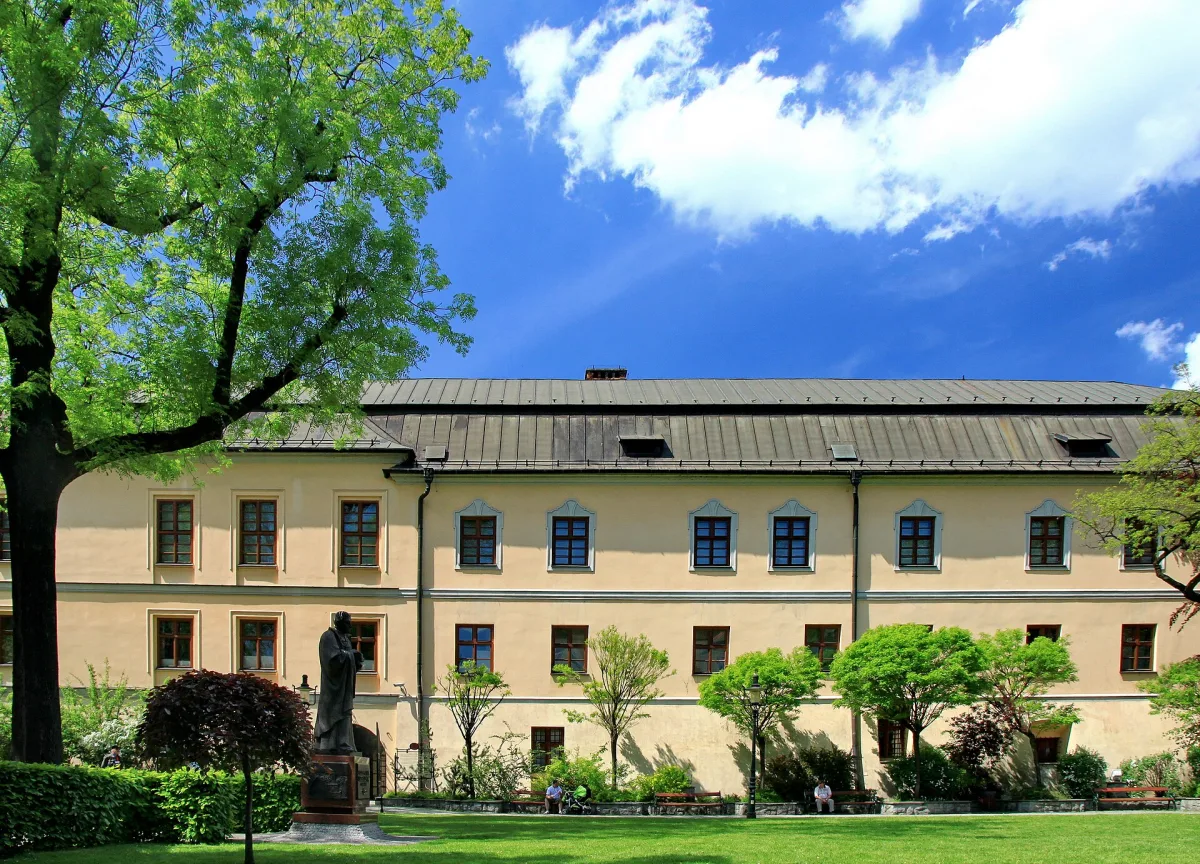
Museum founded in 1802, since 1931 in the Larisch palace from the late 18th century, with the Egyptian Room and archaeological, ethnographic and photographic collections.
The Museum of Cieszyn Silesia is housed in a palace that Count Jan Larisch had built in Cieszyn after the great fire of the town in 1789. The institution itself is much older than the building: it was founded in 1802 by the priest Leopold Jan Szersznik, and it is regarded as one of the oldest public museums in Poland.
The palace was built in 1790-1796 as the grand residence of Count Larisch. It is a three-wing, two-storey brick building with features of the Baroque-Classicist style, entered in the heritage register. In 1839 the then owner, Count Saint Genois d'Anneaucourt, financed a third wing designed by the Viennese architect Josef Kornhäusel. It housed a round stable, today a café, and above it a ballroom known as the Roman Hall.
In 1840 the palace was bought by the Cieszyn lawyer Antoni Demel, and for years the building was called the Demel tenement house. The town bought it back in 1918, and on 21 June 1931 it became the seat of the Municipal Museum, formed from the Szersznik collections, the ethnographic Silesian Museum, the municipal museum and private collections.
The rooms on the second floor were of a representative character, and some of them were decorated with Classicist polychrome painting. Notable are the Chinese Cabinet with oriental motifs such as dragons and a bird of paradise, and the Egyptian Room, the former ballroom. Its decoration consists of six landscapes with motifs of ancient Egyptian architecture, into which a view of the Piast Tower and the Rotunda of St Nicholas has been woven. One of the landscapes bears the date 1796 and the signature of the painter Josef Mayer. In semicircular niches stand Classicist and eclectic stoves.
The museum runs, among others, departments of archaeology, ethnography and photography. The archaeology department derives from the Szersznik collection, which includes Roman coins, Lusatian culture vessels and painted ancient vessels. The ethnography collection comprises painted chests and wardrobes, paintings on glass, elements of folk costume and ceramics, while the photography collection documents Cieszyn and Cieszyn Silesia.
In 1942 a fire broke out in the Roman Hall and consumed the whole roof. The museum was closed in 1966 and reopened in 1969, and in 1983 the exhibitions were closed because of the poor technical condition of the building and a general renovation began. The restoration was completed in 2002. Today the Roman Hall is sometimes used for temporary exhibitions.

Be the first! Add a comment.
You need to log in to add a comment.
Log in