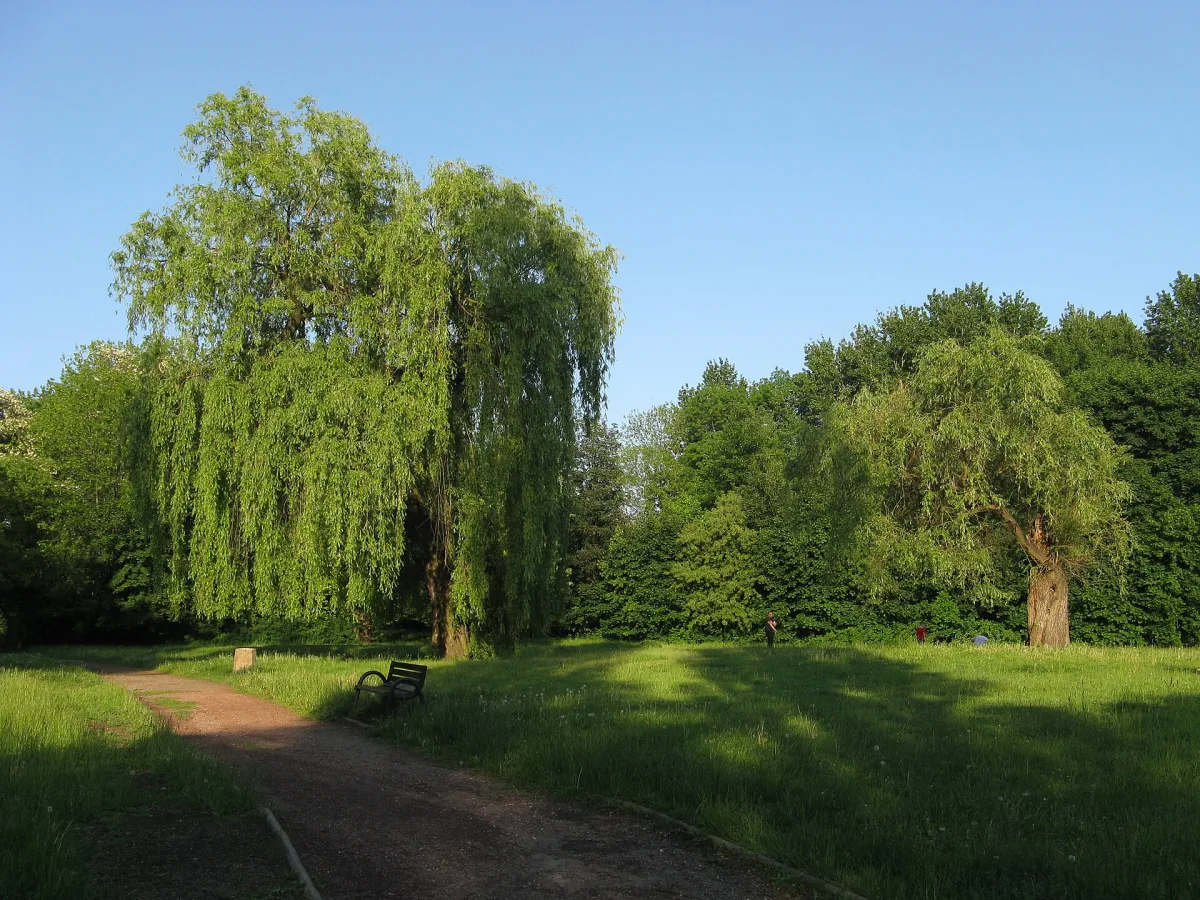
An 8.9 ha park in Bytom from the turn of the 1920s and 1930s, with a modernist layout, ponds and four viewing terraces.
Adam Mickiewicz Park in Bytom covers 8.9 ha in the districts of Rozbark and Łagiewniki and is one of the larger parks in the city. It was created at the turn of the 1920s and 1930s and is listed in the municipal register of monuments of Bytom.
The park was originally called Goethe Park and lay in the historic district of Neubeuthen (Nowy Bytom). Natural forest and varied terrain with post-extraction pits were partly used in laying it out. A workers' estate with so-called Finnish houses was built nearby, and its street names referred to characters from Goethe's works: Egmont-Weg, Faust-Weg, Werther-Weg, Hermann-Weg and Dorotheen-Weg.
In the 1960s the park was modernised with funds from the Rozbark Coal Mine: sports pitches, a children's paddling pool and a sledge run were built, of which only the sledge run has survived. In 2010 the site was reclaimed, with the addition of artificial ruins, a wooden footbridge and viewing terraces, and in 2018 the park underwent revitalisation.
The park is a modernist composition based on geometric, axially symmetrical layouts. It lies mainly in the valley of the Graniczny Stream, by the busy Chorzowska Street. At the centre is a large grassy space with individual trees, and in the park there are several ponds, partly overgrown with common reed, which served as bathing places until the 1960s.
Trees growing here include pedunculate oak, hornbeam, horse chestnut, small-leaved lime, maples, European larch, black locust, poplars and willows. Thirteen species of dragonfly have been recorded in the park.
The facilities include a fountain, a stone circle, trellises, a wooden footbridge and four viewing terraces named “Energia” (Energy), “Przystań” (Harbour), “Wzgórze” (Hill) and “Zamczysko” (Castle Ruin).

Be the first! Add a comment.
You need to log in to add a comment.
Log in