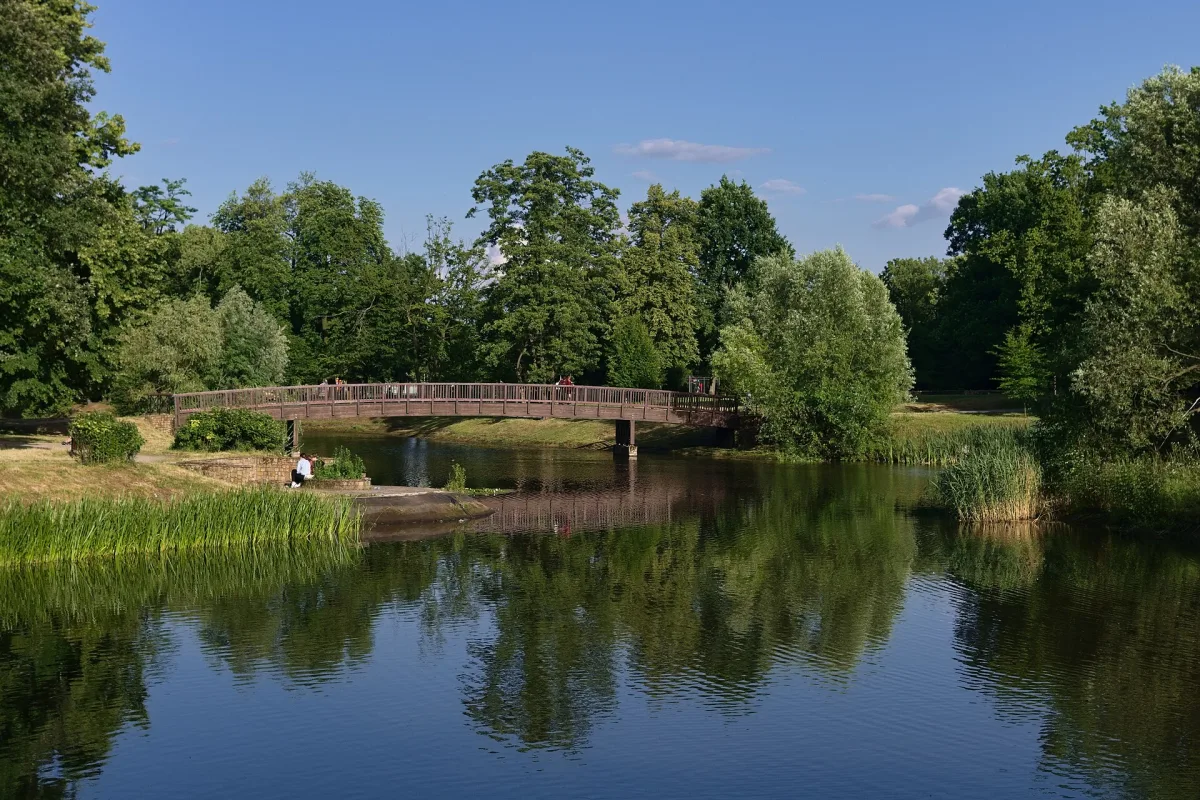
A historic municipal park of 43 ha in the centre of Bytom, laid out around 1840, with two ponds, an open-air swimming pool from 1934 and traces of a former zoo.
The Scoutmaster Franciszek Kachel Municipal Park lies in the north-western part of the centre of Bytom, between Tarnogórska, Wrocławska and Olimpijska streets. Today it covers 43 hectares and is entered in the heritage register. It was created around 1840 and has long served residents as a place for walks and sport.
The land for the park was set aside by Hubert von Tiele-Winckler, who donated 330 morgens to the city. Post-mining land belonging to the Teresa calamine mine was added to it. From 1870, on the former wasteland left by the calamine mine, the plan of Adolf Wermund was carried out. He was a Bytom soap maker, candle maker and city councillor, regarded as the true founder of the park and the zoo; a promenade was laid out at that time, which became the main axis of the composition. In the Polish People's Republic the park bore the name of General Karol Świerczewski, and today it is named after the scoutmaster Franciszek Kachel.
The park has a landscape character typical of the 19th century: informal, with glades and clumps of trees emphasising the routes through it. The eastern part, with the city hall and the swimming pool on a geometric axis, has a horseshoe-shaped driveway and a fountain, while the western part is more of a promenade, with radiating avenues. In the 20th century a tramline divided the park into a utility part and a recreational part. The dominant trees are the horse chestnut, Norway maple, pedunculate oak, sycamore maple and black locust, and weeping willows grow by the ponds. Among the introduced trees are the tulip tree, London plane and honey locust. Góra Miłości (Love Hill) is a former mining spoil heap turned into an alpine garden, and north of the pond runs an avenue of sculptures by Tadeusz Sadowski. In 1911 and 1912 the park director Fritz Köhler extended the grounds to the north and introduced new plantings; after 2010 restoration work was carried out, covering the pond, the rose garden, the Greek corner, Góra Miłości and the concert shell.
In 1898-1957 the Municipal Zoological Garden operated in the park, regarded as the first zoo in Upper Silesia. At the start it had 89 animals of 25 species. There are no animals at the former zoo today, and the park has remained a place for walks around the ponds, including the Southern Pond.
In 1934 a swimming pool designed by Carl Schmidt was opened on the site of the former municipal bathhouse; an open-air pool operates there today. The park also has the tennis courts of Górnik Bytom and a concert shell. In the interwar period a monument to the fallen soldiers of the Bytom 156th Infantry Regiment was erected, and after the war a monument to General Świerczewski was put up in its place; after it was removed, a flower bed was laid out. Among the newer elements, a steel outdoor sculpture by Jacek Wichrowski from 2018 stands out. At the beginning of the 20th century a 16th-century wooden church of St Lawrence was moved to the park; it burned down in 1982, and the foundations and a wooden cross have survived.
From the park it is close to the Silesian Opera building, and within one walk or a short ride lie Fazaniec Park and the Szombierki Power Station. Another historic park is the Tiele-Winckler Park.

Be the first! Add a comment.
You need to log in to add a comment.
Log in