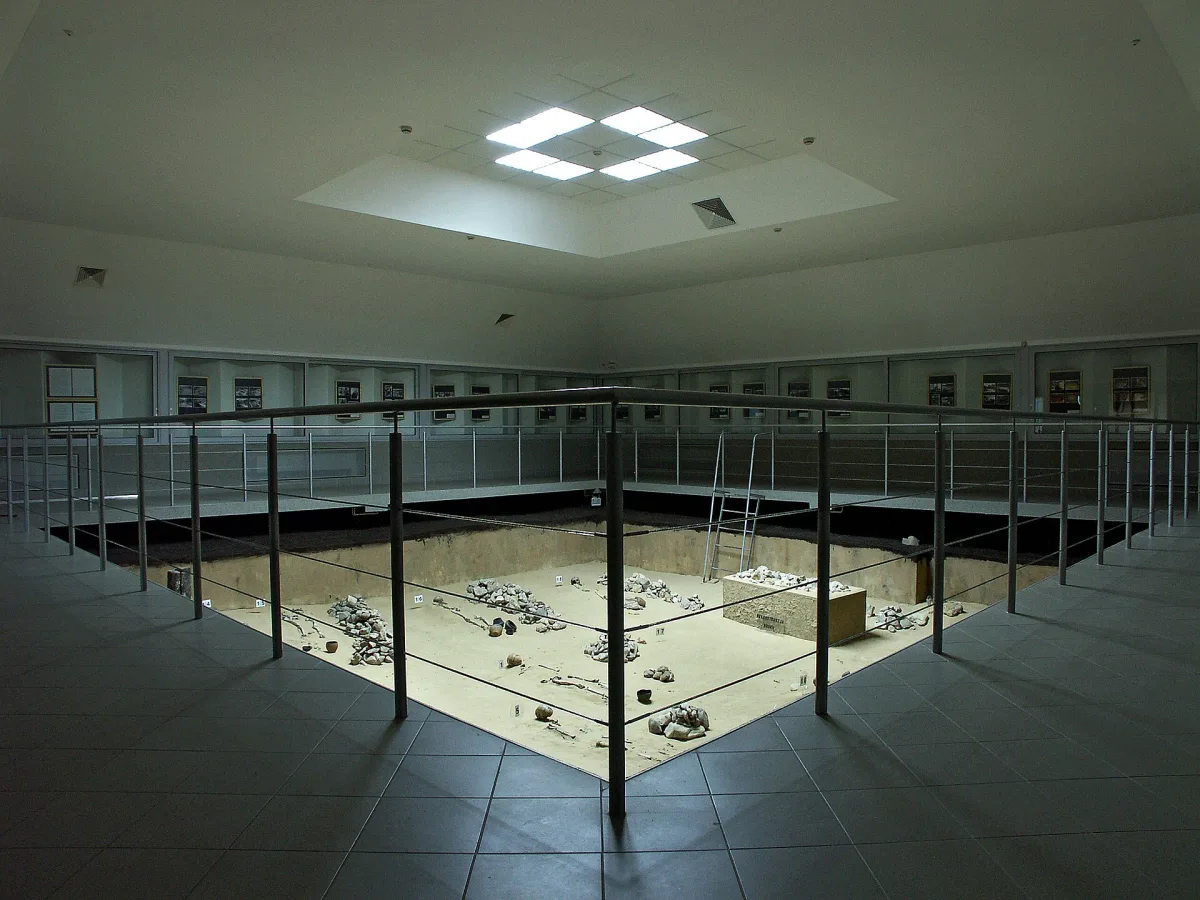
A branch of the Częstochowa Museum with a Lusatian culture cemetery preserved under a pavilion where it was found, in the Raków district.
The Lusatian Culture Archaeological Reserve is a branch of the Częstochowa Museum in the Raków district. Under the pavilion a cemetery of the Lusatian culture population from the early Iron Age has been preserved on the spot where it was found, and next to it a permanent exhibition, “Z mroku dziejów” (“Out of the Darkness of History”), has been set up.
Under the pavilion lies a cemetery of the Silesian-Lesser Poland group, dated by the museum to 750-600 BCE. It takes up nearly 100 m² and has a characteristic row layout of graves. They include cremation and inhumation graves, which were covered with pieces of limestone and granite. In the inhumation graves the dead were laid out extended, with their heads towards the south.
It is one of the few sites in Poland where a permanent exhibition stands directly above an authentic burial site.
The cemetery was discovered in January 1955 during construction of a tram line and a viaduct at Aleja Pokoju. In the summer of that year rescue excavations were carried out and 11 graves were secured. Research in 1960 covered a larger area and yielded 69 more graves. It was then that the decision was taken to build a reserve, and a Public Committee for the Construction of the Reserve was also formed.
The pavilion was designed by the Częstochowa architect Włodzimierz Ściegienny, although for financial reasons the design was cut back in construction. The reserve was opened on 9 June 1965. Some of the discovered graves are under the pavilion, and the others are shown in display cases around the excavation.
On the basis of the research it has been established what diseases the inhabitants of these lands suffered from and how they treated them. Traces of a successful trepanation of a skull were found, for example. Food, vessels, ornaments, tools and weapons were placed with the dead. Three rattles in the shape of little birds and two bracelets, most probably of meteoritic iron, were also found in the graves.
In 2001-2002 the building was thoroughly renovated and five more graves were discovered during the work. Conservation of the finds was carried out by staff of the State Archaeological Museum in Warsaw, and in 2004 the reserve was opened to visitors again.
In the same district stands the Sanctuary of St Joseph. According to its parish, a Lusatian settlement existed on the Raków hill 2,500 years ago.

Be the first! Add a comment.
You need to log in to add a comment.
Log in