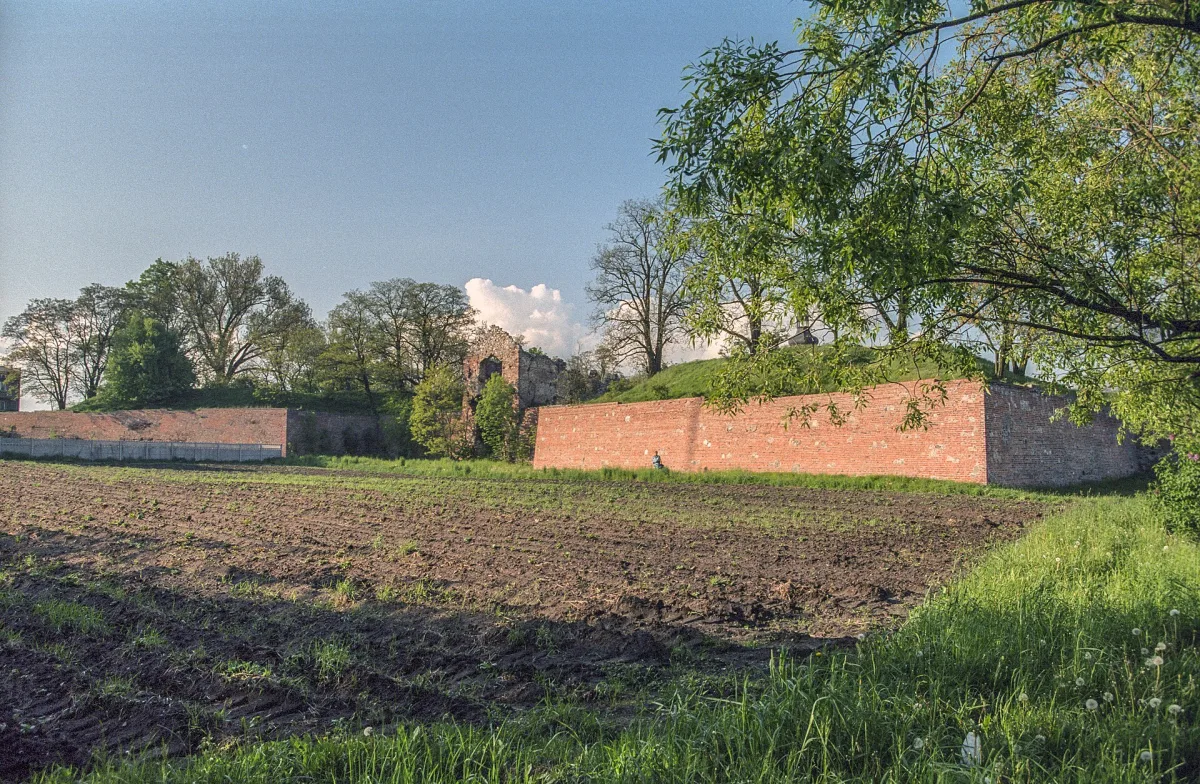
The ruins of a 17th-century bastion fortress on the Liswarta, with the surviving Church of St Stanislaus inside the fortifications.
Danków Castle is the ruin of an early modern bastion fortress from the first half of the 17th century, built by Stanisław Warszycki on the Liswarta river, in the municipality of Lipie in Kłobuck County. Within the former fortifications the brick Church of St Stanislaus has survived, while there is no trace of the owner's residence and the farm buildings.
It is a complex of earthen fortifications faced with a wall at the front, built according to the principles of the Old Dutch and French schools. These fortifications are considered an isolated example in Poland of applying the principles formulated by the French military engineer Jean Errard. The longer front on the landward side was defended by one large central bastion, and on the river side a tenaille trace was used. Around the fortifications on the landward side ran a moat about 30 metres wide, and from the east the fortress was protected by an artificial lake.
There was no brick residence at the castle. The main residential building was made of wood, as noted in 1657 by the queen's secretary Pierre des Noyers. The storehouse (lamus), the kitchen and the large church were of brick. The site is entered in the heritage register, which describes it as a fortress complex and dates it to the 17th century.
The first mention of the village dates from 1217, when Leszek the White, Henry the Bearded and Władysław Laskonogi met on the Liswarta. The settlement lay at a river crossing on the road from Greater Poland to Lesser Poland and in the Middle Ages was sometimes a venue for gatherings of the dukes. Some of the older accounts of a medieval stronghold or castle are not confirmed in sources, and the place where an earlier castle stood is not known.
From 1581 the village belonged to the Warszycki family. According to the account, in 1657, after the Deluge, the Castellan of Kraków Stanisław Warszycki hosted King John Casimir, returning to the country, with Queen Marie Louise here, and for several months the court and administrative centre of the Commonwealth was based at the castle. During the Deluge the fortress was probably not attacked by the Swedes and was among the few places in the country that they did not occupy. According to the Jasna Góra tradition, twelve heavy cannons were sent from here to Jasna Góra.
The castle later passed to the Poniński family, who did not live in it. An inventory of 1768 described it as ruined, or rather abandoned and unused, and a year earlier the remaining buildings had burned down after a lightning strike. In 1823 the castle was described as a ruin.
In the 1970s the most damaged brick elevations of the bastions were partly faced and the artificial lake, which had existed at Danków since the 15th century, was drained. In 2014 archaeological research was carried out here, which uncovered traces of use of the site from before the fortress was built.
The bastion ramparts have survived, along with the ruin of the Krzepice Gate, which was reached by a bridge, and the rear gate in the form of a tunnel passing obliquely through the rampart. A single stone wall stands of the former storehouse, known as Dom Kasztelanowej (the Castellan's Wife's House). In the Church of St Stanislaus, probably built in the second third of the 17th century, there is the tomb of Andrzej Warszycki, father of the fortress's builder, who died in 1615.

Be the first! Add a comment.
You need to log in to add a comment.
Log in