
Klimczok and Szyndzielnia: huts of the Bielsko Beskidenverein
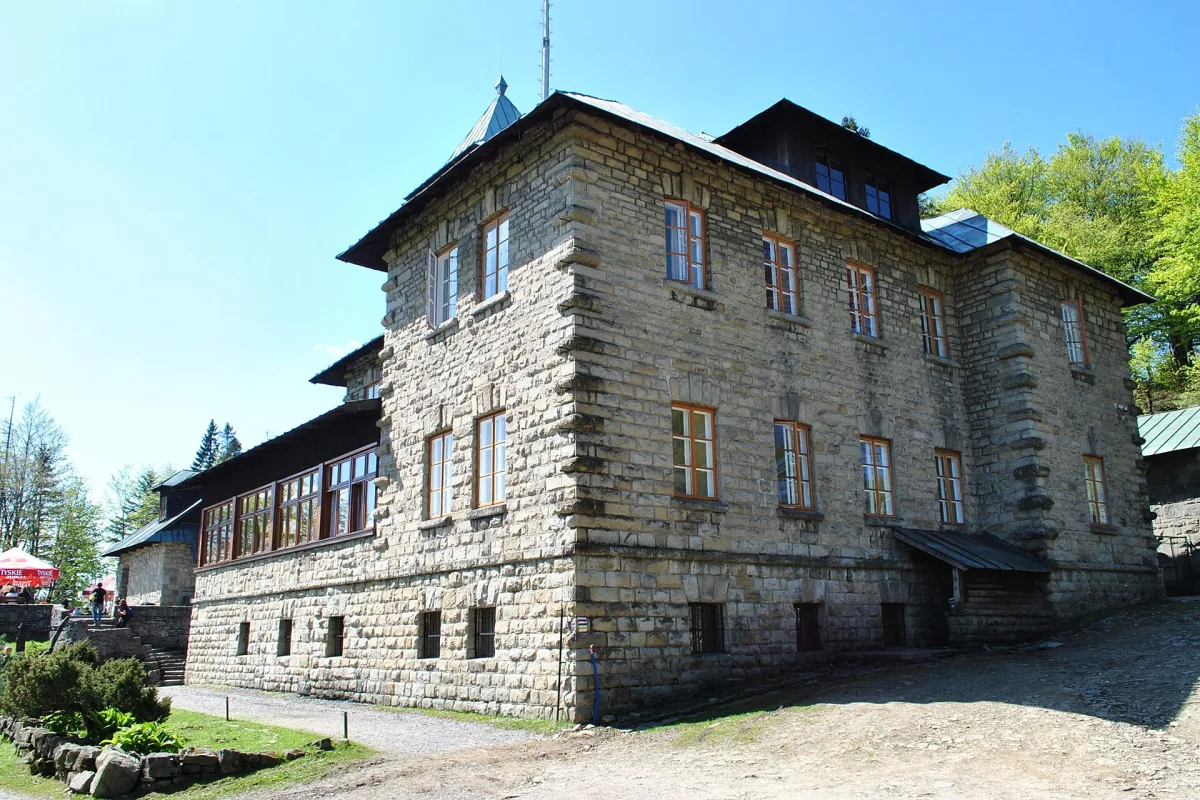
The oldest mountain huts of the Silesian Beskids grew out of the rivalry between German and Polish tourist societies, and their history is easy to trace on a single ridge above Bielsko-Biała. On Magura, near Klimczok, stands the PTTK Klimczok mountain hut. The first wooden hut, called Klementynówka after the owner of the Łodygowice estate, was built here in 1869 and served mainly hunters. After it was extended by the Bielsko Beskidenverein the building burned down on the day of its opening in 1895, then again in 1910 and 1913. That is why in 1914 a masonry building of stone was put up, which with small changes stands to this day.
The same contest for tourists can be seen in the neighbouring PTTK mountain hut on Szyndzielnia. The Bielsko section of the Beskidenverein decided on its construction after the fire at Klementynówka. Building began in 1896, and the opening took place in July 1897. The design was prepared by Wilhelm Schlesinger, and the building was erected by the firm of the architect Karol Korn in a masonry and timber construction, with a turret modelled on Alpine huts. Szyndzielnia is regarded as the first masonry hut in this range and lies at a height of 1001 m above sea level. At the hut there is an alpinarium founded in 1906 by the Bielsko museum curator Eduard Schnack.
The fate of both buildings during the Second World War was similar. In 1944 the Germans included Klimczok in a system of fortifications running from Magura through Klimczok, Szyndzielnia and Trzy Kopce as far as Błatnia and Skoczów. Szyndzielnia found itself in the defensive line of Bielsko and in February 1945 was hit several times by Soviet shells. After the war the pre-war branches of the Polish Tatra Society were reactivated in Bielsko-Biała already on 18 February 1945, and Szyndzielnia returned to use on 22 July that year. Klimczok was reopened in June 1945.
In the area there is also the Kozia Góra mountain hut, called Stefanka. It grew out of a forest workers' cabin, was turned into a hut in 1912, and its name comes from the nearby gazebo Steffansruhe with a plaque dedicated to Karl Steffan, president of the Beskidenverein and mayor of Bielsko. In 2023 the Bielsko-Biała councillors changed the wording of a resolution and formally it is no longer a mountain hut but a tourist facility.
Błatnia and Skrzyczne: two huts, two different beginnings
West of Bielsko the ridge leads to the PTTK mountain hut on Błatnia. It was built in 1925-1926 by the German society Naturfreunde (Friends of Nature) from Aleksandrowice, and the builder was the carpenter Jan Krechut of Jaworze. The opening took place on 23 May 1926. The Polish Tatra Society of Bielsko bought a plot next to it in 1930, but did not build its own hut there, because it concentrated on a facility in Zwardoń. In the winter of 1944/1945 the Germans devastated the building and used the material from the demolition for nearby fortifications, and in August 1945 the hut was opened again. The trail from Jaworze leads on from here through Stołów and Trzy Kopce to Klimczok and Szyndzielnia, so Błatnia is a link in the same ridge walk.
Quite different roots belong to the PTTK mountain hut on Skrzyczne, located at an altitude of 1250 m just below the summit. Skrzyczne (1257 m) is the highest peak of the Silesian Beskids. Around 1930 Rudolf Urbanke bought from the inhabitants of Lipowa a plot on the summit clearing and in 1933 put up a wooden hut. In the mid-1930s the building burned down, and the owner began to build a larger one. In the winter of 1945 the building found itself on the front line. It survived the war, but was destroyed and looted, and after renovation was solemnly opened in June 1950. Since the end of 1950 it has belonged to PTTK. Tourist traffic increased with the building of the chairlift from Szczyrk, completed in 1958.
Stożek, Soszów and Pod Tułem: huts of Cieszyn Silesia
The Stożek and Czantoria range belongs to the western part of the Polish Silesian Beskids, and huts arose here on the initiative of Cieszyn societies. The PTTK Stożek mountain hut is regarded as the oldest existing Polish hut in the Silesian Beskids. The idea was put forward in 1910 by Jan Galicz of the Cieszyn Polish Tourist Society Beskid. Talks on buying the land ended in a scandal, because the forest district forced the owners to withdraw from the agreement, and the matter was raised in the parliament in Vienna by the deputy Father Józef Londzin. Construction was interrupted by the war. The foundation stone was laid on 30 May 1920, and the opening took place on 9 July 1922. The building was designed by Stanisław Chorubski. The hut lies at a height of 957 m above sea level, while the hut's website gives 978 m for the nearby summit of Stożek Wielki. The Main Beskid Trail runs past the hut, which is regarded as the longest trail in the Polish mountains, about 496 km long, and which begins in Ustroń.
On the same ridge stands the private Soszów Wielki mountain hut, opened in 1932, at an altitude of 792 m. At first it had 40 beds. During the war the occupier forced a lease in favour of the Beskidenverein, and on 10 March 1946 the first tourist station of the Cieszyn branch of the Polish Tatra Society was set up in it. Beside the hut trails diverge to Czantoria Wielka and Stożek.
Lower down, on the slope of the Zagoj hill, stands the former PTTK Pod Tułem hut. The building was erected in 1930-1931 by a German merchant from Cieszyn as a private villa. In 1946 it was taken over by the Cieszyn Polish Tatra Society, and after renovation in 1968-1969 PTTK opened a hut here. In 2006 PTTK sold the property, and today a restaurant with rooms operates in it. It is an example of a hut that stopped being one, although the building stands.
Przysłop, Stecówka and Karkoszczonka
Under Barania Góra it is easy to trace three eras of a single place. The first building on Przysłop was a wooden hunting lodge of Archduke Frederick of Habsburg from 1897. The Polish Tatra Society renovated it and handed it over to tourists on 15 July 1925. In 1973-1979 PTTK put up a new masonry building next to it, the PTTK mountain hut at Przysłop below Barania Góra, located at an altitude of 951 m. The old lodge was dismantled in 1985 and moved to Wisła, to Lipowa Street, where it serves the PTTK branch. At the hut three trails to the summit end: the blue from Rupienka, the green from Istebna and the red, that is the Main Beskid Trail, from Kubalonka.
The Museum of Mountain Tourism at Przysłop below Barania Góra moved into a former outbuilding next to the hut. The originator of the centre was Edward Moskała, and the museum was opened on 12 November 1994. The exhibition occupies three rooms and tells the history of tourism in the Silesian Beskids, of societies such as the Polish Tatra Society and the Beskidenverein, and of the development of skiing.
The wooden tourist hut at Stecówka was built in 1934 by the Legierski couple. The owners supported the resistance movement, for which Michał Legierski ended up in the camp in Oświęcim, and he returned to Stecówka in 1945. The building lies on the Main Beskid Trail.
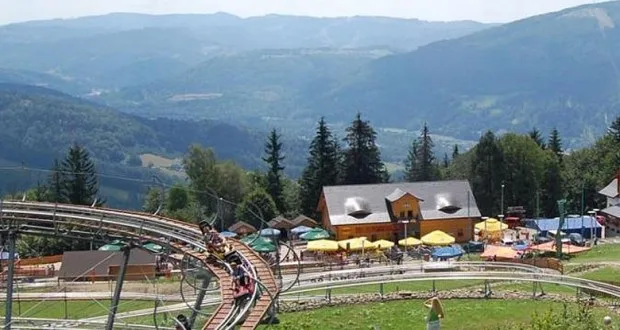
On the Karkoszczonka pass, linking Szczyrk with Brenna, stands Uncle Tom's Cabin (Chata Wuja Toma). It is housed in a wooden highlander cottage from 1918, whose first owner was Adam Porębski. In the second half of the 1970s a student hut of the Silesian University of Technology was set up in it, and after 1992 the building served as the base of the toboggan run. Today it is a year-round destination for short trips for people holidaying in Szczyrk.
Be the first! Add a comment.
You need to log in to add a comment.
Log in