
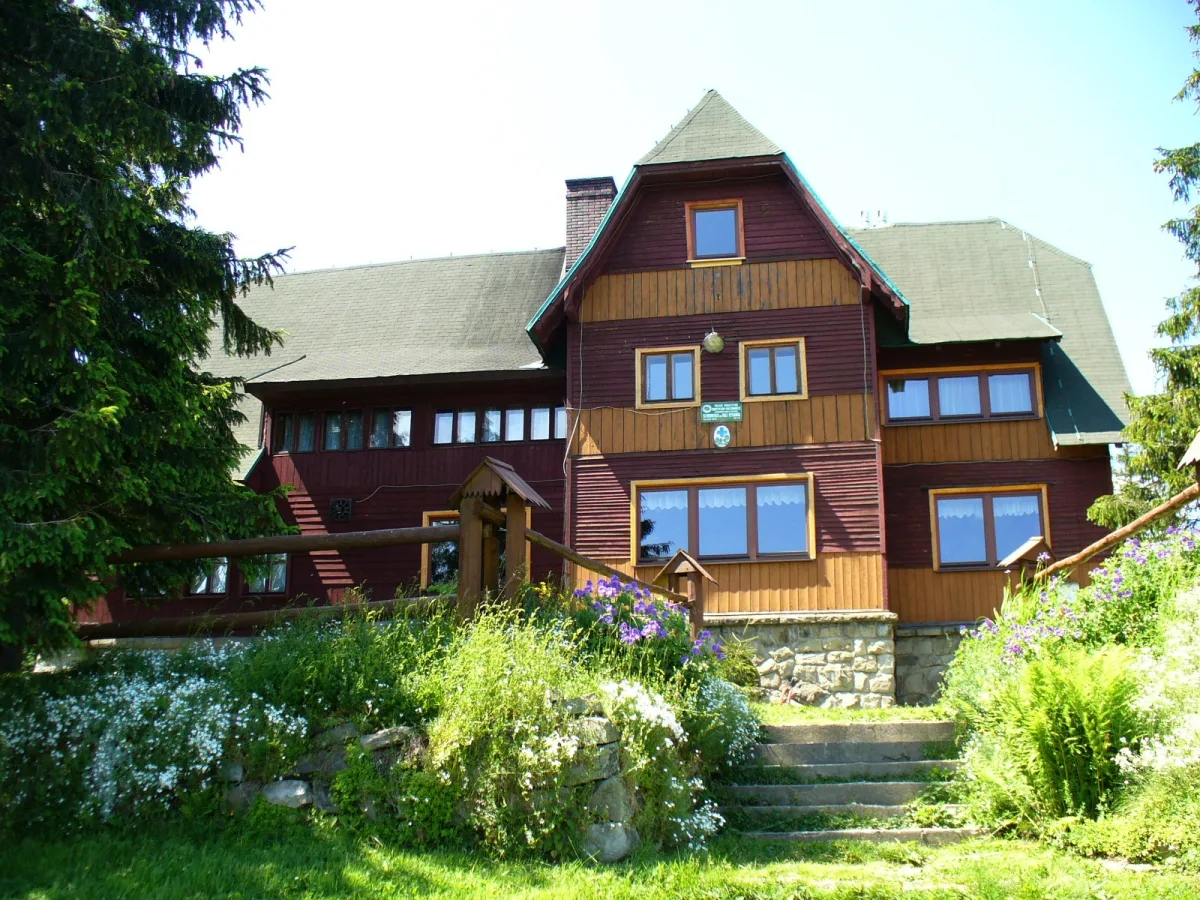
Lipowska and Rysianka: two huts a quarter of an hour apart
The best-known duo in the Żywiec Beskids is formed by two huts on neighbouring meadows. The PTTK mountain hut on Hala Lipowska was begun in 1931 on the initiative of the German Beskidenverein. The Polish Tatra Society opposed the construction, but the Germans obtained the necessary permits and the official opening took place on 6 August 1932. The building had five rooms with 22 beds. After the war, on 9 June 1946, it was put back into use under the care of the Babia Góra Branch of the Polish Tatra Society.
The neighbouring PTTK mountain hut on Hala Rysianka lies at an altitude of 1290 m above sea level, and its creation is linked with Gustaw Pustelnik, the tenant of the hut on Lipowska. Pustelnik marked out a plot on the Rysianka meadow and began to put up a building which turned out to be a three-storey house, not an outbuilding with a small upper floor, as had been permitted. This caused protests from tourist organisations and residents, and the authorities ordered demolition. The building was saved by the intervention of the Tatra Ski Society of Kraków, which supported Pustelnik and opened a hut here. The official opening took place on 16 May 1937, although the building obtained formal permission for use only in October. The design was prepared by the Żywiec architect Gustaw Maślanka.
Before the war a kind of war for tourists went on between the two huts. During the occupation Rysianka operated under the name Lipowska-Baude, and in 1943 units of the Home Army attacked it twice, taking food and blankets. From Lipowska to Rysianka runs a trail that takes about a quarter of an hour's walk.
From Złatna-Huta to Rysianka runs a trail which is linked with the Gawra hut. It is a former mountain tourist hut, today a private accommodation facility, located in the upper course of the Bystra stream at an altitude of 680 m above sea level. It therefore does not belong to the PTTK network, and the rules of stay are set by the facility itself.
Hala Boracza and Hala Miziowa: two huts with a fire in the background
The PTTK mountain hut on Hala Boracza has an unusual history. The first wooden building was put up in 1926 (other sources give 1925) by the Jewish Sports Society Makkabi of Bielsko, and the hut is regarded as the first Jewish mountain hut in the world. Care of it was then taken over by the Jewish Tourist and Ski Society. A fire on 12 April 1932 destroyed the building, but already on 18 December of that year a new, masonry hut was opened, named after Max Nordau. It was regarded as one of the most modern in Poland, powered by electricity, with eight guest rooms, a common room and a postal agency. During the war the hut was plundered and devastated, after which the Beskidenverein took it over, and after the war it was reopened on 29 September 1946. Some sources assign the building to the municipality of Milówka. The dates from different sources are not consistent, so they should be treated as approximate.
The PTTK mountain hut on Hala Miziowa stands on the slopes of Pilsko at an altitude of 1274 m above sea level. Plans for building appeared in 1912 on the initiative of Kazimierz Sosnowski, but were interrupted by the war. The design was prepared in 1927 by the Babia Góra Branch of the Polish Tatra Society, and construction lasted three years. The timber for the building was given by Archduke Charles Stephen of Habsburg, then owner of the Żywiec estate. The hut was opened on 20 July 1930. The two-storey building in highlander style burned down on 19 March 1953. The farm buildings served as a temporary buffet and sleeping place, and a new large hut was opened only on 12 October 2003, half a century after the fire. The Main Beskid Trail runs across the meadow, and from here one sets out for Pilsko and Góra Pięciu Kopców.
In the same mountain group lies also the AKT Dobrodziej cabin, the former Builders' Cabin (Chatka Budowlańców) in the Witasówka clearing above Sopotnia Wielka. For a long time it was managed by the Faculty of Civil Engineering and Architecture of the Silesian University of Technology in Gliwice, hence the former name. Today it is a private facility, and nearby runs the trail from Sopotnia Wielka to Hala Miziowa.
Przegibek, Wielka Racza and the bacówki near the border
In the south-western part of the Żywiec Beskids, right on the border with Slovakia, the huts have a different character. The PTTK mountain hut at Przegibek was built in 1923 as the private holiday house of Józef Pietrusiewicz of Żywiec, one of the founders of the ski section of the Babia Góra Branch. In 1935 it was bought by the Bielsko Branch of the Polish Tatra Society, which set up a tourist shelter, and from May 1938 the building received tourists all year round. The hut lies at a height of 1000 m above sea level, within the Żywiec Landscape Park, with views of Wielka and Mała Rycerzowa and Wielka and Mała Racza.
Higher up, below the summit, stands the PTTK mountain hut on Wielka Racza at an altitude of 1236 m. Construction was begun by private owners in 1933, and a year later the unfinished building was bought by the Bielsko branch of the Polish Tatra Society and opened on 17 December 1934. In August 1939 a unit of the Border Protection Corps appeared in the building. During the war a Luftwaffe post was set up here, and in April 1945 the hut was hit by two artillery shells. Another source, however, speaks of a gendarmerie post, so the sources differ in describing this episode. In 1964 a PTTK commission was to decide on demolition, but decided on a general renovation.
The youngest group is formed by the PTTK bacówki (shepherd's-hut-style shelters), built on the initiative of Edward Moskała. The PTTK Bacówka on Rycerzowa is regarded as the first of a series of small huts for qualified tourism, the so-called bacówki, and was opened on 14 September 1975. Built of wood on a stone foundation, to a design by Stanisław Karpiel, it stands on Hala Rycerzowa in the municipality of Ujsoły. It originally had a shingle roof, which was replaced with sheet-metal tiles in 2012. From the hut a panorama opens covering Pilsko, Babia Góra, the Tatras and the Little Fatra. Trails lead to the meadow from, among others, Soblówka and Glinka.
The PTTK Bacówka on Krawcowy Wierch was put into use on 4 December 1976 and stands on the Krawcula meadow at an altitude of 1038 m. Both bacówki belonged to the Bacówkarz Club. Until 21 December 2007, when Poland and Slovakia joined the Schengen agreement, a border crossing operated on the nearby Glinka pass. Today the border can be crossed freely. A night rally called Noc Krawculi is organised in the area of the bacówka.
Be the first! Add a comment.
You need to log in to add a comment.
Log in