
The nature reserves of the Silesian Beskids are not parks with paths and benches, but fragments of mountains where the aim is to preserve ancient forest, peat bogs or one very specific phenomenon, such as a spring carpet of flowers. Below is an overview of fourteen of them, from the Silesian Beskids through the Żywiec Beskids to the Little Beskids. For each one the question is what exactly is protected here and why this particular place.
Silesian Beskids: the sources of the Vistula and the beech woods above Ustroń
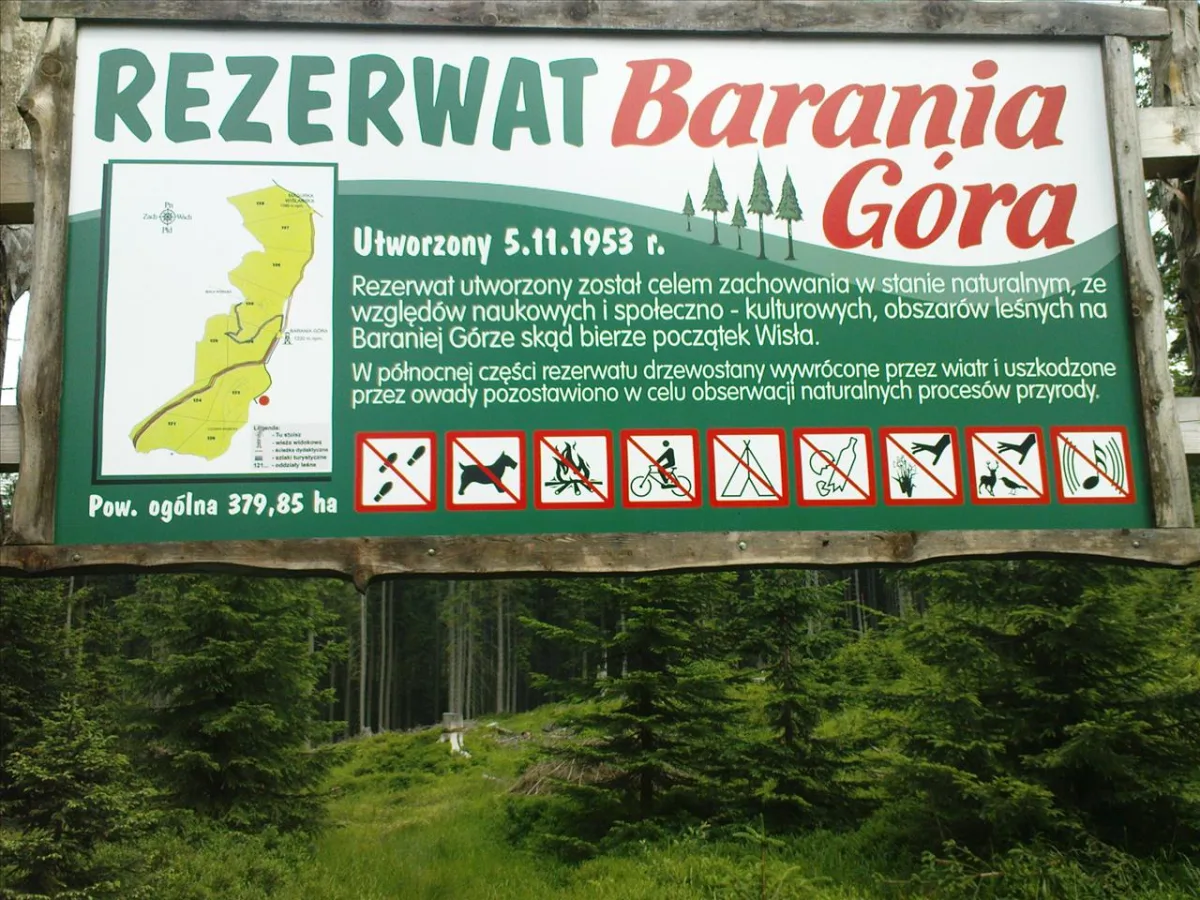
The oldest story belongs to the Barania Góra reserve. The Barania Góra forests were already cared for in the second half of the 19th century by the Habsburgs of Cieszyn, who came here with guests to hunt capercaillie and brought in foresters from Styria and Carinthia so that nobody would disturb these birds. After 1922, when the autonomous Silesian Voivodeship was in existence, Silesian naturalists wrote about the value of this area. A concrete project for a reserve was presented in 1931 by Marian Koczwara of the Silesian Museum in Katowice. Even before the 1934 nature protection act, the State Forests created a partial reserve of 388 ha here, and the present one was established by a ministerial order of 5 November 1953 within very similar boundaries.
The reserve lies within the boundaries of the town of Wisła, on the western slopes of the mountain, and covers 379.85 ha. It includes the springs of two source streams of the Vistula: the Czarna Wisełka and the Biała Wisełka. The area is under strict protection, and the climate is among the rainiest in the country: precipitation reaches 1100 to 1700 mm a year, and in the summit areas snow often lies more than two metres deep. The height of the summit is given in different ways: some sources say 1220 m above sea level, others give 1215 m and explain that 1220 m refers to a geodetic point on a concrete obelisk, standing less than 5 m above the ground. Data on the area of the reserve also differ: 379.85 ha according to some sources, 386 ha according to others. The summit itself is described on a separate card: Barania Góra. In the 1930s attempts were made to introduce dwarf mountain pine and Swiss stone pine here, but in competition with spruce only the stone pine survived.
The Wisła reserve belongs to the same water story. It is a faunal, aquatic reserve of 17.61 ha, established in 1959. It covers the Biała and Czarna Wisełka, the headwater course of the Vistula down to the mouth of the Malinka, and the Malinka stream itself. The main purpose was to protect the native population of brown trout. According to the studies cited in the entry, stream regulation, the dam at Wisła Czarne and water pollution caused the trout to die out in the Czarna Wisełka, while in the Biała they persist thanks to stocking.
The Czantoria reserve in Ustroń has a completely different character. It was established on 12 November 1996 on 97.71 ha as a partial reserve. It occupies the steep northern slopes of Wielka Czantoria and protects natural lower montane forests: acidophilous mountain beech wood, fertile Carpathian beech wood and Carpathian sycamore wood. The blue trail named after Jan Galicz runs through the reserve from Ustroń to Wielka Czantoria, and on the Czech side of the border lies the Čantoryje national nature reserve.
Żywiec Beskids: the last fragments of the Carpathian Forest
Most of the reserves are concentrated in the south of the voivodeship, in the Żywiec Beskids, within the Żywiec Landscape Park. The common denominator here is the Carpathian Forest (Puszcza Karpacka), the former extensive mountain forest of which only islands remain today.
The Pilsko reserve protects the upper montane spruce forest in the summit areas of the massif on the Polish side of the border. The present reserve of 105.21 ha was created in 2005 by merging two: the Pilsko reserve from 1971 (15.41 ha) and the Pięć Kopców reserve (88.74 ha). In the original boundaries there were spruces about 200 years old, and many of them exceeded 350 years, 30 metres in height and 70 cm in trunk diameter. The reserve reaches an altitude of 1534 m above sea level.
On the neighbouring ridge lies the Romanka reserve, established in 1963 to preserve a fragment of the Carpathian Forest: the spruce forest of the upper montane zone. Since 2005 it has covered 124.5 ha (previously 98.45 ha) and extends from 1030 to 1366 m above sea level. The most important feature here is the spruces aged 150 to 200 years, branched almost from the ground, and beside them ferns reaching over one and a half metres.
Close by, on the north-eastern slopes of the saddle between Rysianka and Trzy Kopce, lies the Pod Rysianką reserve (27.02 ha, 1970). Its aim is to preserve a fir-spruce-beech forest that is a fragment of the primeval Carpathian forest of the lower montane zone. One of the few sites in Poland of the Moravian aconite grows here. The red Main Beskid Trail runs along the southern boundary of the reserve.
A little further on, in the massif of Lipowski Wierch and Rysianka, the Lipowska reserve was created in 2008, the 64th reserve in the Silesian Voivodeship and the 11th in the Żywiec Beskids. It protects raised bogs on the summit plateau, known as mszary or rojsty, and the upper montane spruce forest surrounding them. The bogs formed where the flattened summit of layered flysch hinders the outflow of water. It covers 62.6 ha.
Soblówka, Rycerka and Rajcza: beech woods, a landslide and record-breaking trees
On the border with Slovakia, in Soblówka, lie two reserves of completely different character. Oszast on the slopes of Mount Oszus was established in 1971 on 48.82 ha as a partial reserve, and since 1998 it has been a strict reserve of 46.27 ha. It protects a beech-spruce forest, a fragment of the primeval Carpathian Forest, and thanks to its inaccessible location, surrounded on three sides by the state border, it has kept its primeval character. Many trees here exceed 40 metres, and the rare animals mentioned include the bear, lynx, wolf, capercaillie and eagle owl.
Muńcoł is a floristic reserve (45.20 ha, 1998) on the eastern slopes of Muńcuł and Kotarz. It was created to protect the largest site of snowdrop in Żywiec County, numbering several thousand individuals. The undergrowth changes over the season: at the turn of April and May it is white with snowdrops, at the end of May it turns pink with hollow corydalis and coralroot bittercress, and in summer it is green with wood stitchwort and sweet woodruff. Access is easy, and an educational path has been laid out next to the trail.
In the Wielka Racza group lie three more. Dziobaki (13.06 ha) protects Carpathian beech wood and tall-herb sycamore wood on the northern slopes of Majcherowa. As to the date of its creation the sources differ: some give the order of 11 December 1995, but it was published in the Monitor Polski in 1996, which is why some lists give that date. Butorza (30.08 ha, 1961) is a strict reserve of lower montane fir-spruce forest with the local, genetically fixed Istebna spruce. Some sources place it in the village of Sól in the municipality of Rajcza, while some other data simply indicate the municipality of Rajcza.
The most unusual history belongs to Śrubita in Rycerka Górna. It is a strict reserve of 24.99 ha, created by an order from the end of 1957, which covers the western slopes of Mount Bugaj. A large part is occupied by a landslide. It is precisely because the surface is heavily disturbed, and the landslide tongue is made of clay saturated with water, that the forest was never felled or replaced with spruce plantations. Beeches and firs reaching 50 metres survived, and in 2011 a spruce 51.8 m tall was found here, then recognised as the tallest tree in Poland. Later first place was taken over by the Douglas firs from Bystra Krakowska in the Silesian Beskids, which measure 53 to 57 m.
Little Beskids: Madohora and Zasolnica
Furthest to the west lies the Little Beskids. Madohora covers the summit areas and slopes of Łamana Skała and reaches into two voivodeships: of the reserve's 447.06 ha, 297.33 ha lie in Silesia and 149.73 ha in Lesser Poland, in the municipality of Andrychów. In the summit area there are outcrops of sandstone and conglomerate of the Istebna beds, reaching up to a dozen or so metres in height. Three tourist trails cross the reserve.
Much smaller is Zasolnica, also called Buczyna na Zasolnicy. The reserve from 1973 covers 16.65 ha, lies in the municipality of Porąbka on the slopes of a mountain 567 m above sea level, and protects a natural site of Carpathian beech wood.
How to read these places
Strict reserves, such as Barania Góra, Oszast, Butorza and Śrubita, serve nature first of all, so human traffic there is restricted. Others, such as Muńcoł, have an educational path and are open to visitors. Before a trip it is worth checking the rules with the site manager: the forest district or the landscape park in whose area the reserve lies.
Be the first! Add a comment.
You need to log in to add a comment.
Log in