
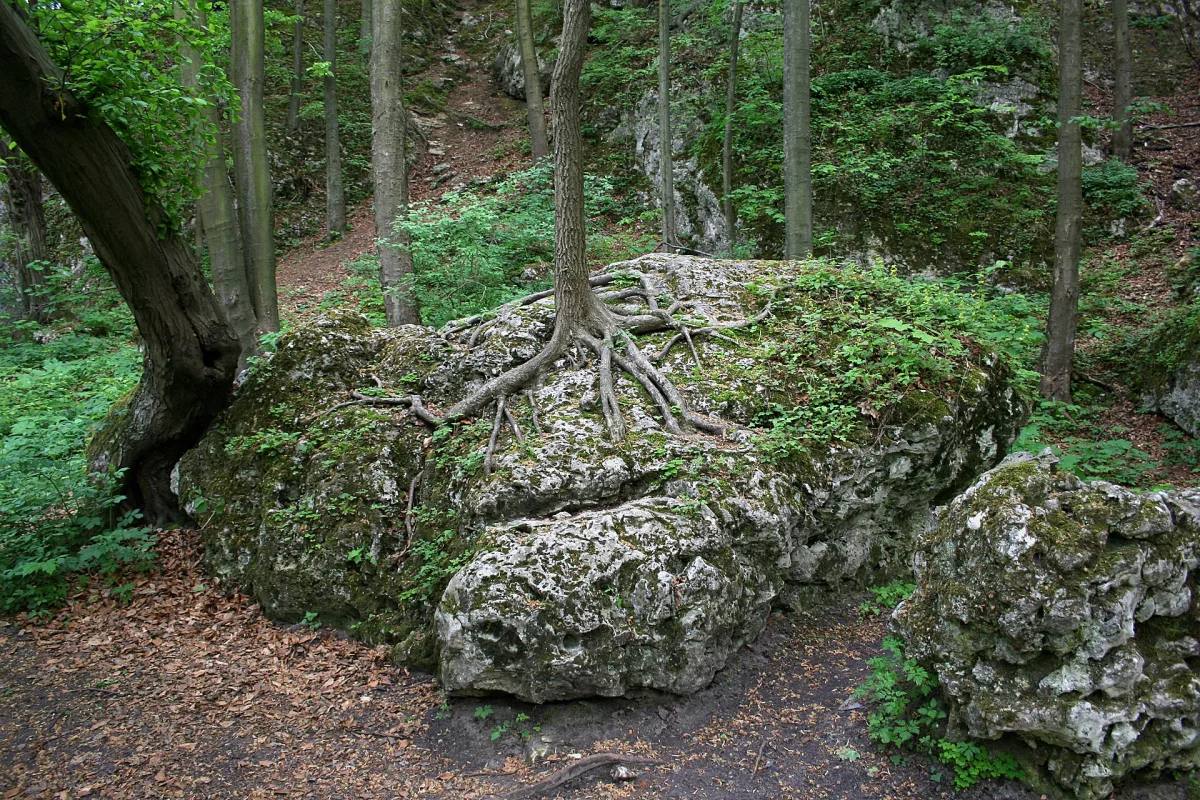
The northern Jura has a dense network of nature reserves, and most of them lie in the municipalities of Janów, Olsztyn and Żarki, within the Trail of the Eagles' Nests Landscape Park. This text arranges them in a walking order: first the core of the area around Złoty Potok, then the reserves around Mirów and Olsztyn, and finally the yews in Żarki and three reserves north of the Jura, around Kłobuck and Koniecpol. The order follows location in municipalities and counties, not a ready-made route: the sources do not give a marked loop connecting all these places.
First Parkowe and the area around Złoty Potok
Parkowe Reserve is a good start, because it has the longest history of protection. In 1907 Count Raczyński limited tree felling here, in 1927 a reserve district was established, and the area was declared a reserve on 3 September 1957. After its enlargement in 2011 it covers 234.13 ha. It protects hills with fragments of the Wiercica valley, rock outcrops, including the Devil's Bridges (Diabelskie Mosty), the Rock with a Cross (Skała z Krzyżem) and Twardowski's Gate (Brama Twardowskiego), and several types of forest: from alder-ash riparian forest to beech woods. In the eastern part the Wiercica rises from two springs, Elizabeth's Spring (Źródło Elżbiety) and Sigismund's Spring (Źródło Zygmunta).
If there is time left after the walk, in Złoty Potok stands the Raczyński Palace. Złoty Potok itself and nearby Góra Zborów have separate texts on the portal, and here they remain only as a reference: Góra Zborów is a separate reserve with a large climbing area.
Not far away, near Apolonka in the municipality of Janów, lies Kaliszak: 14.64 ha of fir and pine forest, established on 18 December 1953. The trees are from 100 to 160 years old. About 540 species of butterflies live in the reserve, among them the scarce swallowtail and the swallowtail. The sources do not describe marked paths, so this is a reserve for a short look, not for a whole-day route.
Siedlec, Mirów and Olsztyn: beech woods and rocks
Bogdaniec protects beech woods on two extensive hills, Bogdaniec and Koziarska Góra, with limestone outcrops and rock faces overgrown with mosses and brittle bladder-fern. It was established by an order of the Regional Director for Environmental Protection in Katowice, that is, much later than Parkowe or Kaliszak, so older maps and guidebooks may not show it. It covers 126.13 ha. It lies in the municipality of Janów, about 2.5 km from the Siedlec Desert, which can be combined with it into a single trip.
Further on, between the villages of Gorzków Stary and Holendry, lies Bukowa Kępa. It is a strict reserve, 52.84 ha, established by an order of the minister in 1995. It protects a beech forest on limestone and loess substrate; the difference in height reaches about 100 m, the highest point is 384 m above sea level, and the outcrops reach 30 m. Because the protection is strict, permitted paths must be checked with the Trail of the Eagles' Nests Landscape Park. Nearby stand Mirów Castle and Bobolice Castle.
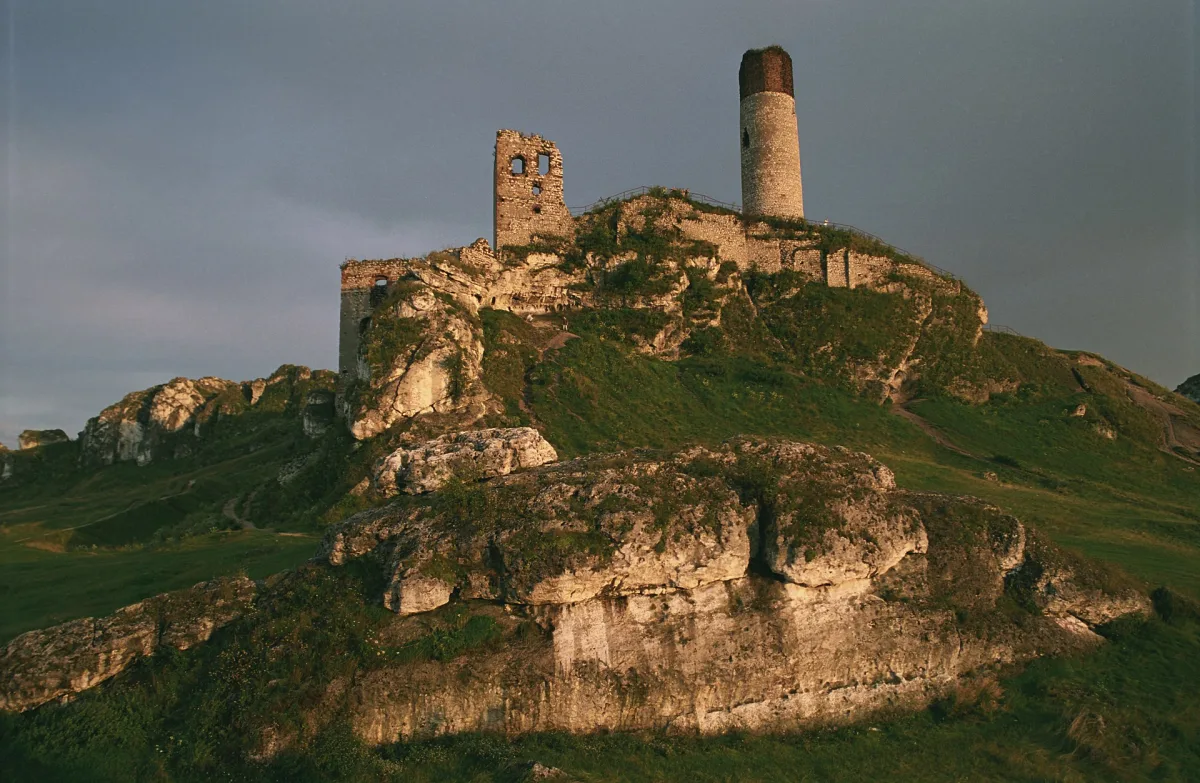
The largest in this group is Sokole Góry near Olsztyn. The reserve was established in 1953 on 333.27 ha, in 1963 it was reduced to 215.95 ha, and since 1 June 2023 it has 222.92 ha, because adjoining forest compartments with Jodłowa Góra were brought under protection. The hills Sokola Góra, Pustelnica, Puchacz, Donica, Karzełek and Setki are made of limestone covered with loess. The caves serve bats for hibernation, and in the Studnisko cave there is a breeding colony of greater mouse-eared bats, one of few in Poland located underground. Through the reserve run the red Trail of the Eagles' Nests, the black trail named after Barbara Rychlik, an educational trail and the St Giles Path (Dróżka Świętego Idziego). Two rocks, Boniek and Pielgrzym, are open for climbing. Two kilometres further stands Olsztyn Castle.
Cisy Przybynowskie in the municipality of Żarki
Cisy Przybynowskie is a small reserve, 7.6 ha with a buffer zone of 20.82 ha, established on 22 August 2015 south-east of the village of Ostrów. It protects a natural site of the common yew: about 30 nearly hundred-year-old trees of tree form and undergrowth, most numerous in the waterlogged parts of the forest. It is one of six yew reserves in the Silesian Voivodeship. The yews are protected by fences against browsing by animals and by the removal of competing trees, so entry may be restricted; the rules are given by the Złoty Potok Forest District.
Beyond the Jura: Szachownica, Dębowa Góra and Borek
Three reserves lie already outside the Kraków-Częstochowa Upland, but neighbour it and fit into one trip. Szachownica in the municipality of Lipie (Kłobuck County) is an inanimate nature reserve, 12.7 ha, established in 1978. It protects the limestone Krzemienna Góra and the passages of the Szachownica cave, exposed during stone extraction. The cave is a site of mass hibernation of bats, so it is not for visiting. Dębowa Góra lies about 2 km south of the centre of Kłobuck: 5.43 ha of oak-hornbeam forest with pedunculate oaks from 140 to 200 years old, established in 1953. Borek near Koniecpol (64.70 ha, 1953) lies in the Włoszczowa Basin, next to the Jura; the founding act gave a slightly smaller area, 64.16 ha.
Szachownica and Dębowa Góra are linked by the Nature Reserves Trail: a blue PTTK walking trail 95.5 km long, from Blachownia station to Chorzew Siemkowice station. It also leads through the reserves Zamczysko, Modrzewiowa Góra, Węże, Dąbrowa w Niżankowicach and Mokry Las. It is the only ready-made chain of marked reserves in this text, but already north of the Jura, in two voivodeships.
Rules that apply everywhere
A reserve is not a park. The rules of entry and permitted paths are set by the orders establishing each of them, and strict reserves, like Bukowa Kępa, have the greatest restrictions. Before you go, check them with the relevant forest district (Złoty Potok, Kłobuck, Gidle) or the Silesian Voivodeship Landscape Parks Complex. On site, keep to the designated roads and trails.
Be the first! Add a comment.
You need to log in to add a comment.
Log in