
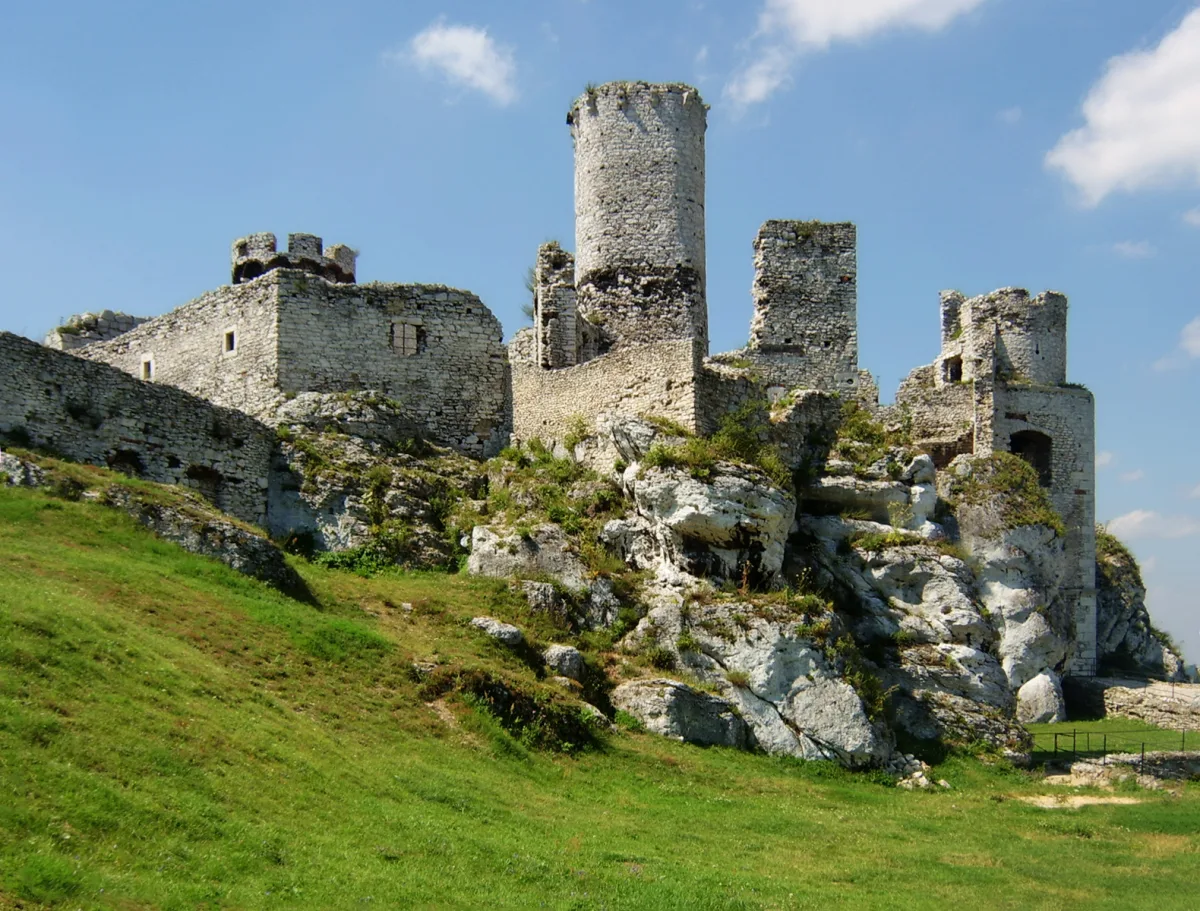
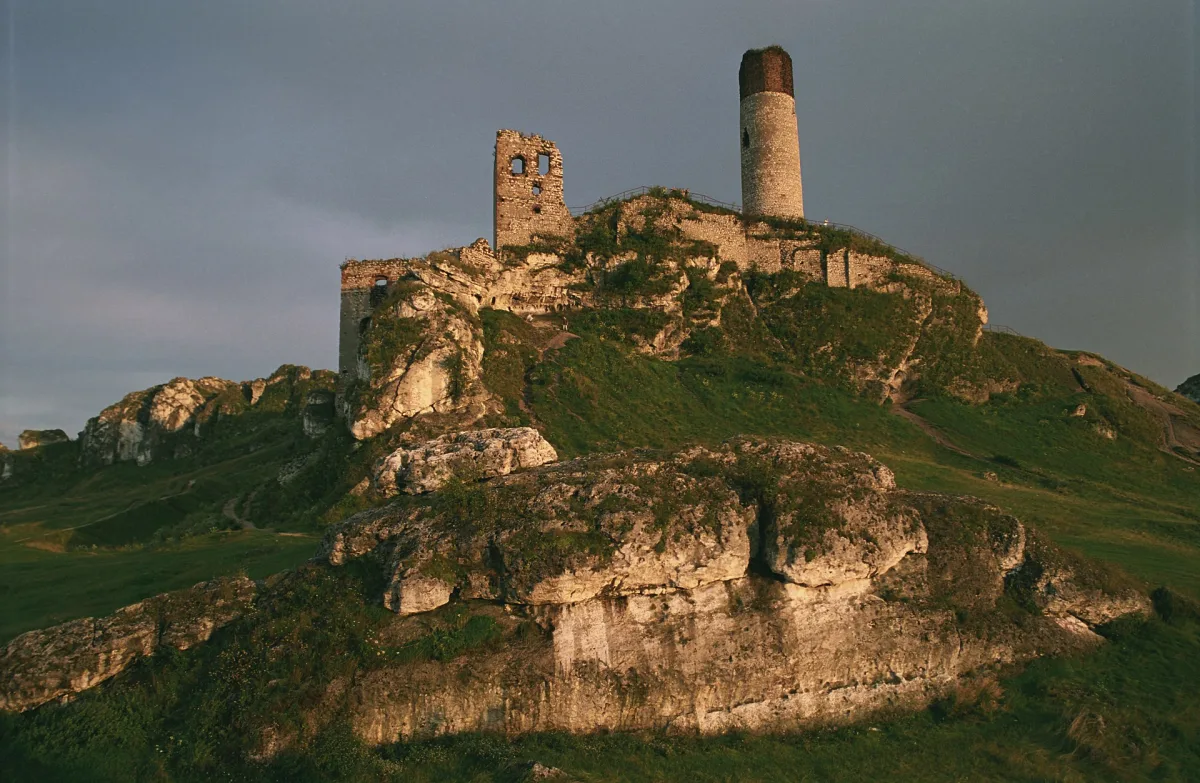
Ogrodzieniec Castle stands in the village of Podzamcze, about two kilometres east of the town centre, on Castle Hill, 515.5 metres above sea level. It is regarded as the highest elevation of the Kraków-Częstochowa Upland. The ruins lie on the Trail of the Eagles' Nests and for decades have been open to visitors as a permanent ruin. The history of the castle is largely a list of successive owners, some of whom expanded the stronghold and others who dismantled it for stone.
From a wooden stronghold to a Gothic fortress
The first fortifications on this spot were built during the reign of Bolesław III Wrymouth and were probably destroyed during the Tatar invasion of 1241. The masonry castle was built later by Casimir the Great, who gave it on a lifetime lease to the Marshal of the Kingdom, Przedbor of Brzezie. Documents indicate that Przedbor spent a considerable sum of money on strengthening the fortifications.
The stronghold was well fitted into the terrain: on three sides it was sheltered by high rocks, the entrance led through a narrow cleft between the rocks, and a stone wall closed the perimeter. In 1387 Władysław Jagiełło granted the castle to Włodek of Charbinowice, cup-bearer of Kraków. From this grant the Włodek Sulimczyk family, of the Sulima coat of arms, held the castle for almost a hundred years. After that the castle often changed owners: in 1470 it was bought by the Kraków bankers, the Salomon brothers, and in 1521 it was pledged by Mikołaj Pilecki, deep in debt.
Boner's Renaissance and the time of the Firlejs
The key moment came in 1530-1545. Seweryn Boner then rebuilt the castle and extended it with a new wing, transforming the Gothic stronghold into a Renaissance residence. To this day fragments of Renaissance frescoes with a lily motif survive on the lowest storey of the tower known as the Hen's Foot (Kurza Stopa). In 1562 the castle passed to Jan Firlej, Grand Marshal of the Crown, husband of Zofia, Boner's daughter.
In 1587 the castle was taken by the troops of Archduke Maximilian, a pretender to the Polish throne. In 1655, during the Swedish Deluge, it was partly burned by the Swedes, who were stationed in it for almost two years. Only Stanisław Warszycki, castellan of Kraków, who bought the castle in 1669, decided to rebuild it. The work lasted until 1680. Warszycki removed the parapets, converted the defensive works into living quarters and surrounded the castle with earth bastions. In the outer ward he added a stable, a brewery, a coach house and a distillery.
Fire, demolition and rescue
After Warszycki's death the castle began to fall into ruin. In 1702 half of the building burned down in a fire which was started by the Swedish troops of Charles XII. Rebuilding was practically not attempted. Around 1784 the castle was bought from the Męciński family by Tomasz Sariusz Jakliński, and the last inhabitants left the stronghold around 1810. The next owner, Ludwik Kozłowski damaged the walls to obtain building material and sold the furnishings. The last private owners were the Wołczyński family.
The turning point came only in the second half of the 19th century. The 1880s were the time when the ruins delighted the writer Adolf Dygasiński, who probably was the first to call them an “eagle's nest”. In the following century this term gave rise to the name of the Land of the Eagles' Nests. In 1906, after a visit by the sightseeing enthusiast Aleksander Janowski to Ogrodzieniec, the Polish Sightseeing Society (Polskie Towarzystwo Krajoznawcze) was founded, and the outline of the castle ruins was placed on its badge.
After 1944 the site was nationalised. Conservation work, intended to preserve the castle as a permanent ruin and open it to visitors, began in 1949 and was completed in 1973. The castle was entered in the heritage register in 1934 and again in 1967.
The castle as a film set
The ruins have long served the camera. In 1973 some of the outdoor scenes for the series “Janosik” were shot here. In 1984 the band Iron Maiden recorded a film insert at the castle, later used in the film “Live After Death”. In 2001 shooting for Andrzej Wajda's “Revenge” took place here, and large parts of the set were then added to the ruins and were not removed after filming ended. In 2019 scenes for Netflix's series “The Witcher” were filmed here, among them the Battle of Sodden. The castle also appeared on a 2-złoty postage stamp issued on 5 March 1971 in the series “Polish Castles”, designed by Tadeusz Michaluk.
The castle also has a seasonal illumination called the Ogrodzieniec Fortress of Light, in which light installations depict the Black Dog and the White Lady, figures known from legends about the castle.
Nearby
On the neighbouring market square in Podzamcze stands a chapel built from castle elements: a portal, spiral staircases and a cornice. Inside lies a cannonball which, according to tradition, fell into the castle during the Deluge. Nearby is the stronghold on Birów Hill, a reconstructed stronghold, and in Ogrodzieniec itself the Miniature Park. The whole can be combined with a drive along the Trail of the Eagles' Nests, to which the castle belongs and which is 163.9 km long and links Kraków with Częstochowa.
Be the first! Add a comment.
You need to log in to add a comment.
Log in