
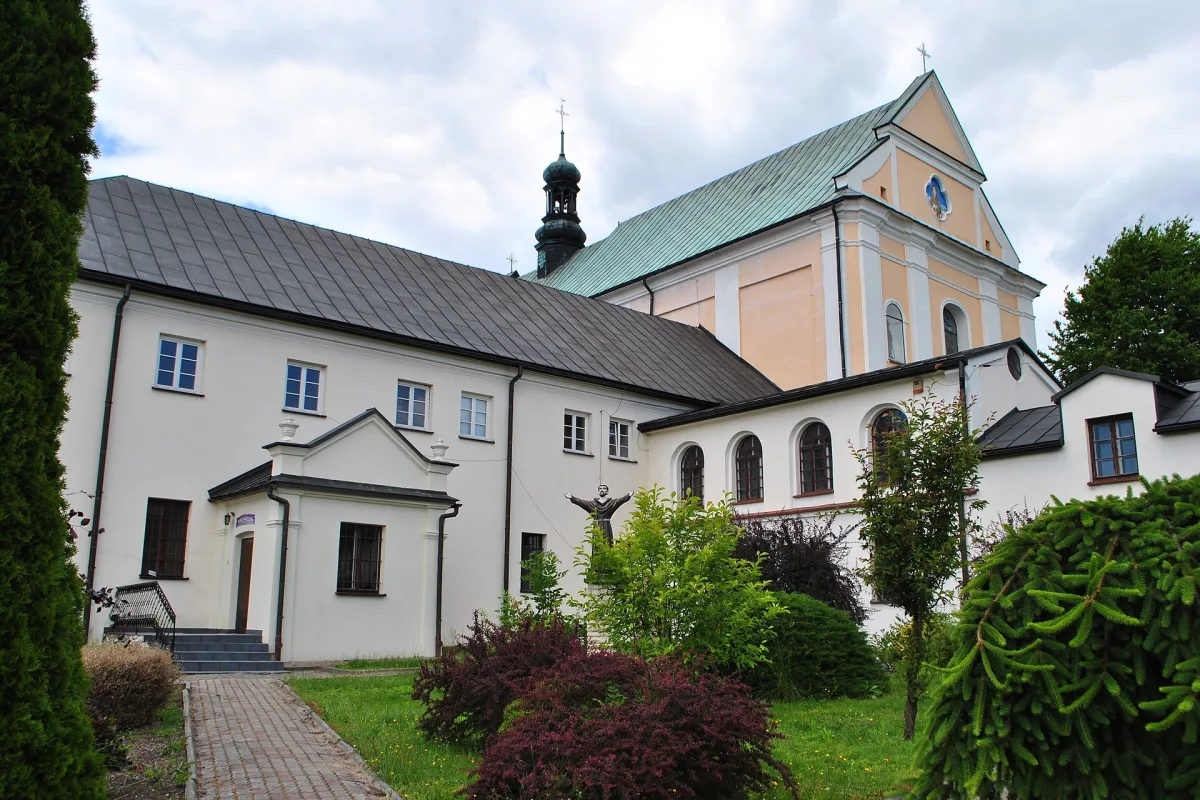
The castle in Pilica is neither a ruin nor a museum. It is a palace from the early 17th century, surrounded by a closed ring of ramparts with six bastions, and one of the few such extensive bastion fortresses in the Jura. One thing recurs in its history: successive owners build, rebuild, sell and in the end quarrel over ownership. So it was in the 17th century, and so it still was after 1989.
From the Padniewski manor house to a fortress
Pilica was bought in 1570 by the Bishop of Kraków Filip Padniewski, who passed it to his nephew Wojciech Padniewski. Wojciech began building a late Renaissance residence shortly before 1605, moving from the farmstead below the castle in Smoleń. Two rectangular buildings were erected facing each other and joined by walls that formed a courtyard. After the Padniewskis died, the unfinished house became the subject of property disputes among the heirs.
In 1613 the estate was bought by the Castellan of Kraków Jerzy Zbaraski. Around 1620 he covered the courtyard with a three-aisled hall on two rows of columns, and on the garden side he added a two-storey loggia with thirteen arcades. The whole began to resemble an Italian villa. Zbaraski also began building fortifications: a letter of 1623 lists among those employed in Pilica the Venetian military engineer Andrea dell'Aqua, known for his work on the fortresses in Zamość and Brody.
The rectangular fortifications measure from 168 to 217 metres in outer length. They are formed by six bastions joined by a rampart 10 to 16 metres high. The top of the rampart is about 10 metres wide, which in the 17th century allowed heavy artillery to be placed on it. A moat about 20 metres wide was dug on the west and south sides. Two vaulted casemates next to the ravelin have survived to this day, along with traces of an earthen retrenchment on the western bastion, where a battery of as many as four heavy guns could stand.
Wiśniowiecka's dowry and the Deluge
After Zbaraski's death in 1631 the castle was inherited by Konstanty Wiśniowiecki, and his daughter Helena brought Pilica as a dowry in 1636 to Stanisław Warszycki. It was Warszycki who around 1640-1650 completed the ramparts and the bastions with casemates, rebuilt the gate area and reinforced the western bastion with a retrenchment. A drawbridge led across the new ravelin to the gate. This produced a fortress that was modern for its time.
War tested it quickly. In November 1655, during the Swedish Deluge, the castle was taken by a unit under Lieutenant Colonel Lars Lindorm. This may have happened without a fight. In February 1656 Warszycki recovered the fortress. Swedish troops took it again in 1705, during the Great Northern War.
The palace of Maria Wessel and the fall of the roof
In 1731 Pilica was bought by Maria Sobieska née Wessel, widow of Prince Konstanty Sobieski. In 1731-1740 she added a Baroque terrace on the south side, which stands to this day. She also demolished two southern bastions and the wall on the town side, so the fortifications lost their military significance and the complex began to be a palace with the old ramparts in the background. In 1734 King Augustus III of Poland stayed here on his way from Kraków to Częstochowa. The nearby Reformed Franciscan monastery also arose from her donation of land: the Franciscan monastery in Pilica was founded in 1740 and officially began operating in 1745.
After her withdrawal from the estate in 1753 things went badly. Pilica became the subject of lawsuits over claims, and in 1787 the Crown Tribunal in Lublin awarded rights to the estate's assets to 86 persons and institutions. The palace decayed. In 1810, when the King of Saxony and Duke of Warsaw Frederick Augustus I visited it on his way to Kraków, the building was already in ruins, and the then owner lived in the outbuilding. In 1846 the roof collapsed.
Rescue came in the 19th century. In 1851 the palace was bought at auction by Christian August Moes, who carried out a renovation with a rebuilding of the interiors. After 1874 the Warsaw industrialist Leon Epstein gave the whole a Neo-Renaissance look, added two orangeries and built a romantic gate in the rampart with sham loopholes. The brick facing that can be seen today on the ramparts dates from around 1874-1894. In 1880 the Epsteins left for Kraków because of financial difficulties and the owner's illness. From 1908 to 1945 the castle belonged to the family of Kazimierz Arkuszewski.
The years of occupation
From the end of 1942 to the spring of 1944 a platoon of German gendarmerie was stationed in the castle. According to an article in Dziennik Polski, about 80 Poles and about 70 Jews were shot under the castle walls during this time. Executions of the Jewish population also took place at the Pilica Jewish cemetery in 1942-1943. Before the war Jews made up the majority of the town's inhabitants. A ghetto was set up here in 1941, and in 1942 the community was resettled to the ghetto in Wolbrom, from where it was sent to the camps. The cemetery is a burial place, not an attraction, and should be thought of that way.
In 1945 a Red Army field hospital was set up in the palace, during which the furniture and the library were destroyed. In 1948 the complex was taken over by the Education Board (Kuratorium Oświaty i Wychowania) in Kraków. It housed a children's home for girls, a school and, in 1957-1982, a reformatory for boys.
The dispute over the castle after 1989
In May 1989 the palace complex was bought from the State Treasury by Barbara Piasecka Johnson. She planned a residence there and a gallery of paintings from her collection, open to the public. Architects carried out research and a design for the adaptation, in 1991 the outbuilding and the old guardhouse were renovated, and a new twin one was built by the gate. After a year the work stopped: claims were lodged by descendants of Kazimierz Arkuszewski, who maintained that the State Treasury had sold the palace without the consent of the Minister of Culture. The Voivodeship Court in Katowice banned further works, although 3 million dollars had already been spent on the renovation.
In 1996 the Regional Court in Katowice held the deed of sale invalid, because the Minister of Culture had not consented to it. The appeal proceedings, had not concluded by the death of Piasecka Johnson in April 2013. For this reason the castle, despite its impressive ramparts, has no single simple scenario for visiting, and the rules of entry to the grounds must be checked before a visit.
The park and the town that regained its rights
Around the palace stretches a park of about 10 hectares, recognised as a natural monument as a work of garden art, with a Classicist well. The card for the castle in Pilica itself can be found in the catalogue of sites, and the complex has been entered in the heritage register since 1961.
The town to which the castle gives its character has its own history. It probably received town rights in 1393, lost them on 1 January 1870 under a tsarist ukase of 1869, issued a few years after the January Uprising, and regained them only in 1994. Some sources, however, give the span 1393-1935 and the year 1994, so the last date would need checking in a legal source. Legends are also told about the castles of the Jura, but they are covered in a separate article.
Be the first! Add a comment.
You need to log in to add a comment.
Log in