
According to the Silesian tourist service, the stronghold in Siewierz on the Czarna Przemsza was already the seat of a castellany at the beginning of the 13th century. From this outpost on the borderland of Lesser Poland and Silesia an independent duchy grew in the 15th century, ruled by the bishops of Kraków. Morsko Castle, whose ruins stand on a rock in Skarżyce, is linked with the same borderland.
From castellany to the bishops' duchy
The Siewierz land was a former castellany ruled in the 14th century in turn by the Opole-Racibórz, Bytom and Cieszyn Piasts. The name “duchy” first appears in 1341. The turning point came on 30 December 1443, when the indebted Duke Wenceslaus I of Cieszyn sold the Siewierz land to the bishop of Kraków, Zbigniew Oleśnicki, for 6,000 marks. Other Silesian dukes opposed this, and peace with the last of them was made only in 1453.
From then on the bishops of Kraków were at the same time dukes of Siewierz. The formal ducal title began to be used in 1484 by Bishop Jan Rzeszowski. The lands of the duchy were sovereign in territorial and judicial terms, and the Polish-Lithuanian Commonwealth influenced them only indirectly, through the king confirming the bishop. The duchy had its own treasury and army. At the end of its existence it comprised about 85 villages and settlements and three towns: Czeladź, Koziegłowy and Siewierz. The extent of the duchy did not coincide with the later Dąbrowa Basin: most of the area of Dąbrowa Górnicza, Sosnowiec and Będzin did not belong to it, while Czeladź and Wojkowice lay in it entirely.
The Great Sejm incorporated the duchy into the Commonwealth in 1790. The bishops of Kraków nevertheless kept the title of dukes of Siewierz: it was confirmed in 1889, and the last to use it was Cardinal Adam Stefan Sapieha, who died in 1951.
Siewierz Castle: stronghold, gate and artillery terrace
The bishops' castle is described in the entry on the Bishops' Castle in Siewierz. The town was chartered around 1276 at a distance of 2 km from the old stronghold, and a new seat of the castellans was built in a bend of the river, among backwaters and marshes. The beginnings of the masonry castle have not been finally established: research since 2001 confirms a wall already in the second half of the 14th century, which contradicts the dating to the 15th century that is common in popular studies. The cylindrical keep, 9 metres in diameter, dates from the end of the 13th century. In 1337-1358 Duke Casimir I of Cieszyn had the rampart replaced by a perimeter wall and a masonry house built on the east side.
The bishops rebuilt the castle into a residence. In 1471-1488 Bishop Jan Rzeszowski built a new gate on the north side, and in 1518 Bishop Jan Konarski raised a tower above it. Around 1524-1530 the Gothic keep was pulled down and its material was used for new residential wings. In 1575 the prince-bishop Franciszek Krasiński added an outer wall, and the space between it and the castle was filled with earth. An artillery terrace with ten cannon was created, and the gate was protected by a barbican. The Baroque rebuilding of 1681-1699 gave the east wing a chapel and, on the north side, an arcaded loggia. The gate tower was then crowned with a Baroque helm.
In 1790, after the abolition of the duchy, the last prince-bishop, Feliks Paweł Turski, left the castle. Throughout the 19th century the building stood uninhabited and deteriorated. Securing work was carried out in the 1950s and 1970s, and since 1999 it has been conserved as a permanent ruin. Among other things the outer walls of the residential wings, the tower above the main gate and the barbican have survived.
The duchy is also linked to the proverb “Bij, kradnij, zabijaj, ale Siewierz omijaj” (“Beat, steal, kill, but avoid Siewierz”). The slaskie.travel service connects it with the Siewierz Tribunal, which from the 17th century was said to have handed down numerous death sentences. The saying also exists in a slightly different version and is set beside the duchy's harsh judiciary with its executioner's privilege. We treat this as a tradition about the reputation of the Siewierz court, not a description of documented numbers of sentences. The duchy also did not mint its own coin: the so-called Siewierz ducats were struck only after its abolition, as a commemoration.
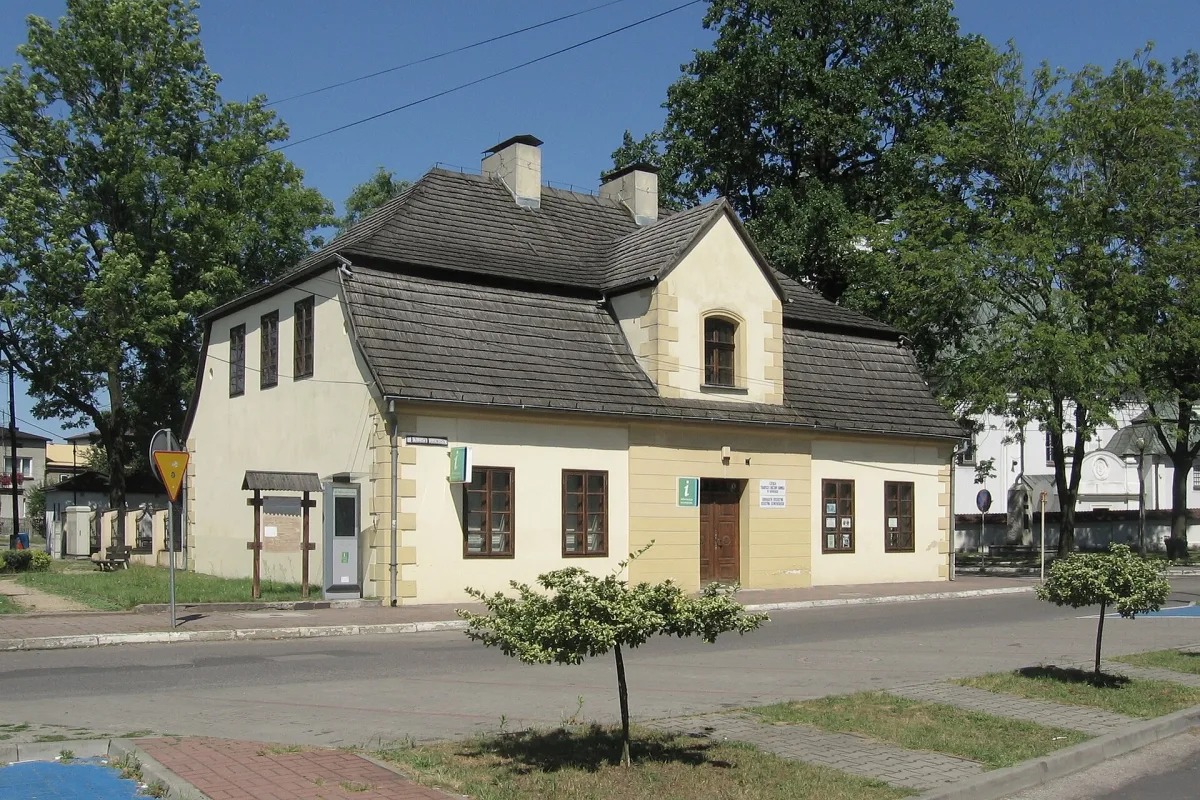
The history of the town and the castle is shown in several rooms by the Chamber of Tradition and Old Culture in a manor house on Kościuszki Street, with models of the castle and of the town hall that no longer exists. The castle in Koziegłowy also belonged to the duchy's estates: the castle in Koziegłowy is today a ruin, and already in 1548 it was described as long devastated.
Morsko: Bąkowiec Castle on the Tygrys rock
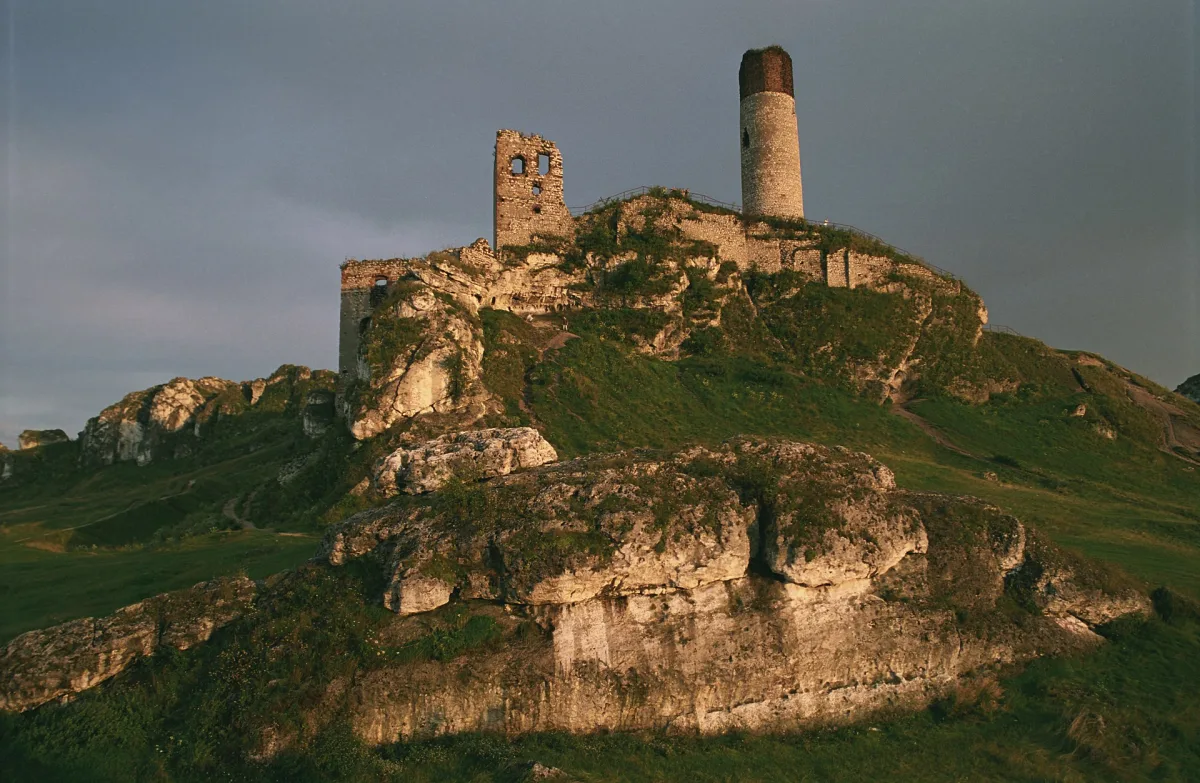
Morsko Castle, also called Bąkowiec, stands on the limestone rock Tygrys in Skarżyce, a district of Zawiercie. The heritage register lists it as Bąkowiec Castle in Morsko, after the village with which it was linked from the Middle Ages. Details are given in the entry on Morsko Castle. The village was first mentioned in 1220, but the castle itself cannot be dated so early. Sources give several hypotheses: a wooden fortress may have been raised in the 14th century by the Topór family, an outpost may have been built by Casimir the Great as part of the fortifications of the Lesser Poland-Silesia borderland, and the castle may also have been created on the initiative of Duke Władysław of Opole, who briefly ruled the Lelów land at the end of the 14th century.
The first certain mention dates from 1389, when the castle chaplain wrote down the name “Bancowecz”. In the summer of 1391 the castle was taken by royal troops in the fighting between Władysław Jagiełło and Władysław of Opole. In the 15th century the owners changed: from 1392 the burgrave and owner was Piotr of Marcinowice, and in 1442 Bishop Zbigniew Oleśnicki, guardian of the young owner, leased the castle for four years. The masonry castle whose remains can be seen today is attributed to the Włodek family at the turn of the 15th and 16th centuries. From the 17th century the castle was a ruin.
We know the layout of the building from the description of its architecture: an irregular polygon on the top of the rock, a stone gate leading into a small courtyard, semicircular towers at the corners and access to the upper castle on foot only, by a system of bridges and ladders. Around 1927 the architect Witold Czeczott-Danilewicz bought the hill and before 1933 built a house using the castle walls. In 1959-1961 the ruins were conserved, and in 1967 they were entered in the heritage register.
The Eagles' Nests next door
Morsko belongs to the system of castles called the Eagles' Nests, which the red Trail of the Eagles' Nests leads through. On the Silesian section lie also the ruins of Ogrodzieniec Castle, Bobolice Castle, rebuilt from ruins at the beginning of the 21st century, and, about 1.3 km away, Mirów Castle. In Podzamcze, next to Ogrodzieniec, stands also the reconstructed stronghold on Birów Hill. An overview of the castles of the region as a whole is in a separate article on the castles of Upper Silesia and the Basin.
Be the first! Add a comment.
You need to log in to add a comment.
Log in