
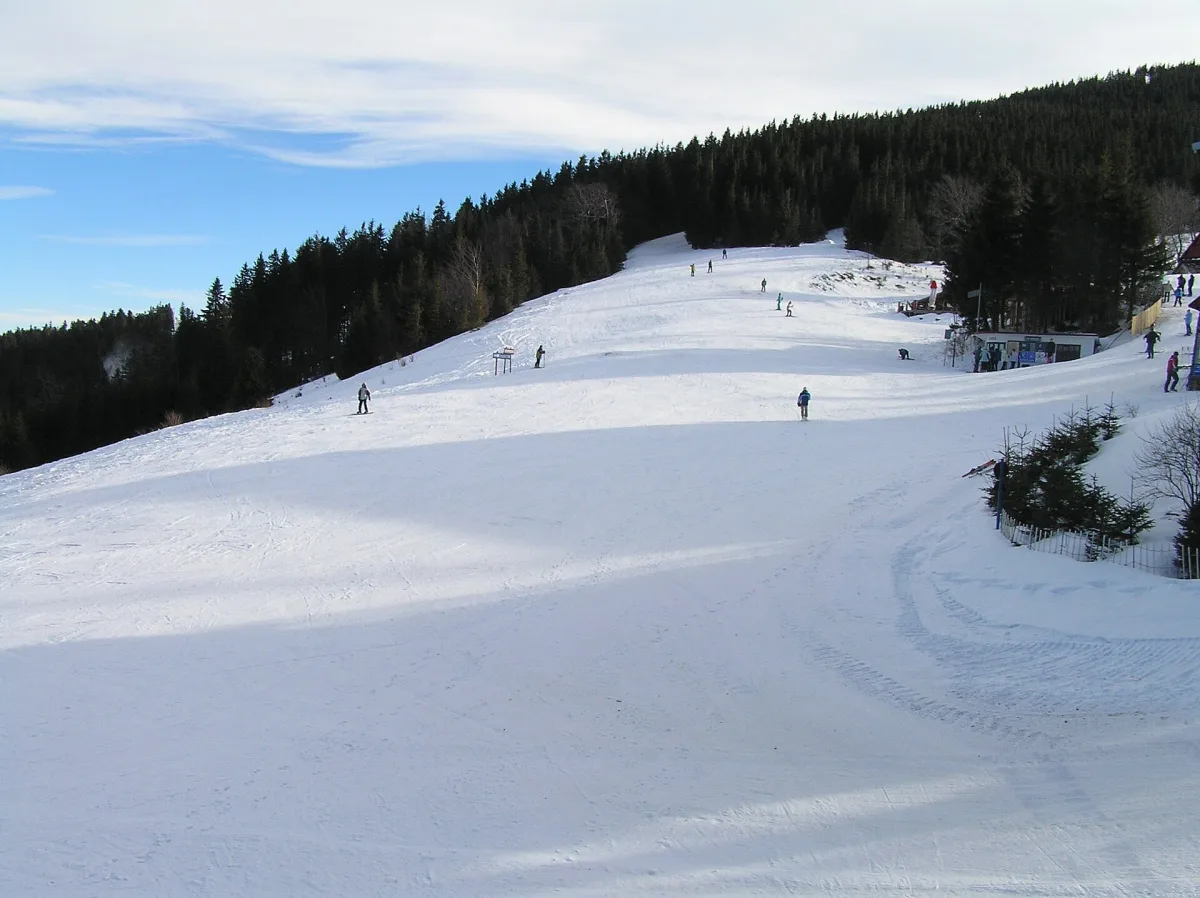
Szczyrk: three large resorts and a small slope for beginners
Szczyrk was learning to ski as early as the interwar period. In 1924 a tourist shelter for skiers was built on Skrzyczne by the German society Beskidenverein. Real development, however, came after the war. At the end of the 1960s the first four ski lifts were operating in the town, two drag lifts and two T-bar lifts, along with a toboggan run and an ice rink.
The beginning of the modern slopes was the chairlift to Skrzyczne in the resort of the Central Sports Centre (COS). It was built in 1954-1960, and the first section was put into use on 26 January 1958. In the following years T-bar lifts were built at Doliny in the Skrzyczne massif, which are regarded as among the first of their kind in Poland. The resort today has three chairlifts and a platter lift, and its downhill runs total 12.5 km. At the top awaits the PTTK mountain hut on Skrzyczne.
On the other side of the valley lies Czyrna-Solisko, also known as Szczyrk Mountain Resort. In terms of the length of its runs it is the largest of the three: it has about 25 km, and among the most difficult are Bieńkula and Golgota. The resort has one gondola lift, three chairlifts and a T-bar lift, and about 80 per cent of the runs are covered by artificial snow. In summer there is infrastructure here for mountain bikers.
The Beskid Sport Arena in Szczyrk-Biła has a quieter character. The resort's website stresses that it is smaller than the other Szczyrk slopes, which translates into shorter queues. A six-seat detachable chairlift started running here on 27 December 2016, and earlier for many years a T-bar stood on the slope. Four runs descend from the top station, including one black. For complete beginners there is Biały Krzyż on Grabowa Street: two short T-bars and a gentle, wide run.
Skalite and Klimczok: ski jumping in the Beskids
Skalite is a complex of three ski jumps on the northern slope of the peak of the same name. The first competitions were held here on 14 February 1937, and competitors then landed at most about 40 metres away. The jump was rebuilt before the Polish championships in 1949, and in 1958-1989 the most important event was the Beskid Cup, with competitors from various countries. The biggest reconstruction fell in 2007-2008, when a jump with a construction point of K95 was created. The K70 jump was added later, and the small one, K40, was opened in 2010.
In 2018 the complex was named after the Beskid Olympians. Skalite is managed by the COS Olympic Preparation Centre, so access to the grounds outside competitions must be arranged with the manager.
A much smaller facility stands in Bielsko-Biała. The LKS Klimczok complex in Bystra consists of two ski jumps side by side, HS-31 and HS-19, built in 2009-2010 and opened in September 2010. Both are covered with plastic matting, so jumping takes place on them outside winter as well. They are used by the LKS Klimczok club from Bystra.
Dębowiec, Żar and Zwardoń: family slopes
In Bielsko-Biała, in the Kamienica district, Dębowiec operates, opened on 18 January 2013. Its basis is a four-seat chairlift to a clearing, in winter for skiers and snowboarders, in summer for walkers. It is a year-round investment by the municipality, mostly financed from EU funds. Beside the lift there is a snow park, a rope park and an educational trail.
Further south lies Żar in Międzybrodzie Żywieckie, in the Little Beskids. The cable funicular was built here in 2003 on the tracks of a former glider launch lift, and pilots proposed moving the cars dismantled during the modernisation of the Gubałówka railway. Three runs lead along the tracks, the longest 1600 metres.
In Zwardoń the Zwardoń Ski station on Mały Rachowiec opened a four-seat chairlift on 27 December 2012. Earlier a two-person T-bar worked here. The resort is linked by a joint pass with the Duży Rachowiec station on the northern slopes of Rachowiec. The smallest in this overview is Ski Park Rajcza: one lift 310 metres long on the slope of Cząpel hill, near the palace complex.
Pilsko and Korbielów: mountains in the traditional style
On the opposite end of the scale stands Pilsko. Outside the Tatras it is one of the highest-lying ski resorts in Poland, and the lifts reach about 1500 m above sea level. Most of the runs are neither lit nor covered with artificial snow, and black run number 7 is not groomed and is rarely open. A section of run number 5 has FIS homologation. A curiosity is lift number IX, which goes downhill over a short stretch, so a skier pulled by the platter must snowplough.
The T-bar lifts and runs here were built by Silesian enterprises at the turn of the 1980s and 1990s. An environmental conflict surrounded this investment: in the 1990s nature organisations protested, and the Supreme Administrative Court ordered some illegally erected lifts to be dismantled by the end of 2005. A scientific expert report recommended restrictions, among them a ban on skiing over dwarf mountain pine. On the Polish side lies the Pilsko nature reserve, so when using the slopes it is worth keeping to the marked runs.
Right next door operates the Baba lift, a small resort with a two-seat chairlift and one easy run 0.9 km long. It is a good place for first descents. As at every resort, lift hours, the condition of the runs and snow conditions should be checked with the operator just before travelling.
Be the first! Add a comment.
You need to log in to add a comment.
Log in