

Wisła, which was the skiing capital right after Zakopane
Skiing in the Silesian Beskids did not begin with today's chairlifts. In the interwar period Wisła was one of the most popular summer resorts in Poland, and as a ski resort it was among the leading ones. In the same period a swimming pool and a ski jump were built in Głębce.
This tradition survived. In Wisła itself and its surroundings there are seven larger resorts, almost 30 lifts (seven of them chairlifts) and more than 20 km of downhill runs. These are not slopes on an Alpine scale: rather, they are descents of a few hundred metres in the forest, but close to one another, with evening lighting and well developed facilities for beginners.
Seven slopes in Wisła, each a little different
Nowa Osada lies on the slope of Wróblonka and has a four-seat Doppelmayr chairlift, put into operation before the 2009/2010 season. Earlier an ordinary two-person T-bar ran here. Six runs (four blue, a red and a green) are lit and covered with artificial snow, and from the 2011/2012 season the resort belonged to a joint pass of six slopes, then called the Wisła Pass.
Further on, in Malinka, two neighbouring slopes stand. Cieńków has six lifts, including a four-seat chairlift from the 2008/2009 season, and red, blue and green runs, no black ones. About 600 metres from it is Klepki, a small resort with a chairlift handed over on 26 January 2014 and an easy nursery slope for the youngest. The ski jump in Malinka itself is a separate subject; here it is enough to know that both slopes lie in its neighbourhood.
Soszów was built in the 1980s by the 1 Maja Coal Mine. Today the resort has a chairlift from the 2008/2009 season and the longest run in the area, 1900 metres, descending from the summit to the bottom station. Below the summit stands the mountain hut on Soszów Wielki. Also linked to the mining background is Stok in Jawornik: the first T-bar was probably erected here in 1972 at the holiday centre of the "Wawel" mine, and the present four-seat chairlift was put into operation on 8 December 2016.
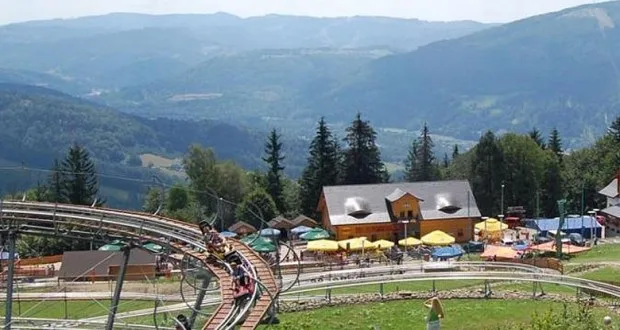
Stożek uses the eastern slope of Stożek Wielki: the slope runs from 959 to 713 m above sea level (the base lies at an altitude of 713 m). It has five runs, including a black one, and a joint pass with its neighbours. By the upper part operates the PTTK Stożek mountain hut, a good destination for a break or an overnight stay. A completely different character belongs to Skolnity in the very centre of the town. A four-seat Leitner lift carries people to the top of Wierch Skolnity, where a 38-metre wooden viewing tower stands, and in summer the slope turns into a bike park.
Ustroń: Czantoria and Poniwiec
In Ustroń there are three larger resorts, each with a chairlift. The chairlift has a long history here. At the resort on Czantoria the first chairlift ran in October 1967, and the present one, four-seat with detachable chairs, was put into operation in December 2006. The top station stands in the Stokłosica clearing at an altitude of 851 m above sea level, and the slopes are served by several lifts: the Faturka T-bar (670 m), the Solisko, Stokłosica and Nartowisko platter lifts and a conveyor belt for children. The five downhill runs total 4.5 km, the longest 2.6 km.
On the northern slopes of Czantoria grows the Czantoria nature reserve, established in 1996, so the descents take place right next to protected forest. Poniwiec on the slope of Mała Czantoria, in turn, is intimate: one red run beside a four-seat chairlift from the end of 2013, a separate nursery slope for children and a snow park. It is a good choice for families who prefer less traffic than on the main slope. The third Ustroń resort, Palenica, has no separate entry in the portal.
Cross-country skiing, museums and one pass
Downhill is not everything. On the Kubalonka pass there are four cross-country loops (2.5, 3, 5 and 7.5 km) together with a biathlon range, managed by the Central Sports Centre from Szczyrk. Close at hand is also the wooden Kubalonka viewing tower. The description of the trails usually changes with the season, so their current state must be checked with the manager.
The history of local skiing is shown by the Adam Małysz Beskid Skiing Centre: a modern museum that grew out of the private Zimowit institution. It has five thematic zones, from the geography of the Beskids to a gallery of the region's champions, and several dozen historic exhibits, including skis from the end of the 19th century. The collection of memorabilia of Wisła's most famous ski jumper is supplemented by the Adam Małysz Sports Trophies gallery, opened in 2007, with cups, skis and suits.
A convenience for those planning is the joint pass system, which in various sources appears as the Wisła Pass or the Wisła Skipass. According to descriptions, Nowa Osada, Cieńków, Stożek, Klepki and Czantoria belong to the joint system, so during a stay several resorts can be visited. There are also the Beskid and Rowienki slopes here, which have no cards of their own in the portal. The scope of the pass changes from season to season and must be checked before travelling. The same goes for lift hours, snow and artificial snowmaking.
Be the first! Add a comment.
You need to log in to add a comment.
Log in