
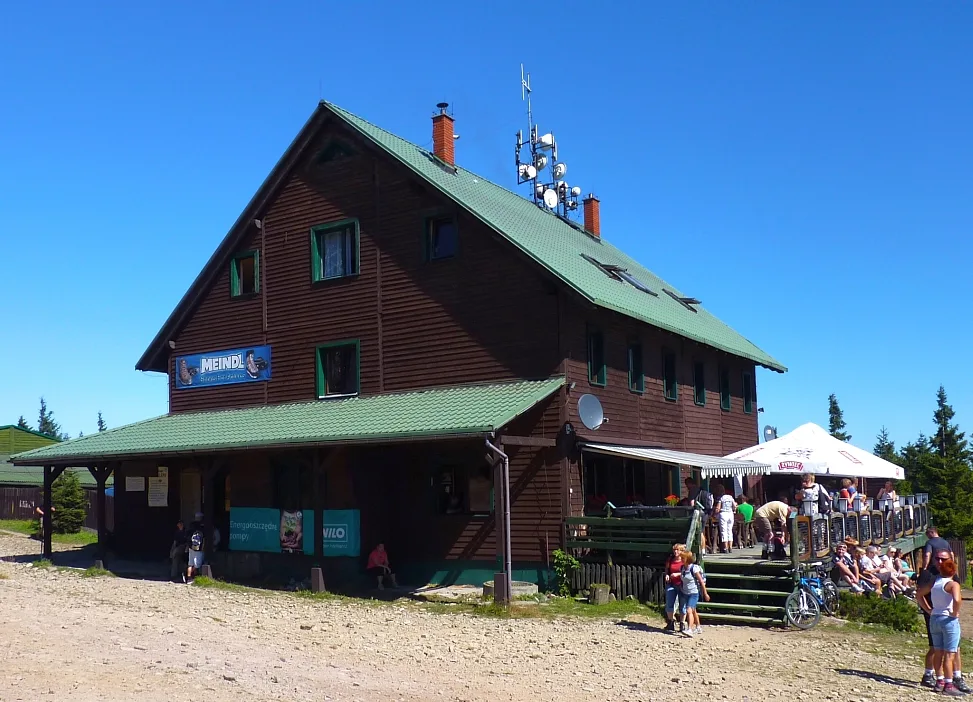
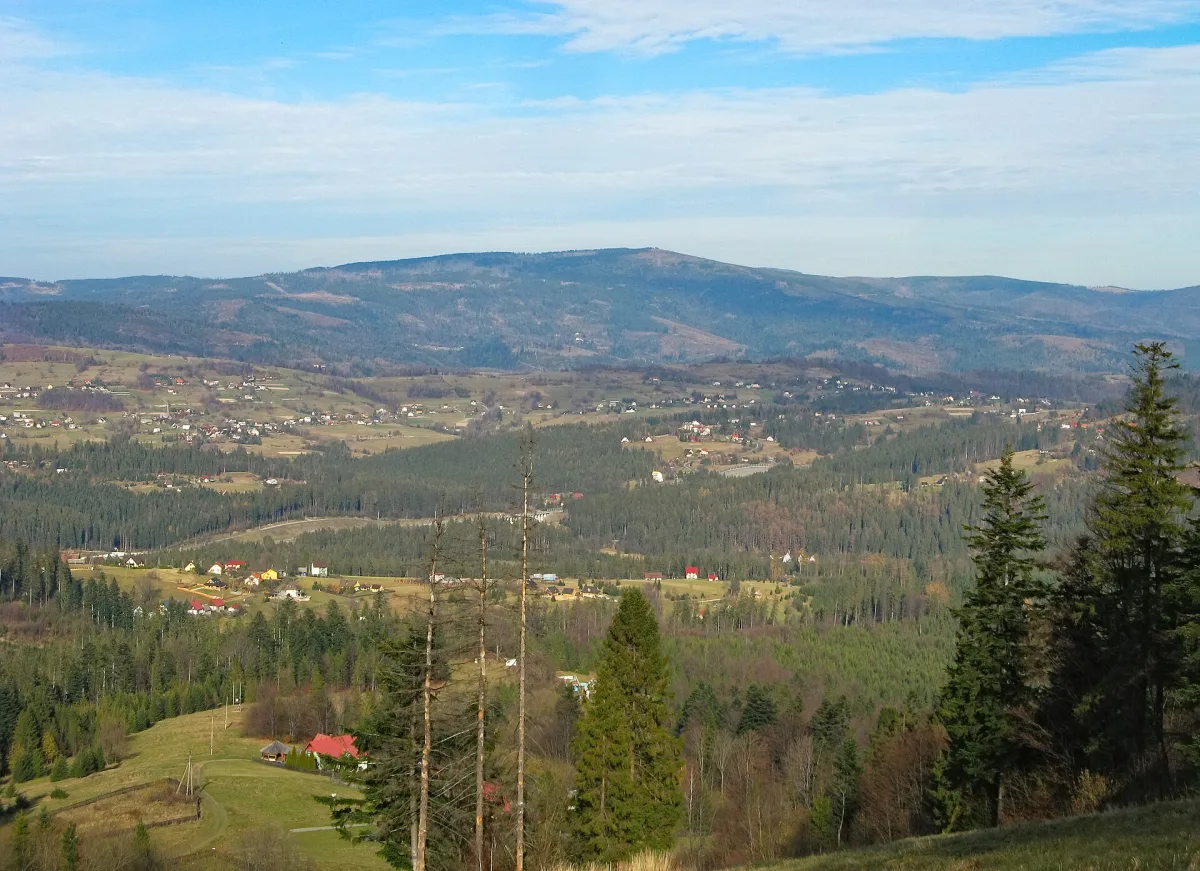
Szczyrk lies in the Żylica valley, at an altitude of 470 to 1,257 metres, beneath Skrzyczne, the highest peak of the Silesian Beskids. Today it is a tourist and leisure town with several ski resorts, but a hundred years ago it was a village of zarębnik settlers, shepherds and woodcutters, where skiers appeared only in the 1920s.
A village of zarębnik settlers
Settlement by Vlachs, Hungarians, Austrians, Czechs and Slovaks is documented here from the 15th century. The first census of Szczyrk, drawn up for tax purposes, dates from 1630. Land was granted in a way characteristic of mountain settlements: a zarębek, the equivalent of a łan (a land holding), was marked out from the axis of the valley, and the settler received equal amounts of land on the sunnier and the shadier slope. In 1808 there were 172 zarębnik holders in the village.
From the 18th century, alongside farming, sheep herding and timber extraction developed, mainly for the industry of nearby Biała and Bielsko. Cloth was also made from sheep's wool. According to the Austrian census of 1900, 2,465 people lived in 411 buildings, including 2,248 Catholics, and 2,455 residents declared Polish as their language. Salmopol was then a separate village, where out of 169 inhabitants as many as 119 professed a religion other than Catholicism, mainly Protestantism.
The first skiers and mountain huts
Tourism began in earnest after the First World War. The first accommodation base was the former Austrian barracks and field hospitals. In 1924 the Beskidenverein built a shelter for skiers on Skrzyczne, and in 1933 a tourist hut began operating. Today's PTTK mountain hut on Skrzyczne stands just below the summit, at an altitude of about 1,250 metres. In 1927 Salmopol was added to the municipality and Szczyrk became a place of two denominations: a Protestant church stands there to this day, next to the Catholic parish church of St James the Apostle from 1797-1800.
On the Salmopol Pass, at the town boundary, there is a small ski complex, Biały Krzyż, with a T-bar lift and a button lift on easy runs.
Holidays for Upper Silesian workplaces
After the war the town began to grow quickly, because the large Upper Silesian conurbation was close. At the end of the 1960s the Workers' Holiday Fund ran four holiday houses in Szczyrk: Halka, Maria, Skalite and Zakopianka, in nine buildings from the interwar years, with 255 places in all. Holidays lasted fourteen days. Private rooms quickly multiplied, and new facilities were built by large Upper Silesian employers. From 1965 the PTTK Tourist House with 296 places operated, and the Zagroń holiday house of the Zabrze Coal Industry Association could take 360 guests and was the only one with its own indoor swimming pool.
In 1958 a chairlift to Skrzyczne was built. In winter the first four ski lifts were then in operation, two tow lifts and two T-bar lifts, along with a toboggan run and an ice rink. Szczyrk received the status of a settlement, and on 1 January 1973 town rights. The sources do not agree here on the date of the settlement status: they give the year 1958 or the transformation of the gromada into a settlement in 1956. At the beginning of the 1980s the town had more than 80 holiday houses, hotels and guesthouses with about 9,000 beds. In 1975-1998 Szczyrk belonged to the Bielsko voivodeship.
From slopes to resorts
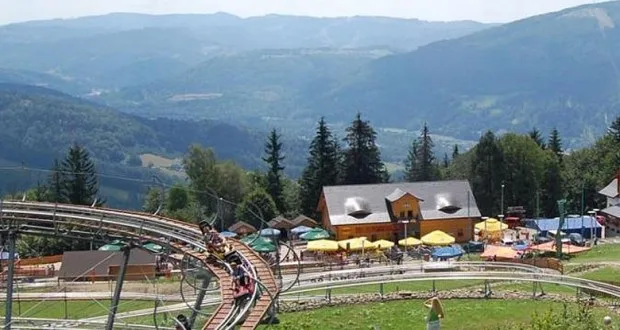
On the slopes of Skrzyczne operates the COS OPO ski resort, known for its black FIS downhill run. On the slopes of Mały Skrzyczne lies Czyrna-Solisko, with the Bieńkula and Golgota runs, and in Biła the Beskid Sport Arena resort. A description of the slopes and lifts can be found in the article on the ski resorts of Szczyrk and the Żywiec region. In summer the area lives differently: you ride up Skrzyczne by chairlift, and the summit is crowned by an 87-metre radio and TV transmitter mast, erected since the end of the 1990s.
The town's skiing tradition is also visible in ski jumping: the Skalite ski jump complex lies in Szczyrk, at the north-eastern foot of the Skrzyczne massif.
Skrzyczne and the tale of the frogs
The name of the mountain, according to a widespread tale, is said to come from the croaking (skrzeczenie) of frogs. It was recounted in the 18th century by the Żywiec village head Andrzej Komoniecki in the Dziejopis Żywiecki: there was supposedly a pond here in the hollow between Skrzyczne and Mały Skrzyczne, where frogs could be heard far off towards evening. Whether the pond really existed is not known, because the source says of it that it reportedly existed. Skrzyczne is today the highest peak of the Silesian Beskids and belongs to the Crown of Polish Mountains.
Be the first! Add a comment.
You need to log in to add a comment.
Log in