
The names of the three highest peaks of the Silesian Beskids sound familiar, but each has a different history. In one case we have a record by an old chronicler, in another a tale about a brigand, in the third several competing explanations, none of them certain. Below these versions are gathered together with information on who recorded them and how far they can be trusted.
Skrzyczne: the mountain where frogs once croaked
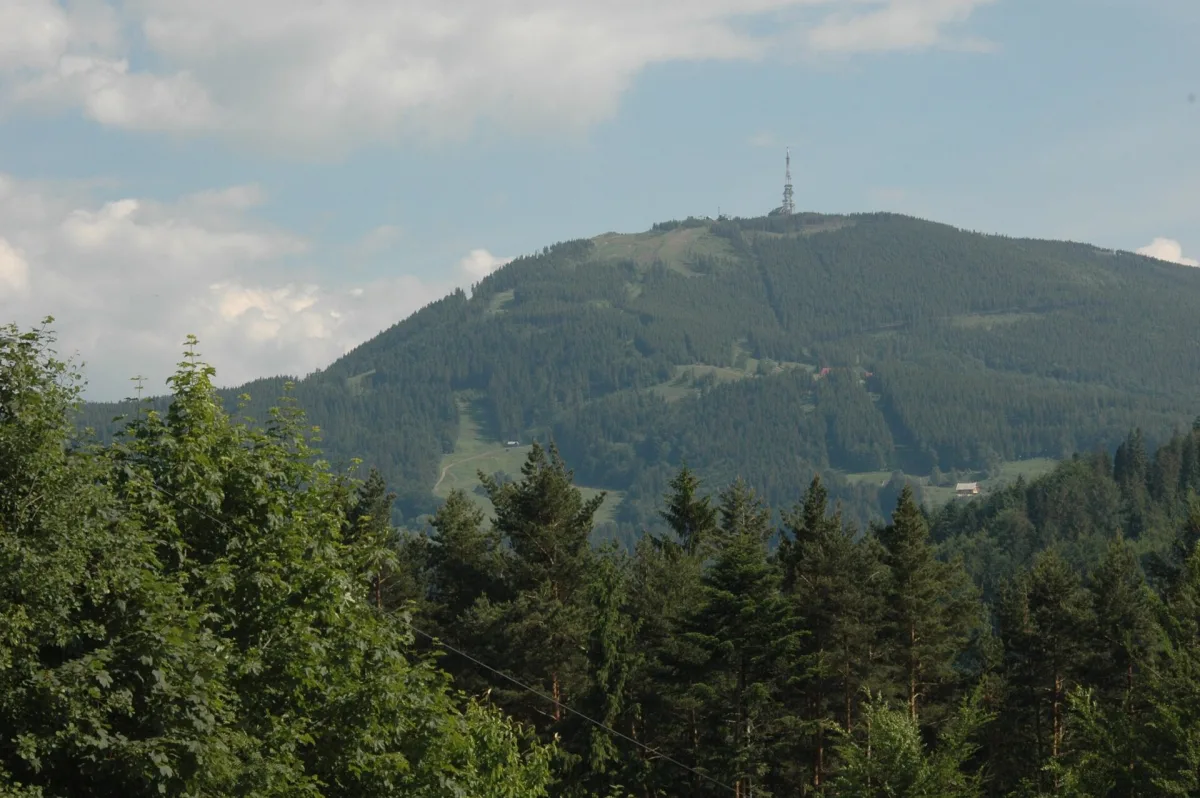
Skrzyczne is 1257 metres high and is the highest peak of the Silesian Beskids. It rises above Szczyrk at the northern end of the main ridge of the Barania Góra and Skrzyczne range, and on the Żywiec Basin side it drops in a steep, almost 800-metre scarp. The mountain used to be called Skrzecznia or Skrzeczno.
The oldest known explanation of the name dates from the 18th century. Andrzej Komoniecki, the reeve of Żywiec, described in his Dziejopis Żywiecki (Chronicle of Żywiec) a lake on this mountain, like a pond overgrown with rushes, in which black water stands. According to him the mountain is called Skrzecznia because frogs often croak in this lake, and in the evening they can be heard from afar. This refers to a pond in the hollow between Skrzyczne and Mały Skrzyczne.
This tale is widespread, and the pond supposedly existed there, while the hollow is allegedly glacial. Two things should therefore be told apart: Komoniecki's record is a historical source, but the claim that the name really comes from frogs remains a folk explanation, not a finding of linguists.
The mountain can be reached by chairlift from Szczyrk, and just below the summit stands the PTTK mountain hut on Skrzyczne. On the summit there is also an 87-metre radio and television transmitter mast, thanks to which the mountain can be seen from afar, reportedly even from the Tatras.
Klimczok: the brigand's mountain
Klimczok is 1117 metres high. The administrative boundary between Bielsko-Biała and Szczyrk runs across its summit, as does the former border between Silesia and Lesser Poland. As late as the early 19th century it was called Goryczna Skałka (Bitter Rock) or simply Skałka. The older name is linked to a system of ridge trenches and rock fissures just below the summit.
The present name is said to come from a brigand of the Żywiec-Silesian borderland who was called Klimczok. According to local tales he hid in one of the small caves on the western slope, the largest of which is 26 metres long. In the Romantic era the brigand's name was said to have stuck to the summit, and the form Klimczak was also used. This is a tale, not an established fact: we do not know whether such a man existed, or exactly when he was active.
A separate story grew up around the brigand. It was recorded on one of the tourist websites, so we treat it only as a curiosity. According to it, Klimczok came from a noble family and loved Klementyna Sułkowska, who had been promised to a Viennese prince. The brigand was supposed to have carried her off from the altar and built a manor for her on the site of today's mountain hut, and to have ended on the gallows hook, handed over to the authorities by a greedy peasant. We know of no written source for this version, and it should not be taken for history.
Next to the summit, about 700 metres to the east, stands the PTTK Klimczok mountain hut. We wrote about the history of the mountain itself, its neighbour Szyndzielnia and the origin of their names in a separate article on Szyndzielnia and Klimczok.
Barania Góra: several explanations, no resolution
Barania Góra is 1215 metres high. The often quoted 1220 metres refers to a survey point on a concrete obelisk, standing almost five metres above the ground. On its western slopes the headwater streams of the Vistula begin, which is covered in a separate article on Barania Góra and the sources of the Vistula.
There are four versions. According to locals the name comes from the surname Baran, supposedly borne by a former owner of this land. Others point to the shape of the hill, which was said to resemble the silhouette of a ram. Still others link it to the grazing of flocks of sheep on the slopes. The fourth explanation is cited from the 19th-century writer Apoloniusz Tomkowicz, who wrote that according to hearsay the name came from the fact that a forest burned on the mountain and 300 rams perished in it. The website's author openly admits that the truth cannot be established, and we do not decide it either.
None of these versions is confirmed in documents; all rest on oral tradition. The Main Beskid Trail runs along the ridge, and on the way up from the Wisła side one passes the PTTK mountain hut at Przysłop below Barania Góra and the Mountain Tourism Museum.
How to read mountain names
The three peaks show three typical ways of explaining names in the mountains. A name may describe a feature of the place, like the frog pond below Skrzyczne or the rock fissures that gave rise to Goryczna Skałka. It may commemorate a person, real or legendary, like the brigand Klimczok. Or it may result from farming, like the grazing of sheep. When it is known who recorded an explanation and when, it is easier to tell an old record from a later story.
If after reading this you want to walk one of these peaks, a good point of connection is the Salmopol Pass, from which trails branch off towards Skrzyczne and Barania Góra.
Be the first! Add a comment.
You need to log in to add a comment.
Log in