
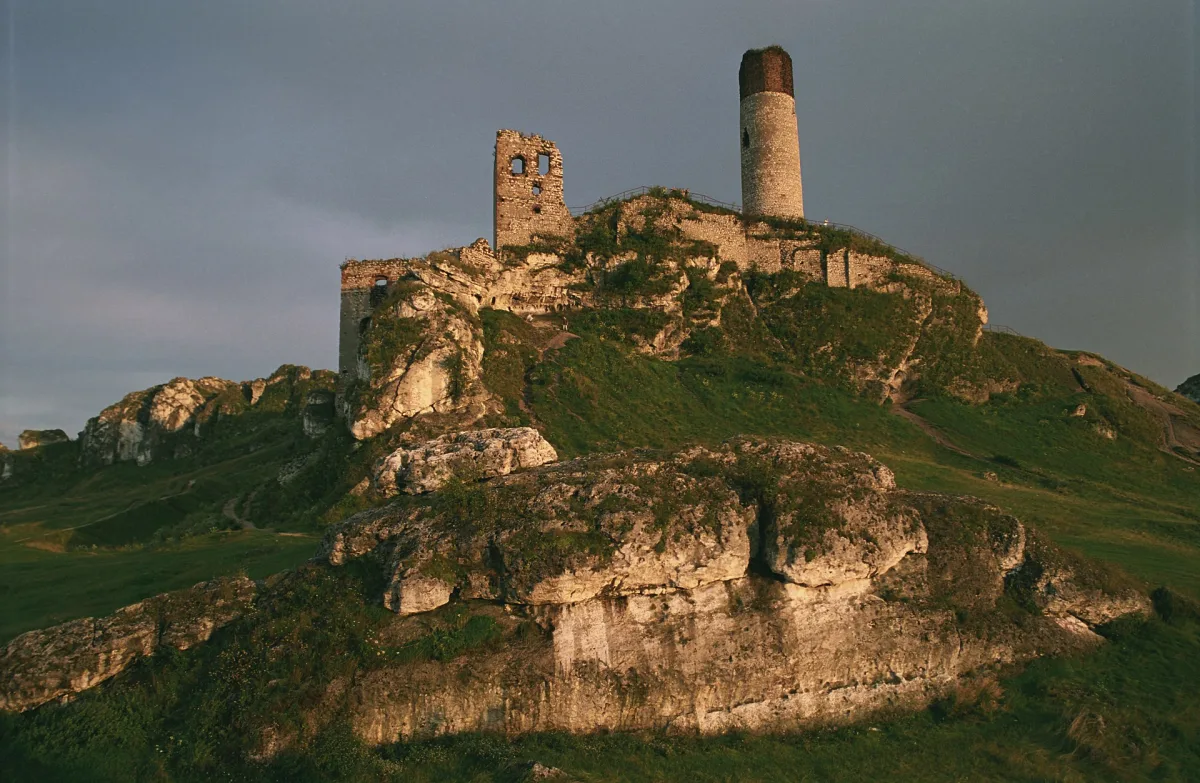
Two castles on Jurassic rocks, separated by a short stretch of trail, and one story about brothers so alike that even the servants confused them. Bobolice and Mirów, in the municipality of Niegowa in Myszków County, are linked today by the red Trail of the Eagles' Nests and by a tale of treasure hidden in a tunnel between them. It is worth keeping the two apart: history on one side, legend on the other.
Two strongholds of Casimir the Great
Bobolice Castle was built on a rocky hill 360 m above sea level. According to accounts by Janko of Czarnków and Jan Długosz it was built by King Casimir the Great, as part of the defensive system on the border with Silesia, known as the Eagles' Nests. The documents do not give the exact date of construction. From the course of events in the king's life it is inferred that it may have happened in 1350-1352, so this is an estimate, not a date from a deed.
After Casimir's death the castle passed to his nephew Louis of Hungary, who granted it to Władysław, Duke of Opole. The Bobolice castle then went to Andrew the Hungarian (Andrzej Węgier), who began to style himself “of Bobolice”. In the 15th century it belonged in turn to the Szafraniec and Treska families, and from 1486 to the Krezas. Around 1560 it was converted from a stronghold into a Renaissance family residence. Another major conversion was carried out in the 17th century by the Fogelweder family, who gave the building a form with a main tower and stone stairs that survived until the early 19th century.
In December 1587 the castle was taken by a pretender to the throne, Archduke Maximilian Habsburg. Some accounts describe great destruction, but scholarly publications rule out such a course of events: the castle surrendered without a fight, and in January 1588 it was recaptured by the forces of Hetman Jan Zamoyski.
Mirów Castle also arose around the mid-14th century under Casimir the Great. At first it was a stone watchtower subordinate to the Bobolice castle, belonging to the Lis family, who initiated its expansion into a knightly castle. In 1378 Louis of Hungary granted the Mirów stronghold to Władysław of Opole, and Władysław Jagiełło took it away in 1396. Some sources give the same grant under the year 1370, so the dates differ.
Later the castle belonged to the Myszkowski family, who bought it in 1489 and added a residential tower, and then to the Koryciński and Męciński families. The original area, about 270 square metres, grew in time to 1200. A military watchtower became a residential building.
Ruin and reconstruction: two different fates
Mirów suffered badly during the Swedish Deluge, and in 1787 it was abandoned. Local residents began to dismantle the walls for building material, which hastened its destruction. In the 19th century the castle was inventoried for the first time: by then it no longer had roofs, and the walls had collapsed in many places. In 1934 its south wall fell. Since 2006 a family of private owners has carried out securing work under the supervision of specialists. Part of the filming for Andrzej Barański's 1991 film “Nad rzeką, której nie ma” (By the River That Is No More) was shot at the castle.
In Bobolice things went differently. In 1932 the castle was recognised as a monument, and in 1961 the ruins were entered in the heritage register. In 1996 the ruins were bought by two brothers who wanted to secure them. Research showed that the only way to save the walls would be to recreate the former appearance. Reconstruction began in 2001 and lasted until 2011, preceded by three years of archaeological research, during which fragments of ceramics, tiles, glass vessels and coins were found. The mortar used, among other things, washed river sand and slaked lime that had matured in pits for 30 years. The castle was opened on 3 September 2011. The reconstructed form corresponds largely to the form of the 17th century.
The reconstruction is controversial. According to Dr Tomasz Ratajczak of Adam Mickiewicz University there were no sources showing the true former appearance of the castle, because the oldest iconographic records concern the ruin of the 18th century, and the design was based on analogies. Prof. Ryszard Kantor, on the other hand, writes that the reconstruction had the support of academic circles, and that the dispute concerned conservation theories whose supporters wanted to keep the castle as a permanent ruin. All the work was carried out on the basis of the required permits, including a decision of the heritage conservator. The rebuilt castle in Bobolice and the preserved ruin in Mirów show two ways of treating a historic monument, which is why it is good to see both in one day.
Bobol and Mir: the tale of the brothers
The tale says that two brothers, Bobol and Mir, lived in the two castles, so alike that even the servants had trouble telling them apart. They lived in harmony and prosperity, because they hid the treasures brought back from military expeditions in an underground tunnel connecting the castles. The harmony was spoiled by a woman whom Bobol brought back from an expedition and took as his wife. Mir fell in love with her, and the lovers met in the tunnel. The legend says that Bobol surprised them there, stabbed his brother in anger, and walled his wife up alive. This is a tale, not a historical fact.
The second part of the tale concerns the treasure. It is guarded by an old witch with red eyes and a black St Bernard, in which, according to the legend, an evil spirit hides. Access to the tunnel is possible only when the witch flies off on a broom to the sabbath on Bald Mountain (Łysa Góra), and the dog, having earlier eaten a roasted ram, falls into a deep sleep. The legend adds that to this day no one has managed to roast a ram during the sabbath. The figure of the White Lady, who is said to appear within the walls of the Bobolice castle, also derives from the tale, but she is described in a separate text on the ghosts of the castles of the Jura.
The rocks between the castles
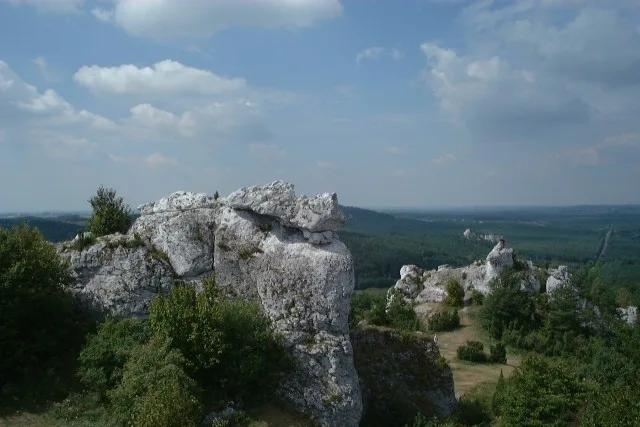
The castles lie in a belt of limestone rocks. The Mirów Rocks (Mirowskie Skały) stretch for over a kilometre from the castle in Mirów towards Bobolice, and the trail often leads along their tops. The rocks are from 5 to 30 metres high and are popular with climbers. The Mirów-Olsztyn range is one of the three main rock ranges of the Eagles' Nests Landscape Park. The walking route is part of the red trail from Kraków to Częstochowa, and an easier family cycling section to both castles is provided by the Eagles' Nests Cycle Trail, mostly closed to car traffic. Going further north, you reach Olsztyn Castle, and in the other direction, south, the Kroczyce Rocks, Morsko Castle and the ruins of Ogrodzieniec.
Be the first! Add a comment.
You need to log in to add a comment.
Log in