
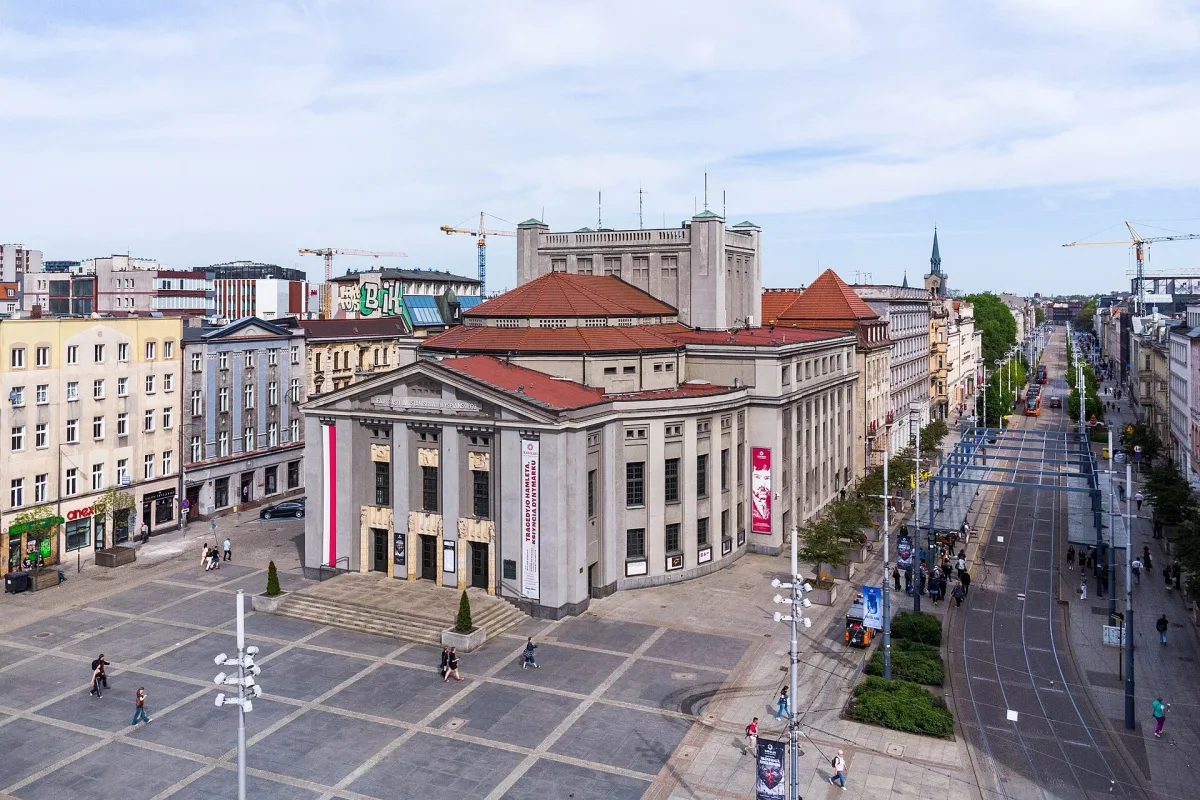
The “Śląsk” Song and Dance Ensemble began as a state folk ensemble, the second in Poland after “Mazowsze”. Today it is associated with the Neoclassical palace in Koszęcin, but it presented its first programme to the public in the theatre building in Katowice, and its first official performance took place in Warsaw. This path from stage to stage tells the story of the ensemble well.
The founders and the first months
The “Śląsk” ensemble was founded on 1 July 1953. The founders were Stanisław Hadyna, the artistic director appointed to that post as early as March 1953, and Elwira Kamińska, a choreographer who had worked with Hadyna since January 1953. The texts for many of the pieces were written by Zdzisław Pyzik. Some sources give a different date and say that Hadyna organised the ensemble as early as 1952. The two dates, 1952 and 1953, therefore exist side by side; the ensemble's website gives the year 1953.
Hadyna was born in 1919 in Karpętna, and he received his musical education in Cieszyn and Katowice. He was a composer, conductor and writer. Among his best-known songs are “Karolinka”, “Starzyk” and “Helokanie”. Kamińska was a native of Warsaw; before the war she ran a ballet school in Bielsko, and after the war she founded a ballet company in Katowice.
The plan was ambitious. The ensemble was to number almost 300 people: 140 in the choir, 60 in the ballet and 80 in the orchestra. It reached roughly half of that number. In 1953-1957 it consisted of over a hundred choir members and dancers, mostly amateurs without wider musical training.
The premiere in Katowice, a performance at the Mirowska Hall
The first closed concerts were held for the delegates of a party conference and for guests from China. There was also an unofficial concert in Kościuszko Park in Katowice. The premiere of the first programme took place on 16 October 1954 in the Silesian Theatre in Katowice. The ensemble's first official performance took place on 6 November 1954 in the Mirowska Hall in Warsaw, on the occasion of the anniversary of the October Revolution.
This beginning is worth remembering together with its context. The ensemble was a state institution, and its first performances were tied to ceremonies of the authorities. Some years later, in 1971, “Śląsk” performed at the first event in the newly opened Spodek. According to the PAP agency, quoted by the dzieje.pl portal, this was the celebration of the 50th anniversary of the outbreak of the Third Silesian Uprising, held on 8 May 1971, with the participation of Anna German. The arena stands not far from the Monument to the Silesian Insurgents, and one of the ensemble's records, “Idą powstańcy” (“The insurgents are coming”), contains songs of the Upper Silesian insurgents.
Repertoire and the world
At the beginning the ensemble presented the folklore of Upper Silesia, the Cieszyn Land and the Beskids. Later songs and dances from other regions of Poland were added to the programme, including Lesser Poland and Kuyavia. The repertoire also includes sacred music, oratorios and operas. The ensemble has released more than a dozen records, including the series “Złota Kolekcja Śląska” (“Golden Collection of Śląsk”). The album “Karolinka” has platinum status. In 2021 “Śląsk” recorded with the rapper Miuosh the album “Pieśni współczesne” (“Contemporary Songs”), which won double platinum and a Fryderyk award.
The ensemble has visited 45 countries on five continents and given over 9,000 concerts for over 27 million spectators. Among the first trips were Czechoslovakia and the Soviet Union in 1955, and later the United States, Canada, China and Australia.
Today the ensemble bears the name of Stanisław Hadyna. In 2007 it received the Wojciech Korfanty Award. In 2017 an agreement was signed on the joint running of the ensemble by the minister of culture and the board of the Silesian Voivodeship.
The palace in Koszęcin
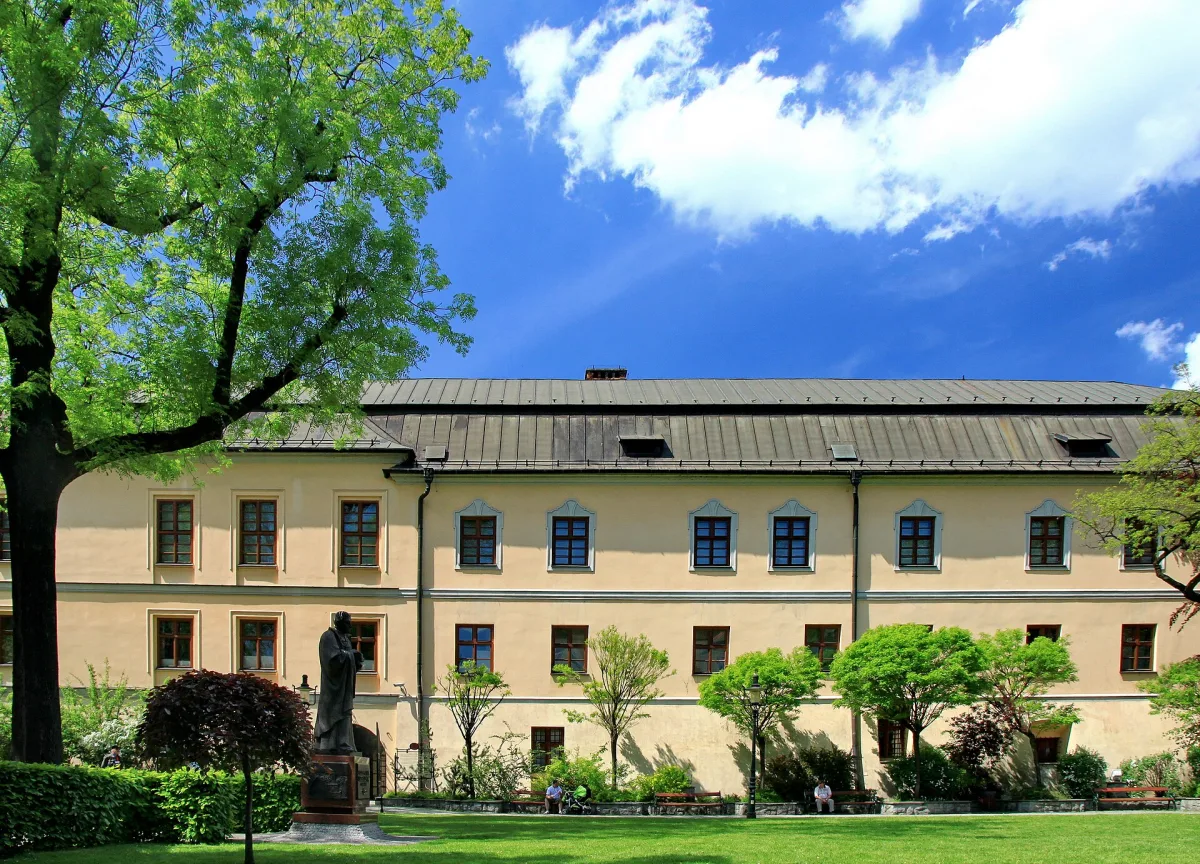
Since 1953 the ensemble's seat has been the palace in Koszęcin in Lubliniec County. The residence's present shape comes from the rebuilding of 1828-1830, led by the Hohenlohe-Ingelfingen family, who held the estate from the beginning of the 19th century until January 1945. The earlier history is described somewhat differently. According to one version the wooden castle burned down in 1603 and the masonry one was completed in 1605 by Andrzej Kochcicki. According to the ensemble's website the wooden castle was set on fire by the Lisowczycy, and that Kochcicki began building the masonry chapel and palace in 1609. We therefore have two versions of the same episode.
The palace has three asymmetrical wings. In the west one are the Ballroom and a terrace overlooking the park, as well as the Green Room with a round tiled stove in the Empire style. The former chapel, out of use since 1945, was renovated in 2001 and serves as an intimate concert hall. In the former riding hall there is the Elwira Kamińska pavilion, and in the farm building the Adolf Dygacz House of Creative Work, with a Memorial Room and an exhibition of Silesian costumes. Around it stretches a landscape park from the middle of the 19th century, with lime trees, horse chestnuts and oaks; some of the trees are natural monuments.
In the courtyard the founder himself sits on a bench. The Stanisław Hadyna bench, with a pipe and the score of “Helokanie”, has stood here since 2006. Its author is the Kraków sculptor Marek Maślaniec, the same who made the Hadyna bench in Wisła. Access to the courtyard should be checked before a visit, because the palace is the seat of a working ensemble. From Koszęcin it is about 4.5 kilometres to the Jeleniak Mikuliny nature reserve, a peat bog with a breeding ground of cranes.
Hadyna in Wisła
Hadyna was connected with Wisła through his private life: he had a house on the slope of Bukowa mountain. He was buried in the old Protestant cemetery, today Na Groniczku, and after his death he was awarded honorary citizenship of the town. In 2010 his name was given to the amphitheatre in the centre of Wisła. A monument to its patron stands in the auditorium.
In 1968 Hadyna had to step down from the post of managing director and left for Kraków, where he became the music director of a theatre. He returned to “Śląsk” on 1 March 1990 as artistic director and led the ensemble until his death in 1999.
Be the first! Add a comment.
You need to log in to add a comment.
Log in