
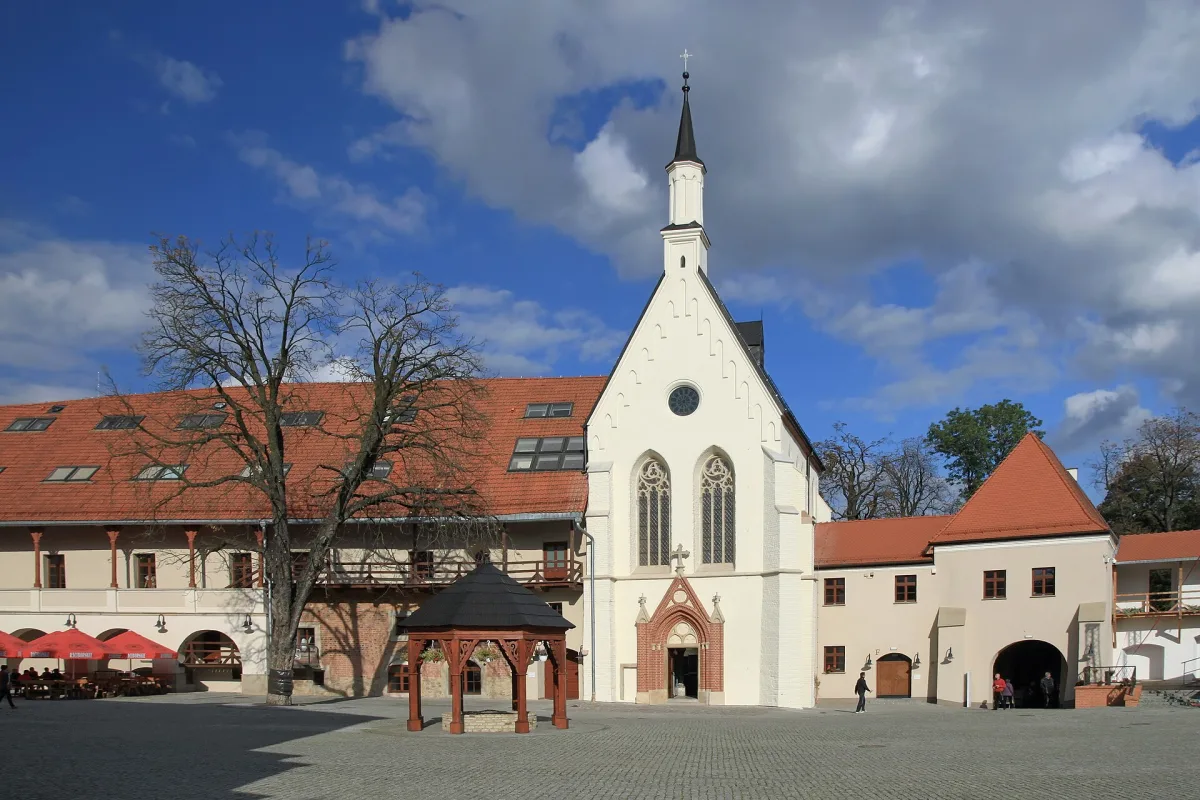
A brick chapel on an island in a bend of the Oder
The Racibórz Castle stands on a former island in a bend of the Oder. The stronghold is known from the chronicle of Gallus Anonymus, in which an entry dated 1108 describes it as a Moravian border fortress seized by the knights of Bolesław the Wrymouth. A masonry castle rose on this site only in the second half of the 13th century, during the rule of Duke Przemysł, ruler of the separate Duchy of Racibórz.
The most valuable part is the chapel dedicated to St Thomas of Canterbury, that is, Thomas Becket. It was built in 1288-1293, and the foundation cannot have taken place later than 1292. The dedication is rare, and its origin is linked with the hospitality that Racibórz gave to the Bishop of Wrocław, Thomas II, during his dispute with the Duke of Wrocław, Henry IV Probus. In 1288 the bishop founded a collegiate church at the chapel, which operated there until 1416. The reconciliation of the bishop with the duke is commemorated by the Monument of Concord not far from the castle.
Since the mid-19th century the chapel has been called the pearl of Silesian Gothic, and it is sometimes compared to the Sainte-Chapelle. It was built of brick in Wendish bond on a rectangular plan measuring 8.5 by 13 metres. It was the first free-standing sacred building on such a plan in the Silesian lands. Fires in 1519 and 1637 damaged it badly and changed its appearance, and after the castle fire of 19 January 1858 the chapel regained its Gothic front facade and the image of St Thomas.
The legend of the stone head
A tale about a Mongol leader was linked to the castle. A version was written down in 1882 by Father Augustyn Weltzel. According to it, a stone head was walled into the corner of a castle building, said to depict a Mongol prince defeated at Racibórz in the 13th century. The eyes of the head were said to point to the place where a great treasure was hidden. Weltzel himself noted that the sculpture does not resemble a Tatar face.
The tale has another version in the description of the castle. It speaks of a leader named Tin-fu, who was said to have been mortally struck by an arrow from one of the defenders, while the castellan Bartek Lasota and his men repelled the siege. In remembrance, Duke Mieszko the Fat was said to have ordered the leader's head to be sculpted. These details are part of the legend, not findings of historians. Studies of the castle mention the repulsing of a Mongol attack on the Racibórz stronghold in 1241, but they do not confirm the details of the tale.
The best-known anecdote comes from the director general of the ducal chamber, Gustav Adolf von Wiese, who died in 1880. When the curious looked at the head, he would confirm the legend in jest: the head really does look at a real treasure. He meant the brewery that stood opposite. The anecdote is cited by the historian Grzegorz Wawoczny, citing Weltzel. The brewery itself, which still brews beer in a castle wing, is the subject of a separate article on beer from open vats.
The building on whose corner the head was set no longer exists. The damaged sculpture went to the collections of the Museum in Racibórz. Until the Second World War the head was in the corner of the south-eastern wing of the castle.
Real and legendary treasures
The only certain treasure the sources mention is said to have left the castle in 1532. After the death of the last Upper Silesian Piast, Duke John the Good, officials of Emperor Ferdinand I of Habsburg took the contents of his treasury to Vienna. So claims Wawoczny, and later mentions of a hidden treasure come only from tales.
A real discovery was a map of Racibórz from 1843, found during the repair of the chapel roof in the 1980s in a finial. The rebuilding of the castle after the fire of 1858 was probably led by Robert Schneider, who drew on the map a line connecting the castle with the Dominican nuns' convent on the other side of the Oder and labelled it an underground passage beneath the Oder. Earlier, stories of such a tunnel passed for legend. In 2001 archaeologists discovered in a former tower an entrance to a corridor, but its connection with the legendary tunnel remains conjecture.
Be the first! Add a comment.
You need to log in to add a comment.
Log in